WASHINGTON — In the 1980s, Fu Xiangdong was a young Chinese virology student who came to the United States to study biochemistry. More than three decades later, he had a prestigious professorship in California and was conducting promising research on Parkinson’s disease.
But now Fu is doing his research at a Chinese university. His American career was derailed as U.S.-China relations unraveled, putting his collaborations with a Chinese university under scrutiny. He ended up resigning.
Beginning in 1978, U.S.-China academic cooperation expanded for decades, largely insulated from the fluctuations in relations between the two countries. Today, it’s in decline, with Washington viewing Beijing as a strategic rival and there are growing fears about Chinese spying.
The number of Chinese students in the U.S. is down, and U.S.-Chinese research collaboration is shrinking. Academics are shying away from potential China projects over fears that seemingly minor missteps could end their careers.
People are also reading…
Analysts say the decline will undercut American competitiveness and weaken global efforts to address health issues. Prior collaborations led to significant advances, including in influenza surveillance and vaccine development.
“That’s been really harmful to U.S. science,” said Deborah Seligsohn, a former U.S. diplomat in Beijing and now a political scientist at Villanova University. “We are producing less science because of this falloff.”
For some, the prospect for scientific advances needs to take a back seat to security concerns. In their view, such cooperation aids China by giving it access to sensitive commercial, defense and technological information. They also fear the Chinese government is using its presence in American universities to monitor and harass dissidents.
Those concerns were at the core of the China Initiative, a program begun in 2018 by the Justice Department under the Trump administration to uncover acts of economic espionage. While it failed to catch any spies, the effort had an impact on researchers in American schools.

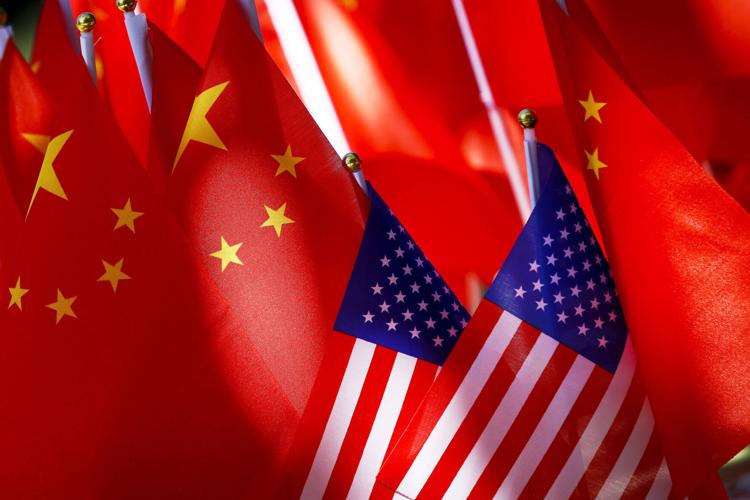
American flags are displayed together with Chinese flags Sept. 16, 2018, in Beijing.
Under the initiative, Gang Chen, a professor of mechanical engineering at the Massachusetts Institute of Technology, was charged in 2021 with hiding links with the Chinese government. Prosecutors eventually dropped all charges, but Chen lost his research group. He said his family went through a hard time and has yet to recover.
Chen said investigations and wrongful prosecutions like his “are pushing out talents.”
“That’s going to hurt U.S. scientific enterprise, hurt U.S. competitiveness,” he said.
The Biden administration ended the China Initiative in 2022, but there are other efforts targeting scholars with Chinese connections.
In Florida, a state law aimed at curbing influences from foreign countries raised concerns that students from China effectively could be banned from labs at the state’s public universities.
This month, a group of Republican senators expressed concerns about Beijing’s influence on American campuses through student groups and urged the Justice Department to determine whether such groups should be registered as foreign agents.
Miles Yu, director of the China Center at Hudson Institute, said Beijing exploited U.S. higher education and research institutes to modernize its economy and military.
“For some time, out of cultural, self-interest reasons, many people have double loyalty, erroneously thinking it’s OK to serve the interests of both the U.S. and China,” Yu said.
The U.S.-China Science and Technology Cooperation Agreement — the first major pact between the two countries, signed in 1979 — was set to lapse this year. In August, Congress extended the agreement by six months, but its future hangs in the balance.
If there is a new agreement, it should take into account new advances in science and technology, Nicholas Burns, the U.S. ambassador to China, said recently.
There were only 700 American students studying in China, Burns said, compared with nearly 300,000 Chinese students in the U.S., which is down from a peak of about 372,000 in 2019-2020.
By October, nearly all Confucius Institutes, a Beijing-backed Chinese language and culture program, closed on American university campuses. Their number fell from about 100 in 2019 to fewer than five now, according to the U.S. Government Accountability Office.

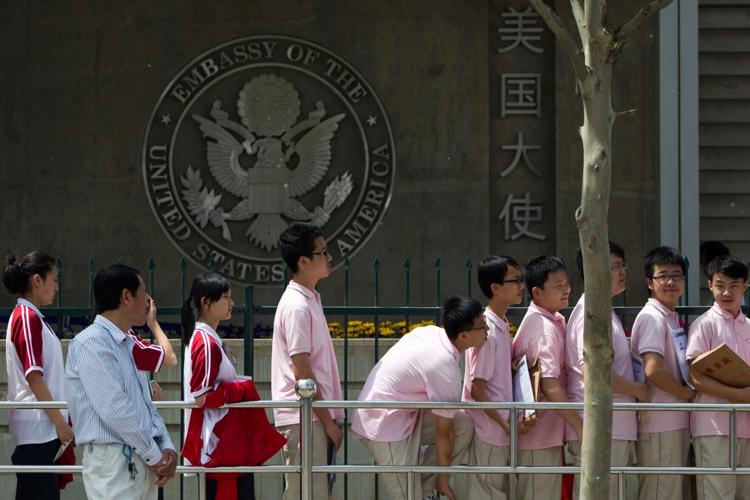
Chinese students wait outside the U.S. Embassy for their visa application interviews May 2, 2012, in Beijing.
The National Institutes of Health in 2018 began an investigation into foreign ties by asking dozens of American institutions to look into whether their faculty members might have violated policies regarding use of federal money, usually in cases involving partnerships with Chinese institutions.
Then a professor at the University of California, San Diego, Fu’s links with Wuhan University were the focus of the NIH investigation. Fu insisted federal money was never used toward work there, according to news outlet La Jolla Light, but the university ruled against him.
Chen, the MIT professor, said once-encouraged collaborations suddenly became problematic.
“Very few people in the general public understand that most U.S. universities, including MIT, don’t take on any secret research projects on campus,” Chen said. “We aim to publish our research findings.”
Disclosure rules had been unclear, he said. “People are so fearful that, if you check the wrong box, you could be accused of lying to the government.”
In June, an academic study published in the peer-reviewed Proceedings of the National Academy of Sciences journal said the China Initiative likely caused widespread fear and anxiety among scientists of Chinese descent.
The study, which surveyed 1,304 scientists of Chinese descent employed by American universities, showed many considered leaving the U.S. or no longer applying for federal grants, the researchers wrote.
An analysis of research papers in the PubMed database showed that, as of 2021, U.S. scientists still co-wrote more papers with scientists from China than from any other country, but those with a history of collaborating with China experienced a decline in research productivity after 2019, after the NIH investigation started.
The study, to be published in the PNAS journal by the year’s end, found the impact of U.S.-based scholars in collaboration with China, as measured by citations, fell by 10%.
Photos from Secretary of State Blinken's trip to China

U.S. Secretary of State Antony Blinken, left, walks after arriving in Beijing, Sunday, June 18, 2023. (Leah Millis/Pool Photo via AP)

U.S. Secretary of State Antony Blinken, left, meets with Chinese Foreign Minister Qin Gang, right, at the Diaoyutai State Guesthouse in Beijing, China, Sunday, June 18, 2023. (Leah Millis/Pool Photo via AP)

Doormen await the arrival of U.S. Secretary of State Antony Blinken, ahead of his meeting with China's Foreign Minister Qin Gang, at the Diaoyutai State Guesthouse in Beijing, China, Sunday, June 18, 2023. (Leah Millis/Pool Photo via AP)

U.S. Secretary of State Antony Blinken, center, walks to a meeting with China's top diplomat Wang Yi, not in photo, at the Diaoyutai State Guesthouse in Beijing, China, Monday, June 19, 2023. (Leah Millis/Pool Photo via AP)

U.S. Secretary of State Antony Blinken, second left, meets with China's top diplomat Wang Yi, not in photo, at the Diaoyutai State Guesthouse in Beijing, China, Monday, June 19, 2023. (Leah Millis/Pool Photo via AP)

U.S. Secretary of State Antony Blinken, left, shakes hands with China's top diplomat Wang Yi, right, at the Diaoyutai State Guesthouse in Beijing, China, Monday, June 19, 2023. (Leah Millis/Pool Photo via AP)

U.S. Secretary of State Antony Blinken, center, walks to a meeting with China's top diplomat Wang Yi, not in photo, at the Diaoyutai State Guesthouse in Beijing, China, Monday, June 19, 2023. (Leah Millis/Pool Photo via AP)

U.S. Secretary of State Antony Blinken meets with Chinese President Xi Jinping in the Great Hall of the People in Beijing, China, Monday, June 19, 2023. (Leah Millis/Pool Photo via AP)

U.S. Secretary of State Antony Blinken, center left, meets with Chinese President Xi Jinping, center, and Wang Yi, Chinese Communist Party's foreign policy chief, center right, in the Great Hall of the People in Beijing, China, Monday, June 19, 2023. (Leah Millis/Pool Photo via AP)

U.S. Secretary of State Antony Blinken shakes hands with Chinese President Xi Jinping in the Great Hall of the People in Beijing, China, Monday, June 19, 2023. (Leah Millis/Pool Photo via AP)

U.S. Secretary of State Antony Blinken meets with Chinese President Xi Jinping in the Great Hall of the People in Beijing, China, Monday, June 19, 2023. (Leah Millis/Pool Photo via AP)

U.S. Secretary of State Antony Blinken shakes hands with Chinese President Xi Jinping in the Great Hall of the People in Beijing, China, Monday, June 19, 2023. (Leah Millis/Pool Photo via AP)

U.S. Secretary of State Antony Blinken meets with Chinese President Xi Jinping in the Great Hall of the People in Beijing, China, Monday, June 19, 2023. (Leah Millis/Pool Photo via AP)

U.S. Secretary of State Antony Blinken holds a news conference in the Beijing American Center at the U.S. Embassy in Beijing, China, Monday, June 19, 2023. (Leah Millis/Pool Photo via AP)

U.S. Secretary of State Antony Blinken holds a news conference in the Beijing American Center at the U.S. Embassy in Beijing, China, Monday, June 19, 2023. (Leah Millis/Pool Photo via AP)

U.S. Secretary of State Antony Blinken holds a news conference in the Beijing American Center at the U.S. Embassy in Beijing, Monday, June 19, 2023. The United States and China have pledged to stabilize their badly deteriorated ties during a critical visit to Beijing by Blinken, who met with Chinese President Xi Jinping. (AP Photo/Ng Han Guan)

U.S. Secretary of State Antony Blinken leaves after a news conference in the Beijing American Center at the U.S. Embassy in Beijing, Monday, June 19, 2023. The United States and China have pledged to stabilize their badly deteriorated ties during a critical visit to Beijing by Blinken, who met with Chinese President Xi Jinping. (AP Photo/Ng Han Guan)