

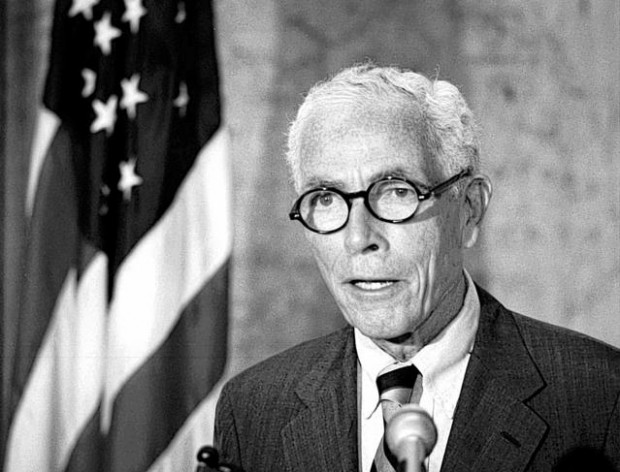
PROVIDENCE, R.I. — Claiborne Pell, the quirky blueblood who represented blue-collar Rhode Island in the U.S. Senate for 36 years and was the force behind a grant program that has helped tens of millions of Americans attend college, died Thursday after a long battle with Parkinson's disease. He was 90.
Pell, a Democrat, died at his Newport home just after midnight, according to his former assistant, Jan Demers.
Pell was first elected to the Senate in 1960. The skinny son of a New York congressman, Pell spoke with an aristocratic tone but was an unabashed liberal who spent his political career championing causes to help the less fortunate.
He disclosed he had Parkinson's in 1995 and left office in January 1997 after his sixth term.
Members of Rhode Island's all-Democratic congressional delegation lauded Pell's legacy.
People are also reading…
"Senator Pell was a remarkable statesman and legislator who worked tirelessly to promote peace and expand opportunity through education," Sen. Jack Reed said in a written statement.
"We will all miss him deeply, and long benefit from the works of his far-seeing soul," Sen. Sheldon Whitehouse said. And Rep. Jim Langevin called Pell a "gentleman and champion for those who needed their voices heard."
When asked his greatest achievement, Pell always was quick to answer, "Pell Grants."
He sponsored legislation creating the Basic Educational Opportunity Grants, which passed in 1972 and provided direct aid to college students. The awards were renamed "Pell Grants" in 1980. By the time Pell retired, they had aided more than 54 million low- and middle-income Americans.
"He believed strongly that a good education could open infinite doors of opportunity, and he has transformed the lives of millions of young people who have been able to go to college because of the grant that rightly bears his name," said Sen. Edward Kennedy, D-Mass.
Thomas Hughes, Pell's chief of staff from 1975 until his retirement, said Pell believed financial aid should be given directly to students rather than distributed by colleges and universities.
"He always had this view that the federal government should help young people be able to have an education beyond high school," Hughes said.
Though criticized by some for his fascination with UFOs and extrasensory perception, Pell was best remembered for his devotion to education, maritime and foreign affairs issues.
Pell also shared a strong interest in the arts, and was chief Senate sponsor of a 1965 law establishing the National Endowment for the Arts and the National Endowment for the Humanities.
Pell was well-liked among peers from both political parties, who respected his non- confrontational style. "I believe in letting the other fellow have my way" was a favorite refrain Pell used to refer to his negotiating skills.
Born in 1918, Pell was a descendant of early New York landowners who lived among the old-money families in Newport. His father, Herbert Claiborne Pell, was a one-term congressman.
Pell graduated from Princeton in 1940, and served in the Coast Guard during World War II. He remained in the Coast Guard Reserve until retiring as a captain in 1978.
He participated in the 1945 San Francisco conference that drafted the United Nations charter and was a staunch defender of the institution.
He served in the foreign service for seven years, holding diplomatic posts in Czechoslovakia and Italy, then returned to the U.S. in the 1950s..
Despite his peculiarities, he became the most formidable political force in Rhode Island. In his six statewide elections, he received an average 64 percent of the votes.
"I attribute (my popularity) to one reason, and that is I have never critically mentioned my adversary," Pell would say.
The late Republican Sen. John Chafee of Rhode Island once said Pell's popularity was due to the state's overwhelmingly Democratic leanings and Pell's honesty and integrity. Voters embraced Pell's quirkiness and, to a certain extent, his distance from common people.


