

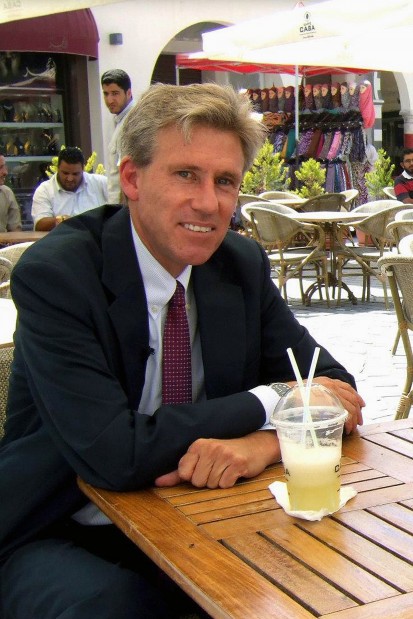
WASHINGTON - J. Christopher Stevens was in many ways the model American diplomat, committed, idealistic, willing to take risks and eager to find out what was really happening in obscure corners of the world.
A lanky 52-year-old Californian, Stevens also looked the part.
"He was always smiling, unruffled, projecting what I think of as a cool California demeanor, in the best sense," said Robert Danin, a former Middle East hand at the State Department who worked closely with Stevens.
A University of California-Berkeley graduate who was confirmed as ambassador to Libya in May, Stevens well knew the dangers inherent in his hands-on style.
From 2007 to 2009, he served as the No. 2 U.S. diplomat in Tripoli after the U.S. resumed diplomatic relations with Col. Moammar Gadhafi's government. And last year, during the height of the revolution that eventually toppled Gadhafi, he secretly slipped back into Libya aboard a Greek cargo ship to serve as U.S. envoy to the rebels who were battling the strongman.
People are also reading…
"We had a bombing at the Tibesti (Hotel) the other day - a reminder that Benghazi isn't safe," he emailed an acquaintance in June 2011, referring to the building where he and other diplomats were staying.
On Tuesday, in an attack on the U.S. Consulate in Benghazi, the lawyer-turned-diplomat became the first American ambassador to die in the line of duty since 1988.
Stevens' friends and superiors, including Secretary of State Hillary Rodham Clinton and President Obama, said Wednesday that his rush to help evacuate others from the building was a reminder of his commitment to the country.
"He risked his life to stop a tyrant, and gave his life trying to build a better Libya," Clinton said in an emotional appearance at the State Department. "The world needs more Chris Stevenses."
Stevens grew up in the East Bay community of Piedmont, graduated from UC-Berkeley in 1982 and UC Hastings College of the Law in San Francisco in 1989. His first service overseas was as a Peace Corps volunteer in the Atlas Mountains of Morocco.
He was the son of a lawyer, Jan Stevens, and a now-retired Marin Symphony cellist, Mary Commanday.
His stepfather, Robert Commanday, a former classical music critic for the San Francisco Chronicle, when asked about his stepson's musical pursuits, told a classical music website that Stevens "played saxophone, about at the Bill Clinton level, but marginally in public." He also was a tennis player and a Los Angeles Lakers fan, passions that he tried to maintain in Libya.
After law school, Stevens worked for two years as an international trade attorney in Washington. But it didn't satisfy him, and at the relatively late age of 31, he joined the foreign service.
When he was confirmed as ambassador in May, he said he considered it "an extraordinary honor."
Fluent in French and Arabic, Stevens previously worked in a variety of Middle Eastern posts, including in Jerusalem; Cairo; Riyadh, Saudi Arabia; and Washington.
Colleagues described him as friendly, casual and rarely rattled. He also was candid, a trait that won him fans among Arabs and a following among journalists who covered Middle East hot spots.
Stevens had a yearning to mingle with Arabs to get a street-level view of events, and he sometimes chafed about post-9/11 security measures that sometimes prevented diplomats from reaching far into the hinterland. As political officer in Jerusalem, given the oft-touchy assignment of working with the Palestinian leadership, he tried to get out into the West Bank even when violence flared between Palestinians and Israelis.
The impression he made among Libyans was apparent on Wednesday.
"Chris Stevens was a friend to all Libyans," read a poster carried by an admirer in Benghazi, a Twitter image showed.
"Sorry, people of America, this is not the behavior of our Islam and prophet," read another.


