

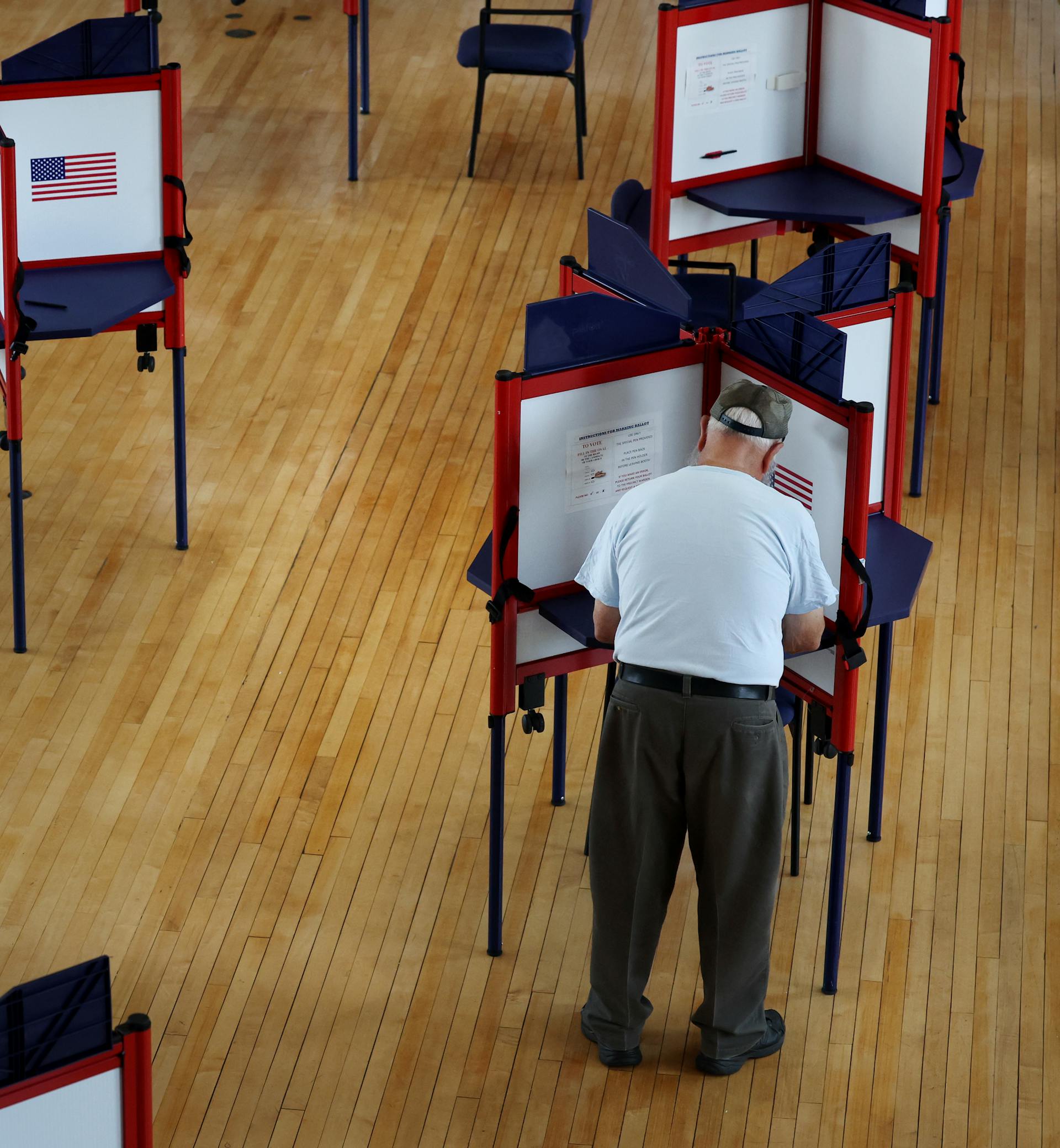
 A voter fills out his ballot at an early voting location in Massachusetts. Craig F. Walker/The Boston Globe via Getty Images
As political campaigning for the midterm elections is ramping up, millions of voters are considering how they should cast their ballots on Nov. 8, 2022. In addition to the traditional way of voting at their local precinct on Election Day, many have the option to vote earlier by mail.
With the exception of Alabama, Connecticut, Mississippi and New Hampshire, early voting is allowed in 46 states and is offered in different forms such as drop boxes, mail or early voting in person.
People are also reading…
It’s important to check with your state’s election office, because different states have different deadlines and options available.
In Montana, for instance, early voting is allowed for about four weeks between Oct. 11 and Nov. 7. But in Texas, the early-voting period is only the 10 weekdays between Oct. 24 and Nov. 4.
The Conversation U.S. has published several articles looking at not only the integrity of early voting but also the larger question of turning out the vote.
1. The long, long history of early voting
Early voting periods are as old as presidential elections in the U.S.
The first presidential election occurred in 1789 and started on Dec. 15, 1788. It ended almost a month later, on Jan. 10, 1789, with the election of George Washington.
It wasn’t until 1845 that Congress adopted the Tuesday after the first Monday in November as the national Election Day.
Given the long history, Terri Bimes, an associate teaching professor of political science at the University of California, Berkeley, raises an interesting point on the impact of early voting on turnout.
“While some scholars contend that early in-person voting periods potentially can decrease voter turnout,” Bimes writes, “studies that focus on vote-by-mail, a form of early voting, generally show an increase in voter turnout.”
Regardless of overall turnout, more and more voters are choosing nontraditional ways of casting their ballots. In the 2020 election, for instance, 69% of voters nationwide voted by mail or through another means earlier than Election Day. That number was 40% in 2016.
Read more: There's nothing unusual about early voting – it's been done since the founding of the republic
2. Is early voting safe?
Election fraud is rare.
And mail-in ballot fraud is even rarer.
The conservative Heritage Foundation conducted a survey in 2020 and found 1,200 “proven instances of voter fraud” since 2000, with 1,100 criminal convictions over those two decades.
Only 204 allegations, and 143 convictions, involved mail-in ballots – even with more than 250 million mail-in ballots cast since 2000.
Edie Goldenberg is a University of Michigan political scientist who belongs to a National Academy of Public Administration working group that offered recommendations to ensure voter participation and public confidence during the onset of the COVID-19 pandemic in 2020.
Goldenberg writes: “The evidence we reviewed finds that voting by mail is rarely subject to fraud, does not give an advantage to one political party over another and can in fact inspire public confidence in the voting process, if done properly.”
3. Voting turnout is key to democracy
More people voted in the 2020 presidential election than in any election in the past 120 years, even as nearly one-third of eligible voters sat it out. That means nearly 80 million Americans did not vote.
Among the reasons nonvoters gave were not being registered, not being interested or not believing their vote made a difference. Despite such apathy, about 155 million voters – that’s 67% of Americans over 18 – did vote in 2020.
Part of the problem of reducing the percentage of nonvoters at the street level can be getting people to answer their doors to strangers or answering a telephone call placed by a campaign volunteer from an unrecognized number. Before the pandemic, an effective door-to-door campaign could increase turnout by almost 10%; a well-run phone campaign could add an additional 5%.
When University of California, Berkeley’s Vice Provost for Graduate Studies Lisa García Bedolla began studying voter mobilization in 2005, it was common for door-to-door campaigns to reach half of the people they tried to contact. By 2018, that number had dropped to about 18%.
To close the gap, campaigns moved toward asking people to contact people they knew and help turn out those supporters and social networks. Text messages, especially reminder texts, became the virtual door knock.
“These friend-to-friend approaches are seen as a way to cut through the noise,” Bedolla writes.
These personal approaches can also create a sense of accountability.
Knowing that someone is paying attention to your vote, however it is cast, might make a difference in a local, state or federal election.
Note: This story is a roundup of articles from The Conversation’s archives.
___

The 10 Senate seats most likely to flip in November
1. Pennsylvania

Mehmet Oz (R) vs. John Fetterman (D)
Incumbent: Republican Pat Toomey (retiring)
The start of the general election in the Keystone State was a mixed bag for Democrats trying to flip the seat of retiring GOP Sen. Pat Toomey. Their nominee, Lt. Gov. John Fetterman, was sidelined by a stroke just before he won the primary and has been off the trail recuperating. But then they got the Republican opponent they wanted in celebrity surgeon Mehmet Oz.
The Donald Trump-backed candidate narrowly won the GOP nomination after a recount, but not without his image taking a serious hit -- weeks of attack ads from Republican rival Dave McCormick and his allies had driven up Oz's negatives. (In a Fox survey ahead of the primary, for example, 46% of GOP voters had an unfavorable view of Oz.) The race is expected to tighten as some of those Republican voters get behind Oz now that he's the party nominee.
But Democrats' message is picking up where the primary left off. Fetterman's TV spots, which lean into an "us vs. Washington" theme that never mentions the candidate's party ID, repeat that he's "from Pennsylvania, for Pennsylvania" -- an implicit knock on Oz, who has said he moved from New Jersey in late 2020. Republicans are equally happy to be running against Fetterman, a former Bernie Sanders supporter who handily defeated his more moderate primary challenger. But in a state that Biden carried and with the GOP primary forcing Oz to the right, this seat is still the most likely to flip in the fall.
2. Nevada

Sen. Catherine Cortez Masto (D) vs. Adam Laxalt (R)
Incumbent: Democrat Catherine Cortez Masto
Nevada moves up one spot, trading places with Georgia, where the fundamentals of the state (for example, past presidential performance) would seem to give Republicans a better chance of unseating a Democratic incumbent. But the Republican Senate nominee in the Silver State, former state Attorney General Adam Laxalt, is a more tested candidate than the GOP nominee in Georgia, ex-NFL star Herschel Walker.
That may not be saying much considering Walker, a political neophyte, is widely seen as the biggest wild-card candidate of the cycle and Laxalt lost his last bid for statewide office (the 2018 gubernatorial race). Laxalt, however, has held statewide office before and is the grandson of the former governor and senator with the same last name. Georgia Sen. Raphael Warnock, who was on the ballot just last year, also started the cycle as a better defined (and funded) Democratic incumbent than Nevada Sen. Catherine Cortez Masto, who hasn't faced voters in this transient state in six years. Masto has a tough road ahead, to be sure -- and fissures in the state Democratic Party aren't helping -- but the Supreme Court ruling on abortion could work in Democrats' favor in a state where even the most recent GOP governor supported abortion rights.
Laxalt sought to downplay the political impact of the court's decision last month, saying in a statement that abortion rights were "settled law" in the state. But that likely won't stop Democrats from pointing to his praise for the decision and arguing that he'd be another Republican vote in the Senate should Congress attempt to pass an abortion ban.
3. Georgia

Sen. Raphael Warnock (D) vs. Herschel Walker (R)
Incumbent: Democrat Raphael Warnock
Even Democrats are somewhat skeptical about a recent Quinnipiac University poll that showed Warnock, who's running for a full six-year term after winning a special election last year, ahead of GOP challenger Walker by 10 points among registered voters. But even if that margin was too big to be true -- there aren't yet many other public surveys for comparison -- it was notably wider than Georgia's gubernatorial matchup, suggesting there's something specific to this race, rather than the poll itself, going on here.
The margin was also a departure from Warnock's and Walker's neck-and-neck standing in Quinnipiac's January poll, which could reflect recent troublesome headlines for Walker, who received negative ratings for honesty in the June survey. His campaign recently acknowledged, for example, that he has three children by women he was not married to, in addition to his son by his former wife. That's opened him up to charges of hypocrisy given his public criticism of absentee fathers, especially in Black families. (Walker just went up with his first ad of the general election, and the positive spot -- a hybrid ad paid for by the National Republican Senatorial Committee -- doesn't offer more than bland platitudes about him wanting to serve Georgia.)
What's most encouraging for Democrats facing a tough national environment may be that Warnock is still viewed more positively than Biden. The senator's job approval rating was at 49% in the Quinnipiac poll, compared with 33% for the President. That's some impressive separation the first-term senator has been able to create from the White House in a state not predisposed to vote Democratic. The poll was mostly conducted after the Supreme Court's abortion decision on June 24, so Warnock's advantage over Walker may also reflect some of the immediate backlash to that ruling, which won't necessarily be sustained through the fall.
The good news for Republicans? A plurality of Georgians said inflation was the most urgent issue facing the state, which means the GOP still has four months to double down on messages like this one, from One Nation, accusing Warnock of voting for "reckless spending" that, the ad contends, has led to higher costs for Georgians.
7. North Carolina

Rep. Ted Budd (R) vs. Cheri Beasley (D)
Incumbent: Republican Richard Burr (retiring)
Republican Rep. Ted Budd enters the general election with a built-in advantage in the race to succeed retiring GOP Sen. Richard Burr given that Trump twice carried the state. And while the conservative congressman's fundraising hasn't impressed, outside GOP groups are carrying the weight on TV, attacking Democratic nominee Cheri Beasley's judicial record. Local TV stations took down one of those ads, but the soft-on-crime attack line is a central message Republicans are deploying against the first Black woman elected as chief justice to the state Supreme Court.
Beasley has responded by touting her law enforcement support, including with a spot that features sheriffs and police captains. "Cheri's always had our backs, and we know she always will," Richmond County Sheriff Mark Gulledge says. Another recent Beasley ad tries to distance the candidate from Democratic control of Washington, as she says, "Neither political party is getting it right" while promising to hold Washington accountable.
Democrats, meanwhile, are trying to portray Budd, who was boosted by the campaign arm of the Club for Growth in the primary, as too extreme for the state. Senate Majority PAC, a major Democratic super PAC, invested in this race after initially leaving it off its early reservations -- a sign that Democrats haven't counted this one out even if it's less of a priority than other GOP-held seats in Pennsylvania and Wisconsin.
9. Ohio

J.D. Vance (R) vs. Rep. Tim Ryan (D)
Incumbent: Republican Rob Portman (retiring)
Rep. Tim Ryan, the Democrat running an uphill campaign to succeed retiring GOP Sen. Rob Portman, is also trying to show his support for law enforcement. "Tim Ryan knows defunding the police is ridiculous," the Stark County sheriff says in a recent ad for the Democratic nominee.
Ryan, a 10-term congressman who easily won his May primary, is up against "Hillbilly Elegy" author JD Vance, who emerged from one of the ugliest GOP contests of the cycle helped by Trump's backing. The former President has twice won Ohio, which hasn't been very hospitable of late to Democrats running for federal statewide office -- US Sen. Sherrod Brown being the notable exception.
That's why Ryan, who once challenged Nancy Pelosi for House Democratic leader, is being vocal about distancing himself from his party. "When (President Barack) Obama's trade deal threatened jobs here, I voted against it," he says in another ad as he walks through Youngstown sporting a gray hoodie. "And I voted with Trump on trade," he adds, trying to project an image of Buckeye State authenticity. It's not clear that'll be enough against a Trump-backed candidate in a nationalized election, but it may be Ryan's best shot. And with his campaign announcing that he raised $9 million in the second quarter that ended June 30, it looks like he'll at least have the resources to carry that message.
10. Colorado

Sen. Michael Bennet (D) vs. Joe O'Dea (R)
Incumbent: Democrat Michael Bennet
Colorado steals the 10th spot on this list from Missouri. What's going on in the Centennial State? Democratic Sen. Michael Bennet is running for a third full term against businessman Joe O'Dea, whose emergence from last month's GOP primary makes this race competitive. (Democrats had spent millions trying to help his primary opponent win because they thought he'd be a weaker general election candidate.)
As a Republican who supports abortion rights in the early stages of pregnancy, O'Dea brings a unique profile to the race. Colorado has trended blue in recent federal elections -- Biden won it by more than 13 points in 2020, the same year GOP Sen. Cory Gardner was unseated by 9 points. But Bennet's previous elections have been close. In 2016, for example, he prevailed by only about 6 points against an underwhelming opponent whom the national GOP had abandoned. Against a more formidable Republican challenger in a tough year for Democrats, Bennet could be vulnerable.
In Missouri, meanwhile, the Republican field is still unsettled ahead of the August 2 primary. Looming over the party is the possibility of disgraced former Gov. Eric Greitens winning the nomination, which is the only way this seat would be competitive for Democrats.
The entrance of independent candidate John Wood could potentially complicate the race. Wood, a former senior investigator for the House January 6 committee, describes himself as a "lifelong Republican" and has said he would back McConnell for Senate leader, if elected. But if Greitens is the GOP nominee, Wood's candidacy could end up splitting the anti-Greitens vote in the general election, making it more likely the controversial Republican keeps this seat in party hands. We'll revisit Missouri's spot on the list after the crucial GOP primary.
The analysis: Some glimmers of optimism for Democrats

The Capitol, seen from the Cannon House Office Building during a House select committee hearing investigating the Jan. 6 attack on the U.S. Capitol, Tuesday, June 21, 2022, in Washington, DC.
With more than half of this year's competitive Senate matchups set, the overall electoral environment remains consistent: President Joe Biden's poor approval numbers, combined with a pervasive sense that the country is headed in the wrong direction, are weighing down Democrats looking to maintain control of Congress.
But bruising Republican primaries and the US Supreme Court's decision to overturn Roe v. Wade last month offer a few -- albeit potentially ephemeral -- glimmers of optimism for Democrats.
Any big Supreme Court-related development can raise the stakes of Senate races because of the chamber's role in confirming future justices. But last month's ruling that found there was no longer a federal constitutional right to an abortion could drive even more attention to the Senate since it's Congress that would set any future nationwide abortion policies.
Pressed on how to respond to the ruling in an interview with CNN's Dana Bash last month, Vice President Kamala Harris repeatedly said, "There's an election happening."
For Democrats or Democratic-leaning voters, especially those feeling uninspired by Biden's first term so far, the ruling could motivate them to vote this fall. It remains to be seen, however, how much of that energy is sustainable and to what degree the ruling also persuades independents or moderate Republicans to vote Democratic. In the immediate term, the elimination of federal abortion rights has resulted in Democratic outside groups such as Planned Parenthood Votes and Women Vote!, the super PAC arm of EMILY's List, going up on the air attacking Republicans.
Another bright spot for Democrats, underscored by the abortion issue, is that the Senate playing field includes states such as Nevada, New Hampshire and Colorado that have recently voted blue. In fact, seven of the 10 races on this list of seats most likely to flip are in states Biden won in 2020.
The addition of Colorado at No. 10 on this latest ranking, however, speaks to the challenging national environment for Democrats. Economic issues -- high inflation and gas prices this summer travel season -- are still weighing on voters and are often cited as their most pressing concern. Republicans have also tried tapping into Americans' post-pandemic anxieties about safety, with ads suggesting Democrats are soft on crime. Some Democratic candidates have worked to get ahead of those attacks early by featuring uniformed police in their own spots and directly refuting the idea of "defunding the police."
Besides Colorado's appearance on the list, the biggest change to this month's ranking is Nevada and Georgia trading places. It may seem somewhat counterintuitive, especially in this era of hyper-nationalized elections and considering Nevada is a more Democratic state than Georgia. But the change was driven by the candidate matchups in the two states, as things stand now. The ranking is based on CNN's reporting, fundraising and advertising data, and polling, as well as historical data about how states and candidates have performed.


