RENO, Nev. — State lawmakers nationwide are responding to the deadliest overdose crisis in U.S. history by pushing harsher penalties for possessing fentanyl and other powerful lab-made opioids that are connected to about 70,000 deaths a year.
Imposing longer prison sentences for possessing smaller amounts of drugs represents a shift in states that in recent years have rolled back drug possession penalties. Proponents of tougher penalties say this crisis is different and that, in most places, the stiffer sentences are intended to punish drug dealers, not just users.

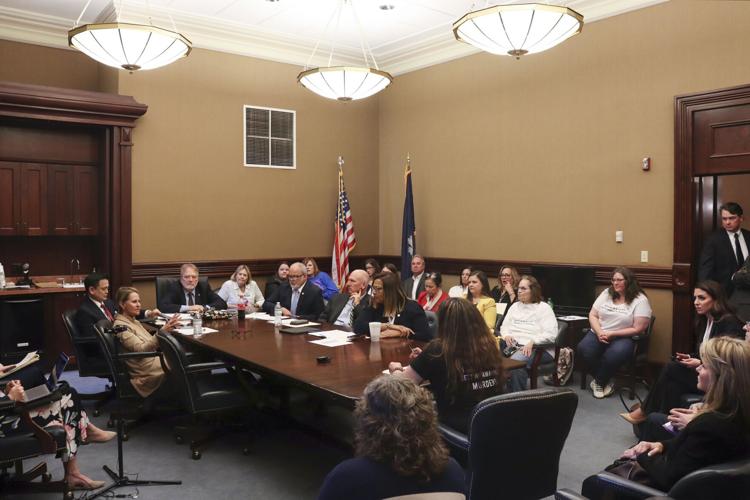
South Carolina Senators hear from the parents of people who died from fentanyl overdose Jan. 19 in Columbia, S.C.
“There is no other drug — no other illicit drug — that has the same type of effects on our communities,” said Mark Jackson, the district attorney for Douglas County, Nevada, and president of the Nevada District Attorneys Association, which is pushing for stricter penalties for fentanyl-related crimes.
People are also reading…
But the strategy is alarming recovery advocates who say focusing on the criminal angle of drugs has historically backfired, including when lawmakers elevated crack cocaine penalties in the 1980s.
“Every time we treat drugs as a law enforcement problem and push stricter laws, we find that we punish people in ways that destroy their lives and make it harder for them to recover later on,” said Adam Wandt, an assistant professor of public policy at John Jay College of Criminal Justice in New York.
Since 2020, drug overdoses are now linked to more than 100,000 deaths a year nationally, with about two-thirds of them fentanyl-related. That’s more than 10 times as many drug deaths as in 1988, at the height of the crack epidemic.

Ingesting 2 milligrams of fentanyl can be fatal, meaning 1 gram — about the same weight as a paper clip — could contain 500 lethal doses.
Before this year’s legislative sessions began, a dozen states already adopted fentanyl possession measures, according to tracking by the National Conference of State Legislatures.
This year, in one legislative chamber of liberal Oregon and one chamber of conservative West Virginia, lawmakers have agreed upon tougher penalties. In her State of the State speech this March, Alabama Gov. Kay Ivey, a Republican, called on lawmakers to adopt a drug trafficking bill that includes tougher fentanyl sentences.
In Nevada, where Democrats control the Legislature, a bill backed by Democratic Attorney General Aaron Ford would give one to 20 years in prison for selling, possessing, manufacturing or transporting 4 grams or more of fentanyl into the state, depending on the amount.
It’s a change for Ford, who has supported criminal justice reforms including a sweeping 2019 law that, among other provisions, raised the threshold for such penalties to 100 grams. It would also remove fentanyl from the state’s “Good Samaritan” law, which exempts people from criminal drug possession charges while reporting an overdose.
“What we’ve learned is that lowering the thresholds for all drugs was overinclusive,” Ford said.

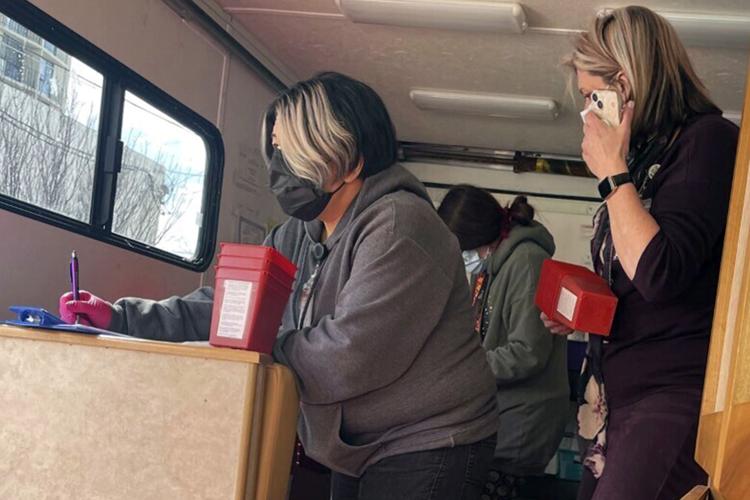
Rosa Johnson prepares her mobile needle exchange March 7 in Reno, Nevada.
Harm reduction advocates are pushing Ford and others to rethink their support, arguing the thresholds for longer penalties can sweep up low-level users — not just the dealers the law is aimed at — as well as some who may not even know they are taking fentanyl.
They warn that the state’s crime labs test only for the presence of fentanyl, not the exact amount in a mixture of drugs. Thus, people with over 4 grams of drugs containing a few milligrams of fentanyl could be subject to trafficking penalties, they say.
Rosa Johnson runs a needle exchange where she meets people who could face consequences should the stricter fentanyl bill pass. For the dozens of people that show up each day, it is rare for them to cite fentanyl as their “drug of choice.”
But it’s also rare that fentanyl test strips come back negative, with the drug being “laced in a lot of things,” Johnson said.
Meanwhile, Nevada’s Republican Gov. Joe Lombardo, a former sheriff, has vowed to introduce tougher legislation that would make possession of any amount of fentanyl the same felony threshold as fentanyl trafficking.
Both Republican-led chambers in South Carolina have passed fentanyl trafficking measures with bipartisan support, although lawmakers haven’t agreed on which version to send the governor. Senators also unanimously approved a bill allowing alleged drug dealers to be charged with homicide in overdose deaths.
House Minority Leader Todd Rutherford slammed colleagues for selling a “false bill of goods.” While Republican Rep. Doug Gilliam said he understood concerns about ambiguity, he said lawmakers had to send a “strong message” to drug dealers.
A Senate subcommittee heard emotional testimony from family members of people who died of a fentanyl overdose.
Among them was Holly Alsobrooks, co-founder of an advocacy group that also supports more fentanyl test strips, opioid antidotes and rehabilitation centers. While Alsobrooks said there is no “perfect” solution, she said the fentanyl trafficking measures are the “best” answers she has heard.
“We are fully behind this bill,” she said. “And if people go to jail, they’re going to go to jail.”
10 essential documentaries on the opioid crisis
10 essential documentaries on the opioid crisis

The Centers for Disease Control and Prevention breaks the opioid epidemic into three waves. The first wave began with the introduction of OxyContin—the highly addictive painkiller made by Purdue Pharma and introduced in 1996—and an increase in prescribing opioids. Spiked opioid addiction rates quickly followed.
A significant rise in heroin overdose deaths marked the second wave in 2010. A third wave followed in 2013 with the sharp jump in overdose deaths connected to synthetic opioids, especially fentanyl, according to the CDC. From 1999 to 2019, close to 500,000 people died due to opioid overdoses.
Hulu’s 2021 drama miniseries “Dopesick” focused on Purdue Pharma pushing sales reps to convince doctors the OxyContin wasn't addictive despite knowledge to the contrary. The Food and Drug Administration backed Purdue, thereby setting the stage for a drug epidemic that took a hold of the nation. A judge in 2021 approved a deal to dissolve Purdue as a business; the Sackler family, which runs the company, agreed to pay $4.5 billion in a bankruptcy settlement. Many who struggled with opioid addiction or lost a loved one due to OxyContin addiction, have voiced objections to the fact that the Sacklers will likely remain one of the wealthiest families in the United States.
To shed light on this manufactured drug epidemic, Zinnia Health compiled a list of 10 documentary films and docuseries that explore the opioid epidemic.

‘The Crime of the Century’

Filmmaker Alex Gibney believes the opioid epidemic is an actual crime committed by physicians, pharmaceutical companies and reps, distributors, and pharmacists. “The Crime of the Century” is an HBO documentary that reveals the role Purdue Pharma and other major manufacturers and distributors played.
Gibney sheds light on the changes the medical community was asked to make to accommodate opioids, including how doctors should expand and rethink the meaning of breakthrough pain, and how pain was the fifth vital sign. The case of Dr. Lynn Webster is also discussed as is his role in the death of Carol Bosley, one of his patients who died of an opioid overdose. Webster was a speaker for the pharmaceutical companies who received monetary compensation.
‘Recovery Boys’

A Netflix original, “Recovery Boys” is a 90-minute documentary that chronicles the journey to recovery for four men. After battling opioid addiction, they spend 18 months at a recovery center that is farm-based and located in Aurora, West Virginia. The men include a young father and husband; an addict in his 10th treatment program; one who stole from his grandmother so often to maintain his addiction that she is on the verge of homelessness; and finally, one who comes in directly from the street and is floored by detox.
Elaine McMillion Sheldon, who also directed “Heroin(e),” brings a raw look at addiction and recovery, proving how difficult it is not only to find a treatment center but also to find support once returning home.
‘7 Days: The Opioid Crisis in Arkansas’

Filmmaker Nathan Willis produced and directed “7 Days: The Opioid Crisis in Arkansas,” which opens with the shocking overdose of a woman. It focuses on the stories of people who have struggled with opioid addiction in Arkansas, the families that have lost loved ones to addiction, as well as law enforcement and medical professionals who discuss the crisis in Arkansas. The film also addresses steps the state continues to take surrounding the opioid epidemic. Several agencies—including law enforcement partners, the Arkansas Department of Education, and Arkansas PBS—came together to create the documentary.
‘Do No Harm: The Opioid Epidemic’

“Do No Harm: The Opioid Epidemic” focuses on the history of the opioid epidemic covering Purdue Pharma’s marketing of the drug OxyContin, which it created, and how misleading it was. The series also addresses the blatant overprescribing by physicians who were coaxed into recommending the drug to patients by Purdue’s overzealous pharmaceutical sales force, which cited an FDA statement that was inaccurate and proved deadly. Ed Harris narrates the three 60-minute episodes of this PBS series. Recovering addicts and their families also share their stories.
‘Heroin(e)’

“Heroin(e),” a Netflix documentary, turns its lens on three women battling the opioid epidemic in West Virginia. The women in the film are a judge, a street missionary, and a fire chief. The state has a much higher overdose rate than the national average and opioids are, “the number one cause of death associated with drug overdoses,” according to the state’s attorney general’s office. The Oscar-nominated documentary is directed by Elaine McMillion Sheldon. One moment in the film, which seems to sum it all up, takes place when the first female fire chief in West Virginia’s history has to cut filming short to head to a reported overdose.
‘This Might Hurt’

After they’ve exhausted other options, chronic pain patients try a new approach to treat and cure their pain. “This Might Hurt” documents their time with Dr. Howard Schubiner, who gets to the root of their pain by revealing the buried trauma causing it. Schubiner then teaches them to retrain their brains to turn off the pain. The film was an official selection at the 2019 Austin Film Festival.
‘The Pharmacist’

“The Pharmacist” is the story of pharmacist Dan Schneider, who works to find justice for his son, killed while buying crack. Schneider then realizes young people are coming to his pharmacy with prescriptions for high doses of the powerful opioid OxyContin. Not willing to lose any more sons and daughters, Schneider tapes conversations and begins a fight against Big Pharma. This four-part miniseries premiered on Netflix and was directed by Jenner Furst and Julia Willoughby Nason.
‘Warning: This Drug May Kill You’

Director Perri Peltz and HBO bring audiences “Warning: This Drug May Kill You,” a story about four families and their battles with opioid addiction. The families’ loved ones had legitimate prescriptions for addictive painkillers, which led to their addiction. These legally prescribed drugs often led to the abuse of illegal drugs like heroin. The 60-minute documentary features personal photos and home videos as well as information and statistics about opioids.
‘The Trade’

The series as a whole shines a light on illicit industries. The first season of this Showtime documentary focuses on the opioid epidemic. From Mexican cartels to middle America, the show chronicles the struggle opioids have brought with them. “The Trade” was directed by Oscar-nominated filmmaker Matthew Heineman who also directed “Cartel Land,” which was nominated for an Academy Award and took home three Primetime Emmys.
‘Dr. Feelgood’

This portrayal of physician and pain management specialist Dr. William Hurwitz tells both sides of the story. Hurwitz presents himself as a caring and trusting doctor who helped his patients by dispensing pain-management drugs—and who was duped by those who sold the medications he prescribed on the black market. Audiences are also presented with evidence to the contrary, a five-year prison sentence for the good doctor and two trials for distribution of narcotics. Eve Marson directs “Dr. Feelgood” and seems at ease giving viewers access to the whole story and the many sides of Hurwitz.
This story originally appeared on Zinnia Health and was produced and distributed in partnership with Stacker Studio.