

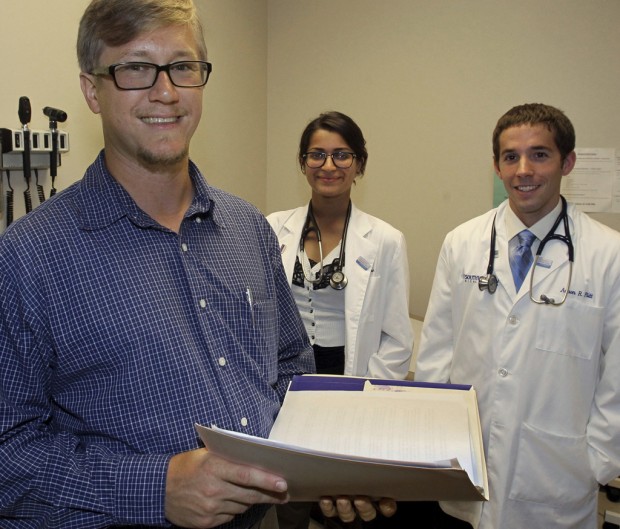
DALLAS - After two tours in Iraq and trouble adjusting to civilian life, Jeff Hensley was looking for a new career path.
He wanted to leave his job as an airline pilot and become a counselor, though he didn't know how he would pay for it.
"I knew there was a real need for it out there," said the 48-year-old Frisco, Texas, resident, who served in the Navy and later the Air Force.
Like thousands of military veterans, Hensley found financial help in the Post-9/11 GI Bill - the latest version of the law first signed by President Franklin D. Roosevelt in 1944.
This fall, with more American troops returning from the Middle East, a record 590,000 veterans are expected to be enrolled in universities and two-year colleges under the new bill.
GI Bill benefits allow eligible veterans to attend a public college or university for free for four years, as well as receive a monthly housing stipend and up to $1,000 a year for books.
People are also reading…
When Hensley returned home from Iraq in 2007, his newest battles hardly resembled those he encountered on aircraft carriers in the Persian Gulf or on fighter jets over Baghdad.
He and his wife divorced, and Hensley eventually underwent heavy counseling to cope with what he described as "reintegration issues."
Inspired by the progress he gradually made, Hensley began considering leaving his job as a pilot for United Airlines. Counseling appealed to him, in part because relatively few veterans make it a career, he said.
"I'm a little bit out of my element," Hensley said. "A bunch of my friends had their own reintegration issues."
Now, with the help of the Post-9/11 GI Bill, Hensley, who has three children, is pursuing a master's degree in mental-health counseling at the University of North Texas.
With the large number of troops coming home, it's only natural that the bill would be an attractive option for soldiers looking to re-enter civilian life, said Tom Tarantino, deputy policy director for Iraq and Afghanistan Veterans of America.
"We have an entire generation who has been fighting for 10 years," Tarantino said. "People who are now GI Bill-eligible are going to be leaving service and doing other things with their lives."
He said he expects enrollment under the bill to increase in each of the next five years.
Since the bill took effect in August 2009, almost three-quarters of a million veterans and their dependents have used the program to pursue some form of higher education.
Justin Beatty, born and raised in Denton, was deployed to the Persian Gulf three times with the Navy - the first time in December 2001. He was stationed in San Diego on the USS Bonhomme Richard on Sept. 11, 2001.
He is now a first-year medical student under the Post-9/11 GI Bill at UT Southwestern Medical Center.


