

Galileo was the first person to point a telescope toward the heavens, and his observations of the moons of Jupiter changed how we understand our place in the universe. Four centuries of advances in telescope size and sophistication have brought unexpected returns, including evidence for dark matter and dark energy.
Along with all astronomers, we are excited about both what we expect to see and what will surprise us when the next generation of giant telescopes looks upward. The University of Arizona plays a key role in the development, building and operation of these giants.
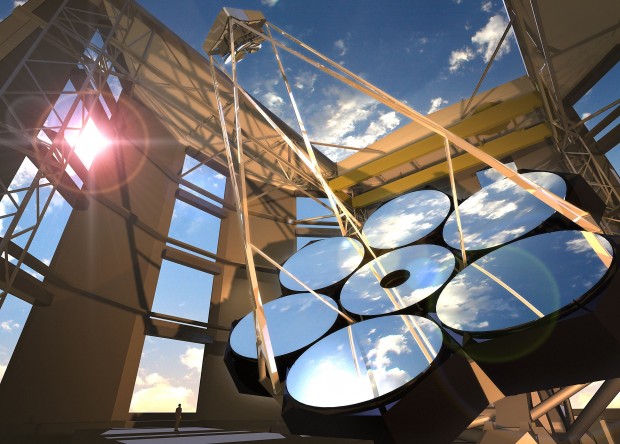
The UA is a founding partner of the international consortium of universities and research institutions working to build what will be the largest telescope in the world, the Giant Magellan Telescope (GMT). Construction is planned to start in Chile in 2014.
Astronomers will use the unique observations from this huge telescope to understand when the first stars and galaxies formed, see other Earthlike planets and track the growth of black holes over cosmic time.
People are also reading…
The GMT will also expand our knowledge of unknown constituents of the universe: the mysterious dark matter and the puzzling dark energy that together account for 96 percent of the total mass and energy in the universe.
Like the current largest telescope, the Large Binocular Telescope on Mt. Graham in Arizona, the GMT will use multiple mirrors, each 8.4 meters (27 feet) in diameter. Unlike the LBT, which has two such mirrors acting as distinct telescopes pointing to the same place in the sky, the GMT will use seven mirrors and stitch them together to form a single humongous mirror.
The large mirrors are being cast and polished at the UA's Steward Observatory Mirror Laboratory. Roger Angel, the laboratory's director, and his colleagues revolutionized the making of telescope mirrors and have enabled the UA's involvement in a continuing series of world-leading telescopes.
Casting and polishing of the first of the GMT's seven giant mirrors is now complete, the second mirror has been cast, and the site for the telescope is being prepared.
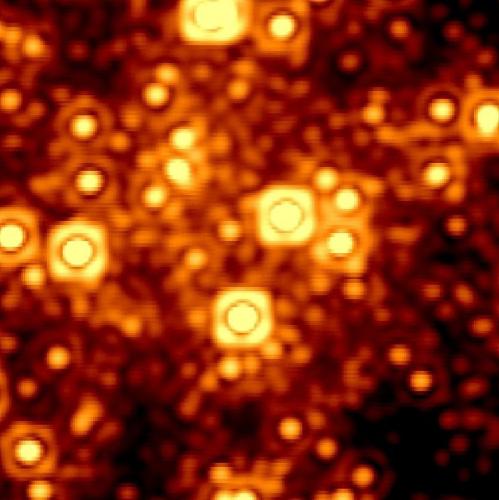
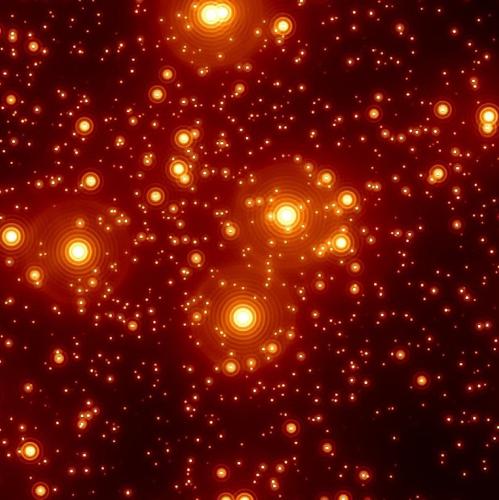
The mirrors in combination with adaptive optics, another technology pioneered at the UA, give the GMT the ability to see fainter celestial objects than any existing telescope and to produce images 10 times sharper than those from the Hubble Space Telescope.
Adaptive optics, rapidly bending thin mirrors a thousand times a second to remove the blurring of images caused by turbulence in the atmosphere, is already implemented at three of our telescopes and is essential to achieving the full potential of the GMT.
Each new leap forward in capability generates tremendous discoveries that challenge our understanding of the universe and pushes us to develop new concepts.
The UA's participation in the GMT will allow UA astronomers to continue to be at the forefront of astronomy. Our most immediate challenge is securing the necessary funding to complete the telescope. There is no time to lose in getting the GMT up and running, because we're competing with several other groups to build the next giant telescope.
About the scientists
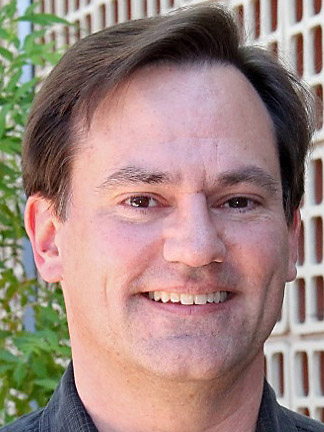
Dennis Zaritsky is a UA professor of astronomy and served on the GMT Board of Directors from 2010 to 2012. He studies a variety of topics in extragalactic astronomy, including the nature of dark matter and the structure and evolution of galaxies.
Buell T. Jannuzi is director of Steward Observatory and head of the UA department of astronomy. He studies the formation and evolution of structure in the universe.
Experience Science
• Giant Magellan Telescope: www.gmto.org
• Steward Observatory: www.as.arizona.edu
• Steward Observatory Mirror Lab (tours available): http://mirrorlab.as.arizona.edu


