

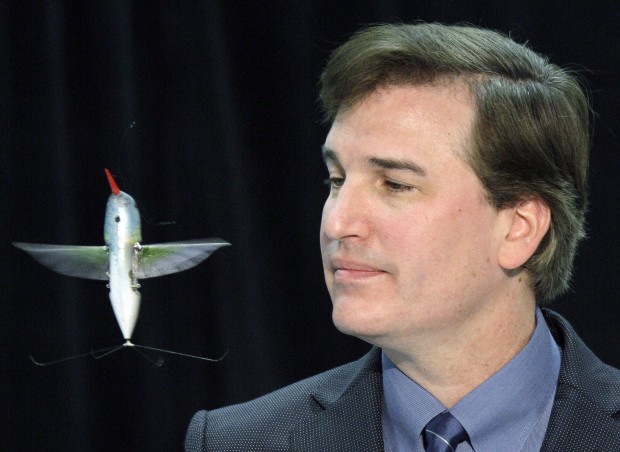
SAN DIEGO - You'll never look at hummingbirds the same again.
The Pentagon has poured millions of dollars into the development of tiny drones inspired by biology, each equipped with video and audio equipment that can record sights and sounds.
They could be used to spy, but also to locate people inside earthquake-crumpled buildings and detect hazardous chemical leaks.
The smaller, the better.
Besides the hummingbird, engineers in the growing unmanned aircraft industry are working on drones that look like insects and the helicopter-like maple leaf seed.
Researchers are even exploring ways to implant surveillance and other equipment into an insect as it is undergoing metamorphosis. They want to be able to control the creature.
People are also reading…
The devices could end up being used by police officers and firefighters.
Their potential use outside of battle zones, however, is raising questions about privacy and the dangers of the winged creatures buzzing around in the same skies as aircraft.
For now, most of these devices are just inspiring awe.
With a 6.5-inch wing span, the remote-controlled bird weighs less than a AA battery and can fly at speeds of up to 11 mph, propelled only by the flapping of its two wings. A tiny video camera sits in its belly.
The bird can climb and descend vertically, and fly sideways, forward and backward. It can rotate clockwise and counterclockwise.
Most of all it can hover and perch on a window ledge while it gathers intelligence, unbeknownst to the enemy.
The success of the hummingbird drone "paves the way for a new generation of aircraft with the agility and appearance of small birds," said Todd Hylton of the Pentagon's research arm, Defense Advanced Research Projects Agency, or DARPA.
These drones are not just birds.
Lockheed Martin has developed a fake maple leaf seed, or so-called whirly bird, loaded with navigation equipment and imaging sensors. The spy plane weighs 0.07 of an ounce.
On the far end of the research spectrum, DARPA is also exploring the possibility of implanting live insects during metamorphosis with video cameras or sensors and controlling them by applying electrical stimulation to their wings.
The idea is for the military to be able to send in a swarm of bugs loaded with spy gear.


