

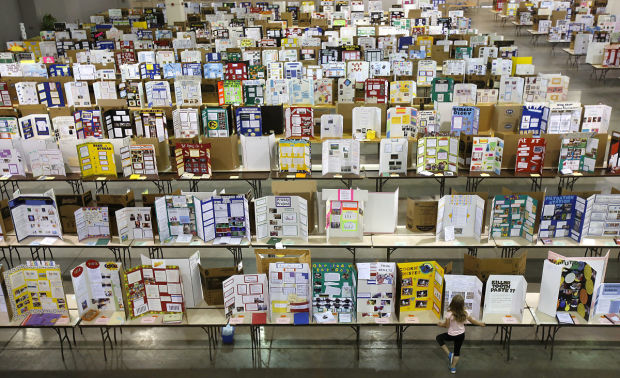
The 1,716 science projects displayed this week at the Southern Arizona Research, Science and Engineering Fair ranged from creating static electricity by rubbing a balloon on your head to crossing the blood-brain barrier with drugs to cure Alzheimer’s disease.
The poster on the balloon experiment was in the kindergarten section of the fair, held all week at the Tucson Convention Center. Nearby was a statistical analysis of the percentage of various colors found in M&M packages.
“We get M&M projects every year,” said Liz Baker, executive director of the SARSEF Foundation.
The scientific conclusion — 28 percent orange M&Ms – may not be stunning, Baker noted, but the mere fact that kindergartners are computing percentages and graphing them on a poster is exactly what the annual fair is all about.
People are also reading…
Five-year-old M&M counters turn into high school seniors who tackle subjects such as curing cancer and analyzing results from radio telemetry information on the recent reintroduction of bighorn sheep in the Santa Catalina Mountains — two of the more advanced high school projects at this year’s fair.
Baker knows the importance of early involvement in science fairs firsthand. She parlayed 10 years of entries at this regional science fair into three wins at the Intel International Science and Engineering Fair, earning more than $200,000 in scholarships along the way.
Baker earned a bachelor’s degree in psychology at the University of Arizona and a master’s in evolutionary and comparative psychology at University of St. Andrews in Scotland.
This year, in her first year as the first paid executive director in the mostly volunteer organization, she was especially pleased by the fact that girls outnumbered boys in every category of the competition.
“What was really striking was that we had one-third more girls than boys in the middle-school group.”
The 4,428 students whose solo or group projects made it to the regional fair represent about 75,000 students at schools in Southern Arizona that participated.
They competed for cash prizes, scientific equipment and scholarships ranging up to $5,000.
A complete list of winners will be posted on the Arizona Daily Star’s website at midnight Friday.


