

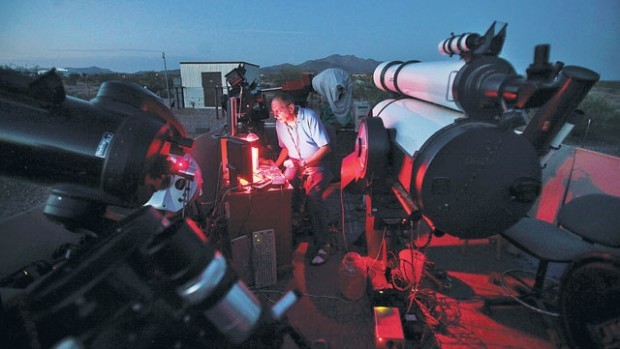
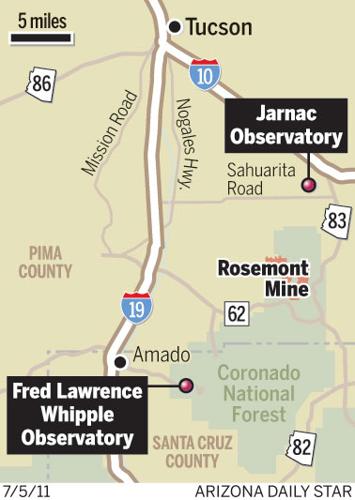
City lights brighten the sky west of David Levy's backyard observatory in the Vail area, but the skies are darker and starrier to the east.
Those contrasting views illustrate what could be at stake for dark skies in the Tucson area due to the Rosemont Mine, according to the U.S. Forest Service's preliminary report on the proposed mine's environmental impact. Levy, an internationally known amateur comet discoverer, as well as astronomers on Mount Hopkins are concerned that the mine's projected increases in sky brightness would make their work more difficult - or impossible.
Rosemont Copper has pledged to meet Pima County's lighting code, although as a mine it is legally exempt from it.
But the mine, producing about as much light as 10,000 homes, will hurt the region's observatories to a "substantial, adverse degree," the Forest Service report says.
People are also reading…
The mine would have fixed lights at its headquarters and pit processing area, mobile lighting of mine pit shovels and ore loaders, and portable light towers at active mining areas, the Forest Service report said. The mine's heap leach pad - a process to extract precious metals - would have its own lighting. Lights would line the mine's access road to Arizona 83.
To lessen the impact on dark skies, the company would use shields, dimmers, cutoff lighting fixtures, timers, motion sensors and directional lighting, the Forest Service report said. Its buildings would be painted or stained to produce flat-toned, non-reflective surfaces. Roads, material-transfer points and processing areas would be treated with dust-control agents, water sprays and wind barriers to limit release of dust into the air.
But those plans' effectiveness can't be measured yet because they must be subject to federal mine-safety requirements and the mine's nighttime operational needs, the service's report said.
For Levy, who has discovered 23 comets - 10 from Tucson - a 22 percent brighter sky spells trouble for his open-air observatory, consisting of 15 telescopes and lying 3 1/2 miles south of Interstate 10. He has discovered two comets there since moving to the area in 1996. He said his work there has been an integral part of the writing and speaking work on astronomy that has helped him earn a living.
He no longer looks at the western sky because Tucson's growth has lit it too much to see stars well, he said. If the mine brightens the eastern sky too much, he might have to abandon comet-watching there, said Levy, 63.
Jon Fast, a Tucsonan who supports the mine, said he's sorry if it would interfere with astronomers' work, but "what are you going to do for jobs - more Burger Kings and Jack in the Boxes and call centers?"
"With progress comes some things that you don't want to go with," said Fast, a safety consultant who has lived in the Tucson area since 1996. "That's just the way things are in this world. It's not like it was 50 years ago."
The mine would add 406 well-paying jobs and continue Arizona's tradition as the largest copper-producing state, backers have pointed out.
But Levy's departure would be a loss for Tucson, said Philip Massey, an astronomer at Flagstaff's Lowell Observatory.
"He is a very famous astronomer. He is in some ways the mini-Carl Sagan of his generation," Massey said.
At Whipple, the impact of a 10 percent brighter sky depends on what you're looking at and how far away it is, astronomers say.
"If you are looking at a distant galaxy, it's very different from looking at individual stars," said Emilio Falco, project director at the observatory, part of the Harvard-Smithsonian Center for Astrophysics. "Distant galaxies are faint, so they are the first thing you lose when you start getting more light pollution. It could be terrible for your project."
Tradeoffs like these between the mine and astronomy always occur with a major development, a prominent Rosemont supporter said.
"We have to step back and be as objective as we can be, and ask ourselves: With the millions of dollars of tax revenue, the jobs and all the positives of Rosemont, which will provide the greater good for the community?" said Mike Varney, president and CEO of the Tucson Metropolitan Chamber of Commerce.
But County Administrator Chuck Huckelberry wrote the Forest Service last week that its environmental report failed to consider the mine's impacts on existing investment and planned expansions of facilities and research in astronomy and space sciences in the Tucson area. Statewide, about $1.2 billion has been invested in these areas, he wrote:
"Damage to this significant industry and the resultant loss of jobs and investment in the region cannot be ignored."
Contact reporter Tony Davis at tdavis@azstarnet.com or 806-7746.


