

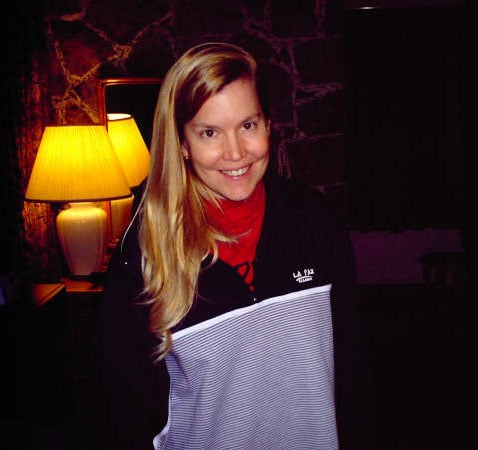
Maeveen Marie Behan was a renaissance woman whose drive to protect the Sonoran Desert was fed by love and a sense of justice.
She was a lawyer who knew that the best way to reach people on a wonkish subject such as the Sonoran Desert Conservation Plan was by telling stories.
She was a thirsty learner who earned three degrees but knew little about the Endangered Species Act until she started putting it into practice in 1998. Three years later, she taught it to lawyers at a continuing-education class. She also was an unsung visionary, shunning publicity as a top aide to County Administrator Chuck Huckelberry.
Together, those traits allowed her to change the face of Pima County, friends, family members and colleagues said after her death of cancer last week at age 48.
She shaped a nationally recognized blueprint for planning and conservation that many scientists believe is the first to balance nature with growth. Beyond that, Behan was larger than life: brilliant, fiercely devoted to her work, a voracious speed reader and an athlete who was the first woman to run the six-minute mile in Georgia.
People are also reading…
She worked 17 years for Pima County government until a few weeks before her death. Her last decade was spent working on the conservation plan.
"The plan's policy concept was from Chuck. The policy direction was from the county Board of Supervisors. The framing of the whole effort, the mechanism, the details - those were the areas where she was head," said U.S. Rep. Raúl Grijalva, a former supervisor who pushed for the plan.
Although her bookshelves were packed with volumes on wildlife, science and the desert, she was most passionately interested in the desert as part of a broader narrative of place, said her husband, Harry Goldwasser, a psychiatrist. She viewed her work as an extension of continuing the story of Tucson, its people, animals, land and culture, he said.
"She drew upon so many different levels of how to know something - the use of history, the use of imagery and the use of myth and folklore through storytelling," said Julia Fonseca, environmental planning manager in the county's Office of Conservation Science, where Behan was director at the time of her death.
During the conservation plan debate, she often drew from complex technical documents to craft a cover memo, using an animal story to explain a problem, Fonseca said.
"In many cases, probably the cover memo was all that people read."
Intellectually and politically, Behan, born in Milwaukee, was a product of a Jesuit tradition in her Catholic family, said Kathleen Behan, one of her five siblings. Fundamental teachings of the church and other religions about the "need to give back were ingrained in us," she said. Behan was passionately interested in issues of social justice, although her family recalled that she never thought of herself as a liberal or an environmentalist.
"Jesuits asked questions. They sought to find philosophical meanings not just in the teachings of the church but in philosophy all over time," Kathleen Behan said. "She was constantly seeking out learning, seeking spiritual and philosophical knowledge, and trying to apply her knowledge to understand the needs of Pima County citizens."
She earned a bachelor's degree from the University of Georgia, where she met and married Goldwasser. She got a law degree, and her husband a medical degree, at the University of Alabama. They moved to Chapel Hill, N.C., where she worked for four years at Employment Law Research, a company that published a guidebook series on employment labor law.
That training helped her 20 years later, when she wrote her doctoral dissertation at the University of Arizona on how cultural and scientific views of nature shape the law. She researched every case in the history of American law that mentioned an animal, Goldwasser recalled, and got her doctorate in 2006.
She moved to Tucson in 1992 when her husband took a job at Palo Verde Hospital, and she was hired as a county equal employment opportunity officer.
In 1998, Huckelberry assigned her to work on the conservation plan - a job for which she had no formal background.
Still, "she was successful at everything she did," Huckelberry recalled. "She took complex and dense subjects and could do research and policy on them simultaneously and make them easy to understand."
Early Friday mornings, Behan would open the door to the county administrator's conference room and say to various interest groups, "My door is open; come in and talk to me," recalled Leslie Dierauf, the U.S. Fish and Wildlife Service's Southwest Regional Habitat Conservation Plan coordinator back then.
"For the first few months, the environmental community would come in, and sometimes the development community would show up and poke their heads in but not come in," Dierauf recalled. "Soon, both the environmentalists and the developers would come in. That's how it started."
Behan's work changed the nature of the county's growth debate that for decades had pitted development against conservation, said Sherry Barrett, a Fish and Wildlife Service official in Tucson.
"She made the two fit together, on how growth could happen with the environment," Barrett recalled. "She knew that the conservation could benefit growth, and maybe even the economy."
She was self-deprecating and preferred to work behind the scenes, said Christina McVie, an activist with the group Desert Watch. Yet as she lay dying last week, Behan felt it was important to see the supervisors name the county's 3 million-acre land reserve after her, because it had never occurred to her that it could happen, McVie said.


