

SARATOV, Russia — Vitaly is the face of Russia's AIDS epidemic, epitomizing many of its most troubling characteristics.
The 23-year-old furniture maker, a former intravenous drug user, tells few people that he carries the virus that causes AIDS, fearing harassment and discrimination. Should his immune system fail, it's likely he won't get the drugs needed to keep him alive.
"It's considered a dirty disease. People are afraid of it. It's become a joke for many. No one wants to deal with people who are infected," said Vitaly, who asked that his last name not be used because of those fears.
Critics say neglect of AIDS victims by authorities and callous treatment by regular Russians are part of a culture of denial that has helped place Russia on the verge of a public health crisis, as AIDS and HIV infections spread.
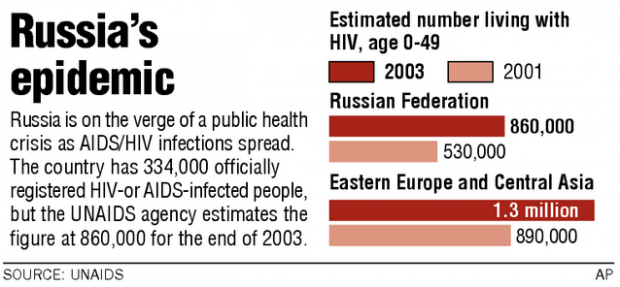
Russia has 334,000 officially registered HIV- or AIDS-infected people. The UNAIDS agency puts the figure at nearly 900,000, and many others say the real number is likely well over a million, around 1 percent of the country's population.
People are also reading…
The critics also believe the epidemic will deepen because of Russia's decrepit health-care system, plummeting health standards, a rising tide of illegal drugs and widespread discrimination.
As hundreds gathered Monday for a major AIDS conference in Moscow, international health experts continued to warn that Russian officials have been too slow to react to a problem quickly moving beyond the traditional core of at-risk people — drug users, gay men and prostitutes — into the wider population.
Without dramatic policy decisions, experts warn, Russia will be overwhelmed.
"Russia's politics of AIDS will be misguided and contentious until its leaders and public believe that they face a threat worth fighting," Celeste Wallender, an expert at the U.S.-based Center for Strategic and International Studies, wrote in a policy paper in December.
Russia's AIDS/HIV prevalence rate was about 1.1 percent of the population in 2003, according to the United Nations' AIDS program. The United States recorded a 0.6 percent rate and France 0.4 percent. The rate for the African country of Botswana was 37.3 percent.
Last month, President Vlad-imir Putin pledged a twentyfold increase in federal funding to fight the disease, and the issue tops the agenda for the Group of Eight major industrialized nations summit in St. Petersburg in July. In his annual state-of-the-nation address this month, however, Putin made no mention of the disease, instead focusing on Russia's sharp decline in population.


