

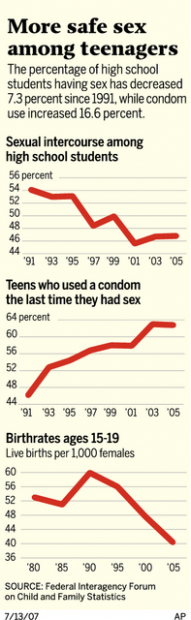
WASHINGTON — Fewer high school students are having sex these days, and more are using condoms. The teen birthrate has hit a record low.
More young people are finishing high school, too, and more little kids are being read to, according to the latest government snapshot on the well-being of the nation's children. It's good news on a number of key health indicators, experts said of the report, released today.
"The implications for the population are quite positive in terms of their health and their well-being," said Edward Sondik, director of the National Center for Health Statistics. "The lower figure on teens having sex means the risk of sexually transmitted diseases is lower."
In 2005, 47 percent of high school students — 6.7 million — reported having had sexual intercourse, down from 54 percent in 1991. The rate of those who reported having had sex has remained the same since 2003.
People are also reading…
Of those who had sex during a three-month period in 2005, 63 percent — about 9 million — used condoms. That's up from 46 percent in 1991.
The teen birthrate, the report said, was 21 per 1,000 girls ages 15 through 17 in 2005 — an all-time low. It was down from 39 births per 1,000 teens in 1991.
"This is very good news," Sondik said. "Young teen mothers and their babies are at a greater risk of both immediate and long-term difficulties."
Education campaigns that started years ago are having a significant effect, said James Wagoner, president of Advocates for Youth, a Washington-based nonprofit group that focuses on prevention of teen pregnancy and sexually transmitted diseases.
"I think the HIV-AIDS epidemic and the efforts in the '80s and '90s had a lot to do with that," Wagoner said of the improved numbers on teen sex, condoms and adolescent births.
"We need to encourage young teens to delay sexual initiation, and we need to make sure they get all the information they need about condoms and birth control," he said.


