

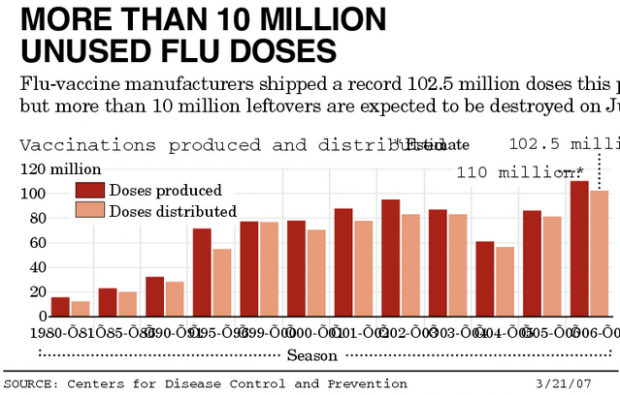
Millions of doses of flu vaccine will expire at midnight June 30, unsold during this year's mild flu season.
Still perfectly good, and possibly useful for a few more years, the vaccine will be destroyed.
This annual ritual is supposed to ensure that Americans get the most up-to-date vaccine, but the leftovers — more than 10 million doses — will be destroyed before a new supply is delivered.
An Associated Press examination of this longstanding practice raises questions about its consequences.
For years, policymakers have talked about letting doctors keep unused vaccine until new doses are in hand, donating leftover supplies to poor countries, or pushing back the expiration date.
Wasted vaccine means lost money for drug companies, and one company stopped making flu shots because of it — setting the stage for a flu-shot shortage in 2004.
People are also reading…
Having no vaccine in the summer deprives travelers of the chance to get a shot before they visit places where flu is in season. It also prevents summer vaccinations for children, who need two doses the first time around.
"All those issues have come up in the past," but there is a strong reluctance to change policy, said Dr. William Schaffner of Vanderbilt University, a government vaccine adviser. "These ideas clearly have merit and at the very least ought to be discussed."
The June 30 expiration date is set by the federal Food and Drug Administration and has less to do with the vaccine's shelf life than with the desire to tweak the recipe each year to include the three strains causing the most cases.
Manufacturers test throughout a flu season to ensure the vaccine stays potent, but they don't test beyond June 30 because it's assumed new vaccine will be made, said Len Lavenda, spokesman for Sanofi-Aventis SA, which supplies most of the nation's flu shots.
But vaccine degrades slowly and not into anything harmful, said Dr. Peter Patriarca, a scientist who formerly worked for vaccine maker MedImmune Inc. and once headed the FDA's vaccine division.
Patriarca said most vaccines would be stable for another year or two years, some as long as three or four.
The June 30 date aims to ensure that all old vaccine is gone before new doses come out.
"What they don't want to have happen is people inadvertently getting vaccinated with last year's vaccine," because it will not be as effective since it targets older strains, he said.
"There is some benefit to a system where unused vaccine is discarded even if it hasn't really lost that much potency," said Dr. John Treanor, a vaccine expert at the University of Rochester in New York.
Old vaccine could be a tough sell if one of the strains is not well-matched to what's expected to circulate.
"You'd have to tell people next year that the vaccine they got could be inferior," said Dr. Walter Orenstein, a vaccine expert at Emory University.
After the 2002-03 season, Wyeth Pharmaceuticals had to destroy a third of the 20 million doses it produced. The company lost about $35 million and dropped out of the flu-shot business. A shortage followed in October 2004, when Chiron Corp. lost a license that deprived the nation of half of its flu-shot supply at the height of vaccination season.


