

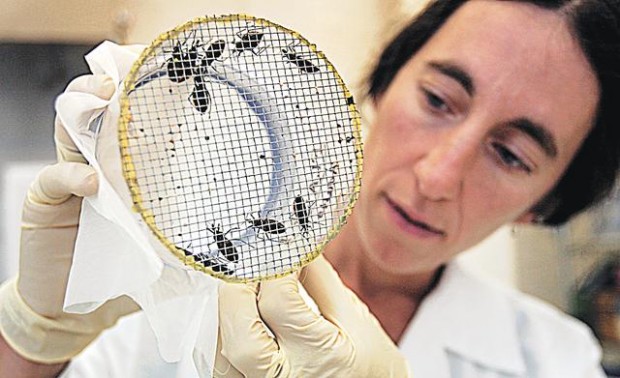
Local vampire hunters are looking for recruits.
University of Arizona researchers studying the kissing bugs — Triatoma rubida, Triatoma recurva and Triatoma protracta — have turned to the community for samples of the bloodthirsty insects.
Kissing bugs usually feed on pack rats, but as the rodents leave their nests in late spring, the bugs begin to disperse to find more food and mates.
They are nocturnal insects that hide during the day, said Carolina Reisenman, a UA associate staff scientist.
"They are attracted by lights. But in the middle of the night, people turn off their lights and go to bed, they may be hiding and come out. Vampires, that's what they are."
There's nothing romantic about the "kiss" left by the bug. Warmth and carbon dioxide emissions attract the bug to uncovered faces. The kissing bug uses an anesthetic to make the bite painless, letting its victim sleep while it dines for about 15 minutes to a half an hour.
People are also reading…
With the rising nighttime temperatures, kissing bugs are on the prowl. But not before many find themselves at the bottom of a bottle, heading for the UA labs.
"We always need more bugs," Reisenman said. "I would say 100 percent of the insects we get during the period from early April through August and September are from the public."
The three-year research project is aimed at studying the bugs as well as their protozoan parasite — Trypanosoma cruzi — that may cause Chagas disease. Chagas can range from being a mild nuisance to fatal. The Centers for Disease Control and Prevention report that being infected with Chagas in the United States is rare, unlike in Mexico, Central and South America, where an estimated 8 million to 11 million people are infected.
There have been at least 10 cases of Chagas confirmed in the Southwest. But none in Arizona, said Teresa Gregory, a UA research specialist. "Our main concern is allergies."
UA researchers don't think that we are due for an outbreak of Chagas. But the research is meant to check on the status of the bugs and see if things are consistent.
Transmission of the parasite isn't as easy here as it is farther south. As kissing bugs gorge themselves on blood, they can grow up to six times their normal size. They also defecate and urinate to make more room for their meal. It is their excrement that carries the parasite. And when the bite begins to itch and there is a temptation to scratch, the feces may get into the fresh bite.
"But the species around here, it is not quite clear, takes a very long time to defecate," Reisenman said. They may not defecate at all, and a lot of insects don't, which stops parasite transmission, making them inefficient carriers, she said.
She said 20 percent to 40 percent of the local kissing bugs have the parasite, based on studies so far. Researchers want to see if the parasite in the bugs is the same strain that causes cardiac problems, which are the typical symptoms of Chagas disease.
"We don't know that and it's likely that the strain from around here is not that bad. Kissing bugs are still a problem in Arizona because they can cause very severe allergic reactions."
Even with the possibility of carrying a microscopic parasite or causing an allergic reaction, the idea of being bitten in one's sleep is still unnerving, but part of desert life.
Tucson's population has expanded, and people now live in areas where kissing bugs live, Reisenman said. "People are in contact with them all the time. Before, it was people who had ranches or lived in mining camps, but now it's everybody."
That's one reason researchers have turned to the community. "We get a lot of insects from a lot a people from different sides of town," Reisenman said. "The larger the sample, the more accurately we can study dispersion patterns and infection rates."
Since the beginning of the study in 2006, the sample size has grown from only a couple of hundred bugs to about 600 in 2007 and then to about 800 in 2008, Gregory said.
Ads and fliers have helped, said Gregory, who has had them posted from the UA to the break room in St. Mary's Hospital.
She said so far this year researchers have about 300 bugs, but the summer has just begun.
Helping contribute to the research are Marcia Lincoln and Victor Ong, who catch the bugs around their home near Ina and Silverbell roads after seeing an ad a couple of years ago.
"We always smashed 'em when we found them. Then we thought, 'Well, somebody can use them, they might as well be put to some good use,' " said Lincoln, who first began collecting the bugs with tweezers and a yogurt cup. Now, she gets plastic medical cups and lids from the UA researchers.
"We get them when they come up to the house. They like to hang around the screen door when the light shines through at night and they try to sneak in."
Coming around the house at night is no surprise. The bugs use celestial cues, the moon and stars, for navigating. City and porch lights may confuse them, Reisenman said. Homes without screen doors and windows may be more susceptible to invasion.
"These insects are flat and very sneaky. And people find them in the house, around the bed, in the porch light."
If a kissing bug is discovered, don't touch it. "It's not that you are going to get anything, but it's always better to be safe." Their excrement may still be fresh on their bodies, Reisenman said. "But they are easy to catch, they aren't like mosquitoes or flies."
Just put a cup over it and slide some paper underneath. And it can be brought in dead or alive. Dead bugs are still acceptable for about a week.
When a bug finds itself in the UA labs, the six-legged vampire is cleaned and drowned in alcohol before DNA is extracted to search for the parasite.
"People have been wonderful providing them," Reisenman said. The public has taken part in the study every year. "And we'll do that as long as we have funding," she said.
The funds for the study, provided by a grant from the Arizona Biomedical Research Commission, are almost spent, but Reisenman said researchers are ready to submit a new proposal based on what they've uncovered. The last kissing bug study was done in the '60s, she said.
"Hopefully, this year will not be the last," she said. "There's still a lot to learn. What we've done is just the beginning."
DONATE YOURS
Think you have a kissing bug?
Place a cup over it and slide paper underneath. You can bring it to the UA lab dead or alive. Dead bugs are still acceptable for about a week.
Visit www.neurobio.arizona. edu/kissingbugs.html or contact Teresa Gregory at the UA: tgregory@neurobio.arizona.edu or 621-6631 for more information.


