

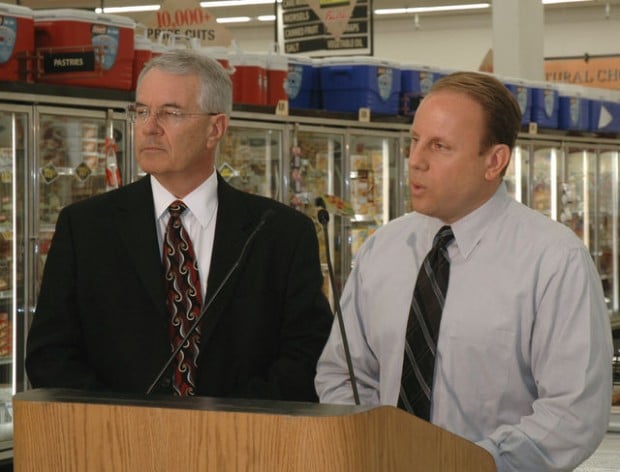
PHOENIX — The state's largest privately owned grocery chain is seeking protection from creditors to give the company some financial breathing room.
In legal papers filed overnight in U.S. Bankruptcy Court, Bashas' said it has about $200 million in assets and close to $245 million in debt.
But company president Mike Proulx said the aim is not to liquidate. In fact, Proulx said he believes the chain, which operates the Food City and AJ's markets in addition to its signature stores named after the founding family, will be able to pay off everything it owes to creditors — eventually.
Instead, he said, the filing will provide some much-needed operating cash to keep most of its stores open.
Potentially more significant, a bankruptcy filing will give the company more leverage to negotiate with landlords at shopping centers where it leases stores for lower rates. That leverage stems from the fact that a bankruptcy judge has the power to allow the company to break a lease entirely and walk away from some of what Proulx said have been "underperforming'' stores.
People are also reading…
Proulx blamed three factors on the decision to seek bankruptcy relief. One, he said, is the national credit crisis which has made it harder to get cash.
Second is the state's soft economy.
"Arizona goes from back in the day from ... three years, four years ago, from one of the fastest growing states in the nation to stagnant growth, unemployment climbing every day'' he said.
And Proulx also laid some of the blame at the feet of the United Food and Commercial Workers which has been engaged in a protracted battle to unionize the company's more than 150 stores. That fight has spilled over into court, with Bashas charging the union is engaged in a scheme to defame the 77-year-old chain.
At the same time, though, Bashas' is facing stiff competition, not only from the national chains of Safeway and Kroger, the latter which operates the Fry's food stores, but also the increasing presence of Wal-Mart.
Proulx said, though, he believes Bashas' is in a better position to survive than other chains which have since disappeared, including ABCO, Mega Foods and Southwest Markets. And part of that, he said, is the fact that even before the filing, Bashas had obtained $45 million in "debtor in possession'' financing to allow the stores to stay in business while it goes through bankruptcy -- a deal he said those other grocery chains did not have.
"We have the opportunity to develop a short-term and a long-term plan that will help us strengthen our operations, certainly strengthen our balance sheets, and improve our cash flow positions to allow us to compete with ... the tough competition we have,'' he said. The chain, though, will be smaller.
Company officials on Sunday listed the location of 10 stores — seven Bashas' markets and three Food City stores — it will close on July 21. That is on top of five other stores the company announced shuttering in February.
And the chain, which listed 14,000 employees two years ago, now has about 10,000. Will there be more cutting?
"We're looking at all options,'' Proulx said.
"Our whole focus and intent is to not sell, not close down, not liquidate,'' he continued. "So when we emerge (from bankruptcy) the first quarter of 2010, we'll be a leaner, stronger, better operation for another 77 years.''
And Edward "Trey" Basha, a senior vice president and family spokesman, said that can't be done without the bankruptcy.
"Frankly, what we need is we need time and we need additional liquidity,'' he said.
What that time also will provide, Proulx said, is a change in thinking.
"In the past, where we had the luxury of good sales and growth in this state, we probably kept some stores open, some locations open, longer than we should have,'' he said. "In today's environment, we don't have that luxury anymore.''
Burt P. Flickinger III, managing director of Strategic Resource Group, said it is important for the chain to get out from under some of its fixed lease costs.
Flickinger, a consultant with whom Bashas' shared its bankruptcy plans in advance, said some landlords have refused to provide breaks in rent or common-space charges. He said the latter is particularly important in new shopping centers where Bashas' went in as an anchor tenant but the other shops were never filled.
With the bankruptcy filing, "Bashas' has the ability to reject the leases that don't make sense,'' he said.
The long-term survival of Bashas', however, could come down to the question of whether there is a place for a family-owned grocery chain.
"We believe there's a place,'' Proulx said.
Part of the company strength, he said, is a presence in all of the state's 15 counties. And he said Bashas' has effective "niche marketing formats.''
The stores that bear the family name are more traditional competitors with other chains. By contrast, Food City is aimed at shoppers looking for lower every-day prices, with a heavy emphasis on marketing to the Hispanic community.
And the 14 AJ's markets are smaller stores stocking high-end gourmet and specialty foods.
Flickinger acknowledged the tough competition in the industry, especially with Wal-Mart which he said has "site-saturated'' the state with both its "big box'' stores with grocery sections as well as its smaller neighborhood markets.
But he said Bashas' has "tremendous customer loyalty.'' And he said local suppliers will support the move.
Basha said, though, change is on the way.
"This economic recession is like any other we've experienced,'' he said, hitting all sectors of the economy. The result is that AJ's already is doing something it never has done before: offering sales on items.
The company's top unsecured creditors are:
Cardinal Health, $2,758,378 Coca-Cola Bottling Co., $2,560,560 Frito Lay Inc., $1,188,134 Shamrock Foods, $1,068,196 Kalil Bottling Co., $1,035,068 Pepsi Cola, $1,007,583 Source Interlink Distributing, $659,738 Swire Coca-Cola USA, $588,916 Holsum Bakery Inc., $536,613 Kellogg Sales Co., 501,997
Source: Bankruptcy Court filings
Store closures
Bashas' stores set for July 21 closure include:
- Chandler Boulevard and Kyrene Road in Chandler;
- Tatum and Bell roads in Phoenix;
- Interstate 19 frontage road in Sahuarita;
- Highway 69 in Prescott;
- Lake Powell Boulevard in Page;
- Cooper and Ray roads in Chandler;
- Greenfield and Baseline roads in Gilbert.
Food City stores set for closure:
- 43rd and Glendale avenues in Glendale;
- 16th and Mohave streets in Phoenix;
- 43rd Avenue and Thomas Road in Phoenix.
-- Source: Bashas'


