

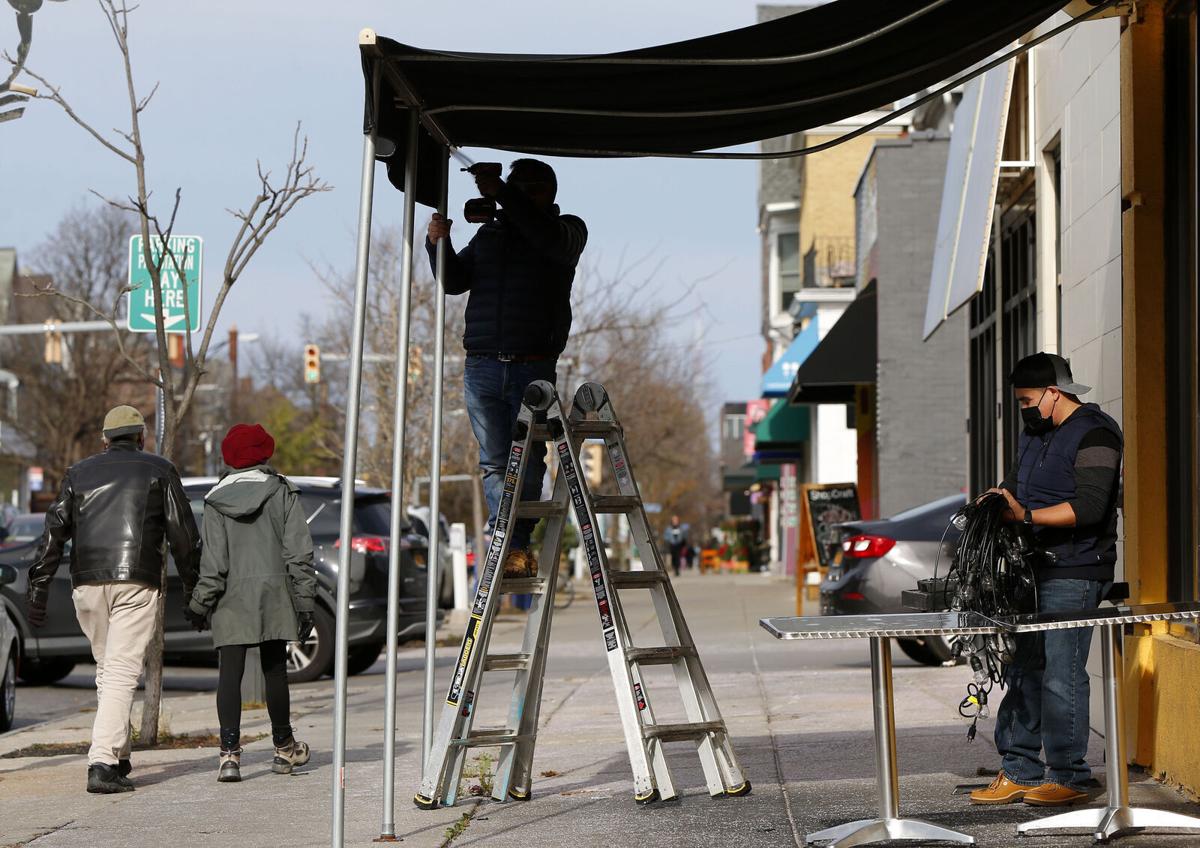
The Buffalo Niagara economy on Friday will veer off the road to recovery.
The job losses are starting again as gyms, hair salons and a smattering of other businesses across much of Erie County shut down again in the second wave of the Covid-19 crackdown. Hard-hit restaurants in those "orange zones" have closed their dining rooms and moved to much less lucrative takeout and delivery options.
Only this time, there’s no safety net for those displaced workers who likely will be going without a paycheck, or the businesses wondering how they’ll keep paying the rent and paying their loans.
This time, there is no supplemental $600 in unemployment benefits for workers, especially the lower-paid ones that have borne the brunt of the job cuts during the Covid-19 recession and likely have eaten deeply into their savings. There are no Paycheck Protection Program loans for businesses that, for the most part, continue to grapple with sluggish sales as consumers stay home more.
People are also reading…
“We’ll see a few thousand jobs lost,” said Julie Anna Golebiewski, a Canisius College economist. “What happens next is dependent on how long this is going to last.”
By this, Golebiewski means the surge in Covid-19 cases and the state’s effort to contain it by pushing regions with expanding outbreaks into microclusters with renewed restrictions on businesses and schools.
The "yellow zone" that initially included 14 Erie County communities beginning earlier this month didn’t hurt much. But by moving into an expanded "orange zone" beginning Friday, with the limited shutdowns and dining restrictions, businesses are starting to get squeezed again.
And there’s a real danger that parts of the region in the coming weeks could turn red, and with it face a much more draconian crackdown that isn’t as severe as the initial lockdown this spring, but closer in tone to the first phase of the reopening that took place in May, with professionals, like dentists, allowed to stay open while nonessential stores are limited to pickup and delivery.
"If we go red, for the retail sector to be impacted during the holidays, that will truly be harmful," Golebiewski said, noting that stores get a big chunk of their sales during the holidays. "That would be a killer."
“I think the job losses could be in the tens of thousands if we went red for an extended period – months. More than one month,” Golebiewski said.
New job data from the state Labor Department on Thursday showed that the Buffalo Niagara region gained 7,300 jobs from September to October as the recovery picked up again after a lull the month before.
But this is probably about as good as it gets for the region’s job market, said Fred Floss, a SUNY Buffalo State economist.
The new job numbers give us a snapshot of employment in mid-October, when coronavirus cases were starting to rise, but hadn’t yet spiked. By then, we had recovered nearly three-quarters of the jobs lost when the outbreak began. But we’re still down more than 40,000 jobs from a year ago.
That’s a lot – and it took us seven months to get that far.
Think of the recovery this way: You’re climbing up a steep hill and you’re three-quarters of the way to the top. It’s been a hard, slow climb, but the top is almost in sight. But then, just as your spirits are starting to lift, you hit a patch of loose soil and start sliding back down the hill.
You don’t know how far you’ll fall before you finally stop and can start climbing back up again. But you do know one thing: You’ll have to repeat part of the climb you just completed – on ground that is even more slippery than it was on the first trip – and you already know how long that took.
“It will go from coming back up, to going back down,” Floss said. “This is going to hurt.”
Even before this week’s microcluster setback, the job market still was fragile. The number of people filing weekly jobless claims over the past five weeks, dating back to mid-October, has been running at more than double the pace of a year ago – a sign that local businesses still were cutting back as the outbreak was starting to expand.
And now that the "orange zone" limitations are in place, those layoffs will spike again as the shutdowns begin anew.
“We don’t want to destroy the economy,” said Erie County Executive Mark Poloncarz. “But we also have to do what’s in the interest of the public health.”
“It’s going to make a lot of lives miserable and make a lot of people go without an income for a period of time,” Poloncarz said. “But we have to do what it takes to stem the tide.”
There’s also no question that the Buffalo Niagara region took a much harder hit than most of the country when the pandemic struck.
A more detailed – and more accurate – set of employment data released earlier this week found that the job losses in Erie County through June were worse than they were in 90% of the nation’s 358 biggest metro areas. While the nation lost 9.4% of its jobs during the second quarter, 14.7% of the jobs in Erie County went away, according to the federal Bureau of Labor Statistics.
So the pain was greater here at the beginning, and as much of Erie County turns orange and faces a new wave of targeted shutdowns, the healing has stopped.
The pain will only get worse.


