

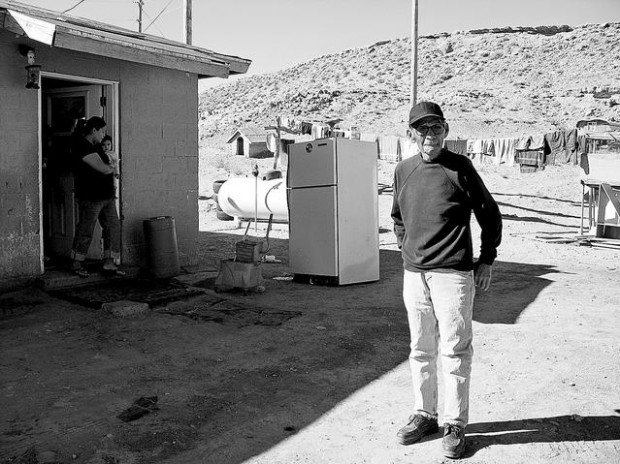
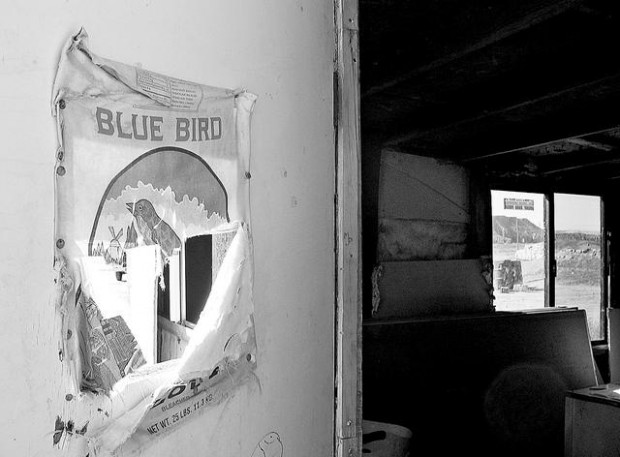
TUBA CITY — The pavement stops abruptly here, giving way to a sandy, washboard road that takes residents onto land where flour sacks in windows shield homes from the elements, electricity and running water are scarce, and tires keep roofs from blowing away.
A sign once posted here read: "Now you're entering Third World country. Bennett Freeze."
The poverty and the lack of infrastructure that are entrenched on the western side of the Navajo Reservation — the largest Indian reservation in the United States — were worsened by a 40-year freeze on building and improvements imposed by the federal government.
A year after the freeze was lifted, development is barely creeping forward.
No money has been allocated by the federal or tribal governments to rehabilitate 700,000 acres that constituted the Bennett Freeze area. The U.S. Bureau of Indian Affairs, has, however, provided $1 million for a one-year study of what sort of development should occur.
People are also reading…
"That area has been neglected for many, many years, and it is going to be a huge challenge to rehabilitate the area," said Tim Varner, a member of a task force established by Navajo President Joe Shirley Jr. to recommend planning.
"At this point, it's anybody's guess exactly what the extent of the need is out there," he said.
On the 27,000-square-mile Navajo Reservation, which extends from Arizona into parts of New Mexico and Utah, residents are deeply rooted in the land, which they use to raise livestock and crops. When the Hopi Tribe laid claim to Navajo land that it said was its aboriginal homeland, a decades-long dispute between the tribes ensued.
In 1966, Robert Bennett, then the U.S. commissioner of Indian affairs, banned new construction or improvements on the acreage unless approved by the Hopis. The ban included extension of water and electrical lines.
Hardly anyone thought the freeze would last very long. The tribes finally reached an agreement last year, and a federal judge signed an order in December 2006 lifting the freeze.
Few people have had new houses built since the freeze was lifted, and only a handful have received electricity through the Navajo Tribal Utility Authority.
Dorothy Reid is one of them. Her bright blue home was completed in April with the help of her family and a tribal housing program. For the first time in her 82 years, she has electricity and running water.
Instead of a wood stove, she now relies on a space heater to warm her home, and she can store food in a refrigerator.
Wesley Bilagody's eyes brighten as he talks about a home that's still under construction. Even at 85 and after a couple of heart surgeries, Bilagody, who is Reid's neighbor, easily walks up the flagstone steps to the partially completed home on a hill just behind his current home. So far, he has only peered through the windows.
"Looks like a big space in there," he said.
But after waiting most of his life for a new house, Bilagody said that celebrating won't be easy. "I'm too old," he said.
For residents who live within a one-mile radius of a religious site, construction still is banned.
It's "hopeless to hope," said Anne Jackson, one of the affected residents.
On the south side of Tuba City in Kerley Valley — named after an Anglo man who established the trading post there — Jackson opens the door to her one-room hogan. It's outfitted with light switches, light fixtures, water faucets and a bathroom, but none of those work.
Two plywood outhouses are at the back of her property — one for boys and one for girls. The foundation of a mud hogan she once lived in lies next to another ceremonial hogan that is patched up with old plywood and plastic.
When Jackson's sons come home, they sleep in a wooden shack that has a dirt floor. Inside, tree stumps are the foundation for the beds, and blankets hanging from the ceiling serve as insulation. This is the land where Jackson remembers herding sheep and gathering water from a nearby spring.
"No matter what, I want to stay here and let my grandsons live here, grow up generation to generation," she said. "But I would like to have a house built for them. That's my main concern."
In the early 1990s, after Jackson made numerous pleas to the tribal government to keep a ditch behind her house from flooding, heavy rains swept through her home, leaving puddles of water on the floor. Her nearly 2-year-old granddaughter was playing nearby and crawled into the water.
"She drowned right in back where we had the old hogan," Jackson said, pointing to the east. "I feel angry. I say a lot of words to them (officials). They come around, they just say . . . 'Can't do nothing about it because Bennett Freeze.' "
While the task force is discussing how various tribal agencies can help, Varner cautions that "it's probably a drop in the bucket in terms of what's actually needed out there."
"The expectations out there are very high," he said. "This whole Bennett Freeze issue has been dragging out for many, many years, and I think people thought as soon as the agreement was reached and the freeze was lifted, there'd be immediate action."
Varner doesn't expect any major projects to be planned for at least another year, and he said those likely won't be completed without the help of federal funds.
Frank Bilagody, the president of the Tuba City Chapter, said the chapter has plans for the needs of the area in place "in case the Navajo Nation government or the U.S. comes out and checks."
"There is still a lot of hopelessness out there, despair, that we're still being neglected, abused by the government," Bilagody said. "It's just not moving fast enough."
"That area has been neglected for many, many years, and it is going to be a huge challenge to rehabilitate the area. At this point, it's anybody's guess exactly what the extent of the need is out there."
Tim Varner
A member of a task force established by Navajo President Joe Shirley Jr. to recommend planning


