

EVERGLADES NATIONAL PARK, Fla. — "Snake!"
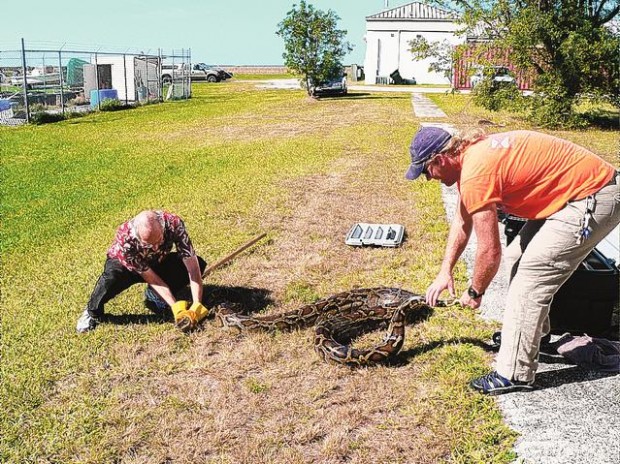
Hearing this shout, Skip Snow slammed on the brakes. When the off-roader plowed to a halt, he and his partner, Lori Oberhofer, leaped out and took off running toward two snakes, actually — a pair of 10-foot Burmese pythons lying on a levee, sunning themselves.
After slipping, sliding and tumbling down a rocky embankment, Snow, a wildlife biologist, grabbed one of the creatures by the tail. The python, Oberhofer says, did not care much for that.
"It made a sound like Darth Vader breathing," she says, "and then its head swung around and I saw this white mouth flying through the air."
Snow saw the mouth, too — the jaws open 180 degrees, the gums an obscene white, the needle-sharp teeth bared in an almost devilish grin. He let out a shriek, then blinked, and when his eyes opened the python's head was hanging in midair, less than a foot from his own.
People are also reading…
Oberhofer, with a Ninja-like thrust, had snared the python in midstrike.
"I snagged it right behind its head, on its neck," the 43-year-old wildlife technician recalls. "It was pure reflex — a defensive move. I don't know if I could ever do it again."
The python hadn't succumbed yet, however. "They defecate on you, on purpose, hoping to make you reconsider what you're doing," Oberhofer says. "It's not pleasant."
In the end, the humans were victorious, if not sweet-smelling: Both snakes were bagged, trucked off to the Everglades Research Center, euthanized and necropsied — meaning their innards were dissected, then meticulously inspected, for the benefit of science.
So goes python control in the Everglades, a painstaking, around-the-clock slog against a voracious, foreign snake species that has established a stronghold in this watery wilderness and put native wildlife at risk.
Critters that pythons find most delectable — raccoons, possums, muskrats and native cotton rats — are already under attack, as are birds such as the house wren, Pied-billed grebe, white ibis and limpkin.
Scientists also worry that these slithery giants — which have been known to grow as long as 26 feet — may feast on native species whose survival is in doubt.
"The Everglades doesn't work by itself anymore," says Leon Howell, 58, who has been associated with the park for the last 21 years as a visitor, naturalist, fishing guide and, presently, park ranger.
Which explains the evolution of Snow and Oberhofer into a human firewall against nonnative exotics. Without them, Howell figures, "there'd be pythons all over the place."
A decade ago, Snow and Oberhofer spent their days reintroducing rare, native birds to the pinelands and monitoring "indicator" species, such as wading birds, alligators, bald eagles, panthers. Then, in the late '90s, pythons began turning up.
Pet owners were releasing their giant, unwanted snakes in the park. But convincing the public that pythons are a danger to the Everglades is a tough sell.
Perhaps that is because of the region's primeval nature. Where else in North America can the visitor find crocodiles, manatees and rainbow-colored tree snails, roseate spoonbills and ghost orchids, towering royal palms and gumbo limbos?
Yet, as vast and threatening as these wetlands may appear, they have been so drained and abused by humans in the last century that a population of pythons, if left unchallenged, could take down this fragile web of life within a generation.
The Burmese python, one of the six biggest snakes, does not possess fangs and is not venomous. Rather, it is a lie-and-wait ambush hunter. Typically, it bites prey with six rows of needle-sharp, back-curving teeth, which dig deeper when its target tries to pull away. It then coils itself around its victim, squeezes the life out of it and swallows it whole.
In the wild, pythons often reach 20 feet in length, weigh more than 200 pounds and grow strong enough to overpower a grown man. Hinged jaws, in fact, enable the snake to open its mouth wide enough to swallow humans.
Since 2000, slightly more than 1 million pythons have been imported by the United States for commercial sale; nearly half are shipped to Miami, the U.S. Fish & Wildlife Service says.
Python hatchlings, which can cost as little as $20 at a flea market, tickle armchair herpetologists. "They're so darling when they're tiny," Oberhofer says. "Later, the big attraction at home is being able to watch your python kill something — like a rat — and gobble it whole in its tank."
Soon, however, the python gets bigger than the kids. (Pythons, fed mice, squirrels and rabbits, grow 6 to 8 feet, or more, within a year.) When this happens, owners try to sell or give away their pets but often cannot find them new homes. Unwilling to euthanize them, many release pythons into the wild, unaware of the ecological havoc they may bring.
Most of the pythons are euthanized because of the threat they pose to native species such as the mangrove fox squirrel, the wood stork and the endangered Key Largo wood rat.


