

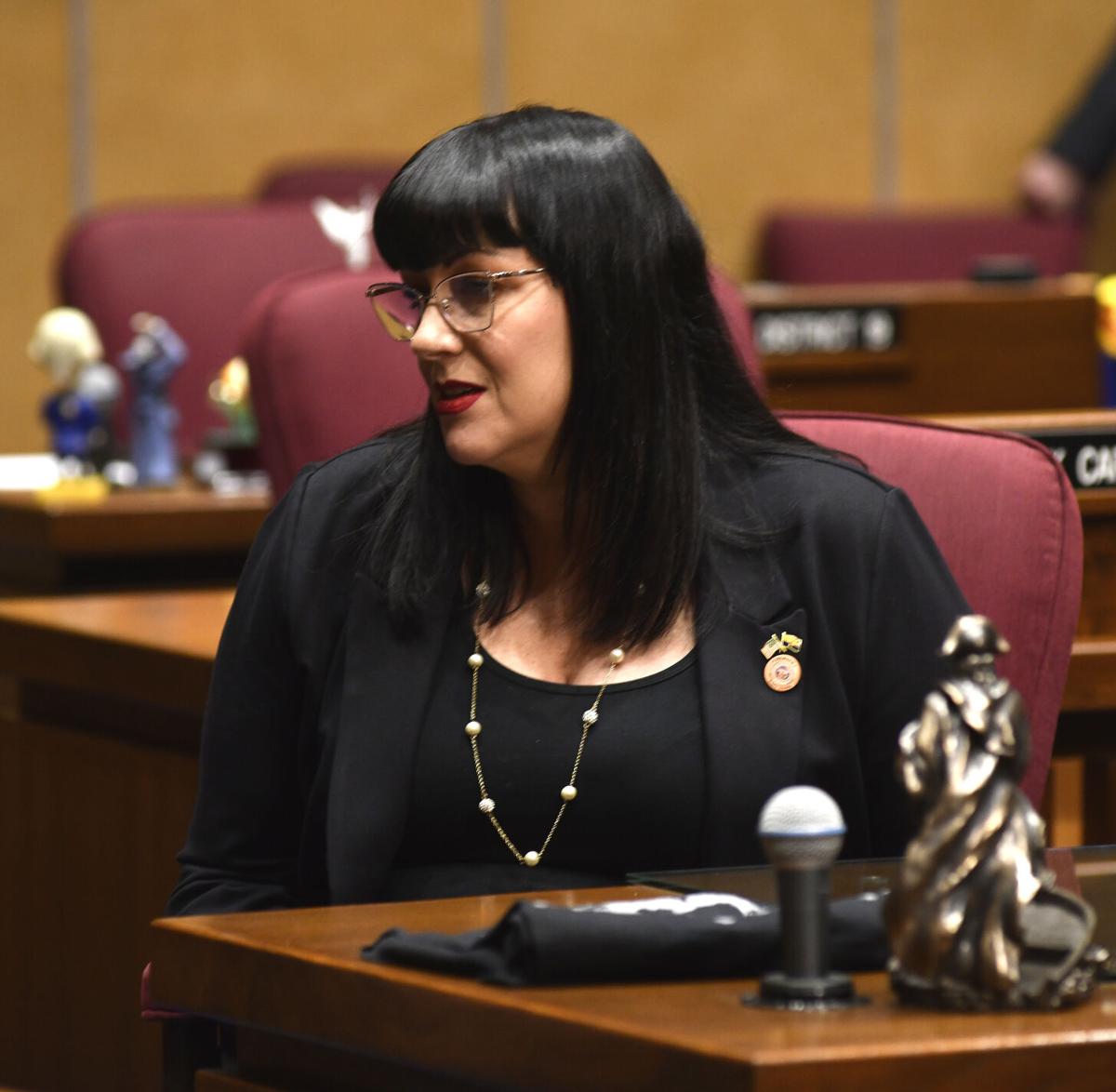
PHOENIX — State senators agreed to have the Arizona Department of Education come up with a list of books that cannot be used in public schools.
Monday’s 16-12 party-line vote came after Sen. Justine Wadsack, R-Tucson, the sponsor of SB 1700, said school libraries in Arizona have copies of “Beyond Magenta,” a book about transgender and nonbinary teens.
Wadsack said what concerns her, is a “very explicit imagery of 6-year-old children giving oral sex.”
Multiple reviews of the book do mention a description of a boy describing his own experiences at that age, with no references to actual images.
Wadsack acknowledged she has not actually seen the book.
People are also reading…
“But I have seen others,” she told Capitol Media Services.
And Wadsack provided fairly explicit drawings of nudity and sex organs she said parents have forwarded to her as found in books in general circulation at schools.
Monday’s vote came over the objections of several Democrats.
Sen. Christine Marsh, D-Phoenix, a former teacher, said existing law already gives parents access to the titles of books that are being used in classes and in libraries.
And she said some may be inappropriate for some children.
“However, there’s no room for banning books in the classroom simply because it upsets one group of people at the expense of so many others,” Marsh said.
She said SB 1700 is set up so that any parent can ask the Department of Education to place a book on the “banned” list if he or she finds the books to be “lewd or sexual in nature, to promote gender fluidity or gender pronouns or to groom children into normalizing pedophilia.”
State senators voted Monday to have the Arizona Department of Education come up with a list of books that cannot be used in public schools. The bill, introduced by Sen. Justine Wadsack, will now move to the House. Video courtesy of Arizona Capitol Television.
There do not appear to be specific rules for that agency to determine what crosses the line. Instead, the legislation says the department will review each submission along with the parent’s basis for concluding it fits into one of those categories.
“And if the department agrees with the parent’s findings, the department shall add the book to the the list,” it says.
And it’s not just books.
That list also can include anything made available to students in electronic or print format.
Creating such a list is just asking for trouble, Marsh said.
“Those will be the books the kids want to read,” she said.
Sen. Anna Hernandez, D-Phoenix, said her concern extends to what the legislation decides is unacceptable. She cited the verbiage making off limits anything “to promote gender fluidity or gender pronouns.”
“Gender fluidity is not a thing promoted,” Hernandez said.
“There are no brochures trying to sell it,” she continued. “Gender fluidity is a naturally occurring phenomenon some people experience.”
In essence, Hernandez said, gender fluidity is simply “part of the human condition.”
“You might as well include books that promote left-handedness or curly hair,” she said.
“They don’t come as consequences of promotion,” Hernandez said. “Gender fluidity will happen whether there are books mentioning it or not.”
And she said that just because some lawmakers don’t understand it or have experienced it does not mean it should be legislated.
Wadsack criticized the Democratic foes of her bill.
“I find it very disturbing that my counterparts on the other side of the aisle continue to make excuses after excuses, as does the public, for these books that are found in our children’s schools,” she said.
“They all want to defend the books, they all want to talk about the books,” Wadsack said. “But they’re not defending the rights of the child to have an innocent childhood.”
What her bill does, Wadsack said, is provide parents with not just access to books but a “pathway to complain about these books that they find to be illicit.”
“This will allow them to finally protect children from being sexualized by our public schools,” she said.
And Wadsack said there’s no gray area here.
“You open the book and you look at the pictures and you can see very clearly when you have 6-year-old children giving oral sex, that the book is explicit,” she said, a picture that, again, Wadsack acknowledged she has never seen.
Monday’s vote sends the measure to the House.
Get your morning recap of today's local news and read the full stories here: tucne.ws/morning


 Koch brothers group sues to overturn law passed by Arizona voters


