

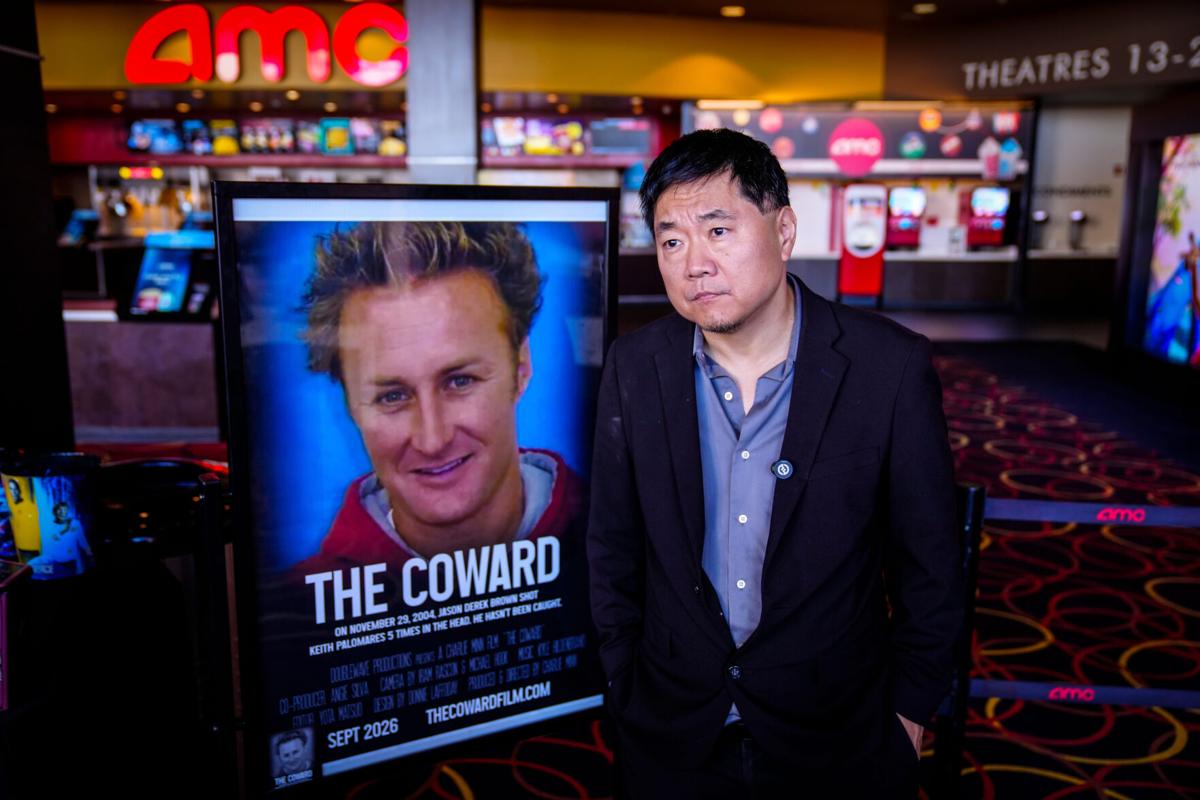
The man accused of ambushing an armored car driver in Ahwatukee Foothills and shooting him dead in 2004 — making off with $56,000 in a bag of cash on a bicycle — has had several labels over the years: suspect, fugitive, one of America’s most wanted criminals.
Film director Charlie Minn has given Jason Derek Brown a new moniker, making it the title of his documentary film about the case: “The Coward.”
“It’s what he is,” Minn said in an interview with The Arizona Republic. “This is as gutless as a move as you’ll ever find.”
The unsolved case quickly captured the attention of the city and the nation. It was re-enacted on the Fox network show, “America’s Most Wanted,” a few months after it happened. It was the subject of a six-part episode of “Dateline NBC” in 2013.
Still, despite all that attention — and the resulting tips to authorities — the wanted man was never located.
People are also reading…
“The Coward” delves deep into the investigation. Minn spoke with the brother of the victim, a rare interview the brother says will be his last. Minn also spoke with the case agents who say they solved the crime but could never nab their man.
The film gives never-before-known details about the manhunt, including how tantalizingly close police came to capturing Brown.
On Sept. 24, the film began a one-week run at the AMC Ahwatukee 24, the scene of the 2004 crime.
Minn hopes “The Coward” revives interest in the case and generates new leads that could lead to Brown’s capture.
“It’s about finding this scumbag and getting him off the street,” Minn said.
What happened in shooting of armored car driver at movie theater?
Police say the crime happened like this: Brown lay in wait by the ticket booth at the multiplex theater. When the armored car courier, Robert Keith Palomares, headed back to the truck with a bag full of cash, police say Brown shot him five times in the head.
The gunman grabbed the bag and then pedaled away on a bicycle as stunned witnesses watched.
He abandoned the bike in some bushes nearby and got away in a BMW he had parked in the area.
Then, he vanished.
One week after the slaying, authorities identified Brown as a suspect and released a photo of him. In the image, he is smirking at the camera, his blonde-tinted hair gelled into small spikes.
That photo launched a flurry of tips to the FBI. Minn said FBI officials told him they received more calls about Brown than any other fugitive.
“This guy was like the FBI’s most wanted surfer,” Minn said, “not a criminal.”
The “surfer dude” look, Minn said, does not match the brutality of the crime. “He’s a destroyer. He’s a murderer,” Minn said.
Palomares had worked for the Dunbar armored car company for six months before the shooting, his wife told The Republic in 2004.
The two met when they both worked at Target. She remembered his funny impressions of actors, including Al Pacino, and the tattoo of a Care Bear on his arm.
He had hoped to become both a police officer and a father, she said.
Former FBI agent: 'That one sticks with me'
The case weighs on Lance Leising, who was the FBI agent on the case. Leising, who has since retired, spoke to Minn for the documentary.
“That one sticks with me,” Leising told The Republic in a phone interview.
The case was solved, Leising said. Agents believe they know who committed the crime. But it remains unresolved because there was no arrest.
“As high profile as it was,” Leising said, “you would expect that we would have him in custody.”
Brown grew up in Orange County. He was linked to homes in the California beach communities of Dana Point, Corona del Mar and Newport Beach. He had two businesses, one a toy company, located in Salt Lake City.
But Leising said Brown mainly made his living as a fraudster who mooched off people. He also pulled off credit card scams.
“He thought he was the life of the party,” Leising said. “He was this $30,000 millionaire … sleeping on friends’ couches.”
Leising said Brown was in deep financial trouble by November 2004.
Brown bought a handgun in Utah weeks before the shooting and enrolled in a class that would teach him how to use it.
The instructor, Clark Aposhian, told The Republic in 2004 that Brown handled the Glock .45-caliber semi-automatic handgun like a first-time shooter.
As part of his background check to buy the handgun, the store took a photo. It was the image later released by authorities, showing a smirking Brown.
Aposhian, who had been a Utah state trooper, said Brown arrived to class in a BMW, with a Billabong-brand sweatshirt and spiky hair. Aposhian said Brown seemed “like a trust-fund kid.”
He described him as “a very irritating young California surfer dude. He didn’t have very many social subtleties. … He seemed to already know everything.”
Brown told Aposhian that he needed to enroll in his class as soon as possible because he traveled frequently.
Weeks later, Brown checked into an extended-stay hotel in Ahwatukee. His only tie to Phoenix, Leising said, was a friend whose house he had stayed at previously.
The hotel was across the street from the movie theater.
Minn said Brown cased the area for four days, planning the robbery.
Brown also went to the Tonto National Forest for a session of target shooting the day before his planned robbery. That was a detail Minn said was not reported on at the time.
One of Brown’s bullets struck a truck parked in the area, Minn said.
The driver of the truck went to where he thought the shot came from and found Brown, who, Minn said, was apologetic. The two made arrangements for Brown to pay for the damage, Minn said.
That driver, Minn said, was later stunned to discover what that target shooter was accused of doing. “The guy he confronted literally committed a murder the day after," Minn said.
Leising said Brown must have figured that robbing the armored car courier on the Monday after Thanksgiving weekend would merit a big haul of cash. The amount ended up being $56,000, Leising said.
Suspect in killing leads authorities on cat-and-mouse chase
Authorities were later able to piece together Brown’s movements after the shooting using pings from cell phone towers.
He drove around the city for a while, Leising said, stopping at Phoenix Sky Harbor International Airport, a gym and driving through parking garages. Brown also returned to the hotel.
Minn said he thought Brown was “testing it out. ‘Are they looking for me? Did I get away with this?’”
Brown then drove his BMW to San Diego, near the Mexico border.
Leising said he thought Brown might have thought about crossing into Mexico before realizing he would “stick out like a sore thumb.”
Instead, Brown went to a relative’s house in California.
Authorities were able to retrieve a partial fingerprint off the bicycle Brown ditched. That’s how they identified him as a suspect, Leising said.
That detail — that it was a fingerprint — was not previously reported. Authorities had said they were able to get a piece of identifying evidence from the bike but didn’t say what it was.
The FBI had a name, Leising said, and the FBI was preparing to check the homes of Brown’s relatives.
But, he said, Phoenix police held a news conference releasing Brown’s name and photo. Reporters, Leising said, were calling relatives in California. And one of those family members called Brown’s sister, with whom he was staying.
Brown destroyed his cell phone and pulled the GPS unit out of his BMW hours before the FBI arrived at the home, Leising said.
Minn said he was unable to get Brown’s sister to cooperate with his film. He wonders what she knew, if anything, about what her brother did.
Brown also was in frequent contact with his brother, David Brown.
Derek Brown drove his BMW to Las Vegas and switched it out for a Cadillac Escalade, authorities said. He parked the BMW in a storage locker and mailed his brother the key to it, court documents say.
David Brown cleaned out the car, affixed dealer plates to it, and then stored it somewhere else, court records show. However, David Brown initially told authorities he didn’t know anything about the BMW or a storage locker.
He later pled guilty to giving the FBI a false statement about the storage locker. David Brown did not return a request from The Republic for comment. Nor did he speak with Minn.
Authorities later found the Escalade in the parking lot of Portland International Airport in Oregon. Its windows were smashed.
Leising said Brown likely wanted authorities to think he took a flight out of the airport. But they could find no record of Brown, who used several aliases, boarding a flight.
'Is he hiding in plain sight?'
The case was featured on “America’s Most Wanted” and, for years, Brown was listed on the FBI’s Top 10 most wanted list.
Tens of thousands of tips poured in, Leising said. But none was a confirmed sighting.
Because Brown’s photo had a passing resemblance to the character that Sean Penn played in the movie “Fast Times at Ridgemont High,” agents ended up questioning some people who had acted as body doubles for Penn on movie sets, Leising said.
Brown was removed from the FBI’s Most Wanted list in 2022. The FBI did not say why.
That same year, a fictionalized film of the Brown story was released. It was called “American Murderer” and starred Ryan Phillippe as FBI Agent Leising.
Minn said he learned about this case after promoting another film while in Phoenix. After an interview with then-FOX 10 anchor John Hook, the two talked about unsolved crimes in Arizona.
Hook told Minn about the case of Robert Fisher, a Scottsdale father who authorities said killed his wife and children and set his house on fire. He has not been caught. In 2011, Minn released a documentary on the case, “Where Is Robert Fisher?”
Hook also told Minn about the Brown case.
Minn has created documentaries about drug cartels and mass shootings. This story, he said, was unique because there was only one victim. But Brown remains a compelling character.
Minn said interviews he’s done in advance of the film’s premiere have resulted in tips to his website, thecowardfilm.com. He said he’s collecting information in case someone might feel more at ease talking to a filmmaker rather than law enforcement.
Minn said he has no idea where Brown could be.
“Is he hiding in plain sight?” Minn said. Brown spoke French, fueling the thought he might have fled into Canada. He did a mission for The Church of Jesus Christ of Latter-day Saints in Paris, Minn said, and had connections in Mexico.
Minn said Brown was known as a fast-talking charmer. He may be living off the good graces of someone, he said.
“He’s convinced somebody he’s not this cold-blooded killer,” Minn said. “Somehow he’s kept this enormous secret in his back pocket.”
Leising said it’s possible Brown took his own life, wracked by guilt over taking someone’s life and disappointed that his haul of cash was not enough to solve his financial problems.
Leising said authorities can’t settle on that conclusion, still aiming to find him.
“A film like this keeps his name out there,” Leising said. “If he’s out there, I do believe we’ll find him.”


