PHOENIX — Gov. Katie Hobbs will ask legislators for $7 million to speed up the repatriation of Native American human remains and artifacts.
In an address to tribal leaders Wednesday, Hobbs said the Arizona State Museum’s collection has continued to grow and repatriation is hampered because of “no significant financial investment from the state.’’
“It is time for that to change,’’ she said. “It is time for the state to take repatriation seriously.’’
Stephen Roe Lewis, governor of the Gila River Indian Community, said he is glad Hobbs is asking the Legislature to help finance the effort.
But the problem is not strictly financial, Lewis told Capitol Media Services.
“From what I’m hearing from certain tribal repatriation specialists a lot of these institutions are not wanting to, or are dragging their feet to be in accordance with the federal law,’’ he said. “This shines a light on it.”
People are also reading…
Lewis emphasized that the money should help. Hobbs’ focus will “make sure that this pushes these institutions along, that they’re under the microscope, at least in the state of Arizona,” he said.
Hobbs’ request drew support from Jim Watson, acting director of the Arizona State Museum at the University of Arizona. He said the museum has about 4,000 human remains that have yet to be repatriated and “maybe 800,000 objects.’’
“We’re an old, large museum and there’s a lot of material here,’’ Watson said, with some of the items going back to the 1920s.
He said money will help.
The building is 100 years old with limited space, and that has hindered staffers’ ability to do the necessary research, Watson said.
He said the federal Native American Graves Protection and Repatriation Act requires institutions that receive federal money to facilitate the return of human remains and eligible other items. But to do that, Watson said, remains and artifacts must be brought out of storage, put together in “appropriate housing,’’ and either brought to the affected tribes or provided to tribal officials who come to the museum to take the remains.
He said a request for funding was made directly to the Arizona Board of Regents last year to at least pay for some of the maintenance that has not been done over the years.
“They tabled it,’’ Watson said, with board members saying this is something that should be funded by the Legislature. And, so far, there has been no money forthcoming from the Capitol even though the facility was closed in August for anticipated maintenance.

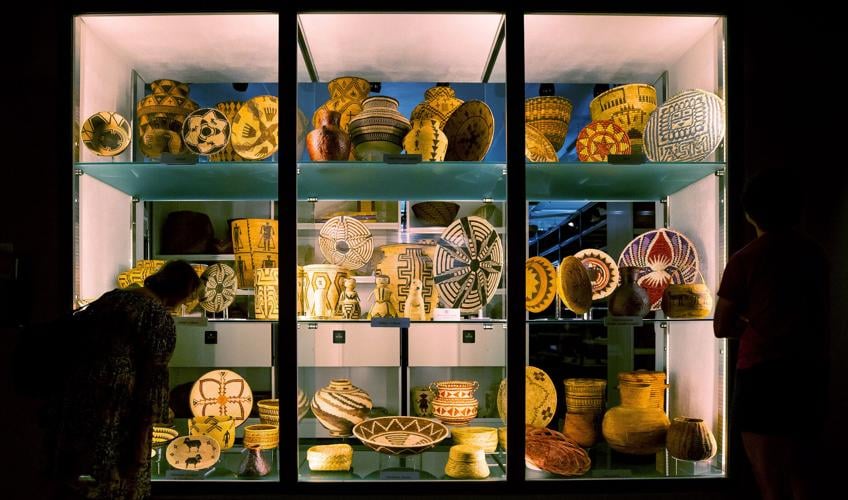
Visitors look at a variety of Native American baskets inside Arizona State Museum’s “Woven Through Time: American Treasures of Native Basketry and Fiber Art” exhibit.
“We’ve sort of been in limbo,’’ he said. Watson said Hobbs’ announcement Wednesday she will seek more money came as a welcome surprise.
But even if the museum had more up-to-date space, he said that, by itself, won’t solve the problem.
“It takes awhile to pore through the archives and the objects and, in some cases, human remains to be able to identify all of repatriation-eligible items and individuals that we have,’’ Watson said. That, too, he said, is a function of not having enough money to hire more staff.
Museum at UA has returned 50%
Still, Watson said the work has continued.
“We have been actively repatriating,’’ he said, saying the museum already gave about 50% of its collection back to tribes. He said that began even before the federal law was passed in 1990.
That leaves the question posed by Lewis of whether there has been some “dragging of feet’’ by institutions that have built up collections of Native American artifacts.
“I would say that that thinking was probably when NAGPRA (the federal law) was first passed ... and people did intentionally drag their feet,’’ Watson said. “Within the past couple of years, I would argue there are a very few institutions that still have that approach.’’
He said new federal regulations were approved a year ago “that were specifically designed to force institutions to stop dragging their feet and remove some of the excuses they had often used to prevent repatriation from occurring.’’

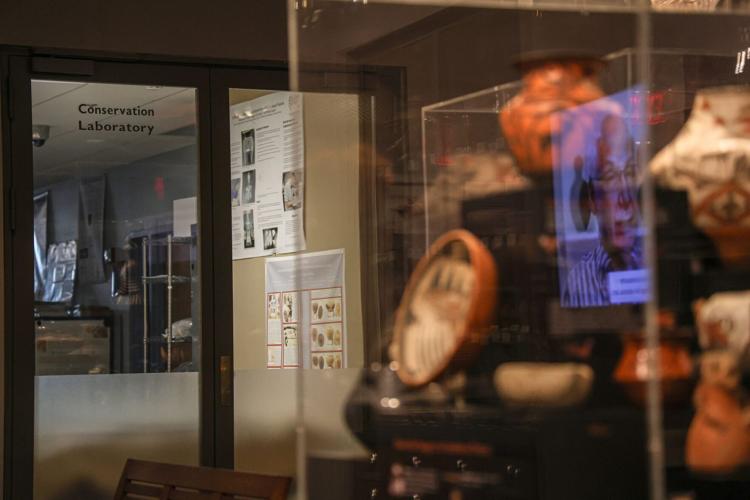
This 2024 photo shows displays in the Pottery Room of the Arizona State Museum. The museum at the University of Arizona has faced public criticism for what are seen as slow repatriation efforts.
Some excuses offered, he said, included issues of time, money and “the intricacies of doing the research.’’
There is also the question of “culturally unaffiliated remains.’’ He said some museums argued that if they cannot identify to which tribe remains are related, they should keep them.
Watson said the way the Arizona State Museum is working to deal with that issue is through an advisory board made up of representatives of all recognized tribes in Arizona. They have found ways to reduce the number of these items by half, he said.
What’s left, Watson said, are those remains for which there is no context to suggest which tribe they belong to other than “we think they came from Arizona.’’ He suspects the advisory board will come up with a plan to have tribal representatives or a single tribe facilitate a single reburial “because we don’t have a good sense of where they’re coming from.’’
ASU disputes findings
It isn’t just the Arizona State Museum that deals with tribal remains and antiquities.
So does Arizona State University. An investigation last year by Cronkite News and the Howard Center for Investigative Journalism at ASU found that ASU had returned fewer than 2% of the remains it had to tribes.
Jay Thorne, an associate vice president at ASU, said the school takes issue with the report and disputes the 2% figure, though he did not immediately have a different figure. He said all of this needs to be examined in context.
“It’s a complicated process,’’ he said, of categorizing and repatriating returns. The school works closely with tribes, Thorne said.
The progress should not be measured strictly by the time involved, he said. “Everybody wants it done. But doing it fast isn’t necessarily the appropriate way of doing it.’’
Other Hobbs goals for tribal needs
Hobbs’ request for the funds came as she gave lawmakers a revised version of the State of the State speech she gave Monday.
Aside from unveiling her $7 million ask, she added other comments specifically designed for the ears of the tribal leaders:
— Directing the Department of Public Safety to set up a version of the “Amber alert’’ program — designed to provide public notice of missing or kidnapped children — specifically for missing tribal members. She said more than 188,000 individuals went missing in 2023, including tribal members, who did not meet the criteria for the existing program.
— Asking lawmakers to expand the services provided by the state’s Medicaid program to include “traditional healing services so that Indigenous people in this state can receive the health care they want.’’
— Directing $4 million to four tribal colleges for scholarship and workforce programs.
Howard Fischer is a veteran journalist who has been reporting since 1970 and covering state politics and the Legislature since 1982. Follow him on X, formerly known as Twitter, Bluesky and Threads at @azcapmedia or email azcapmedia@gmail.com.