

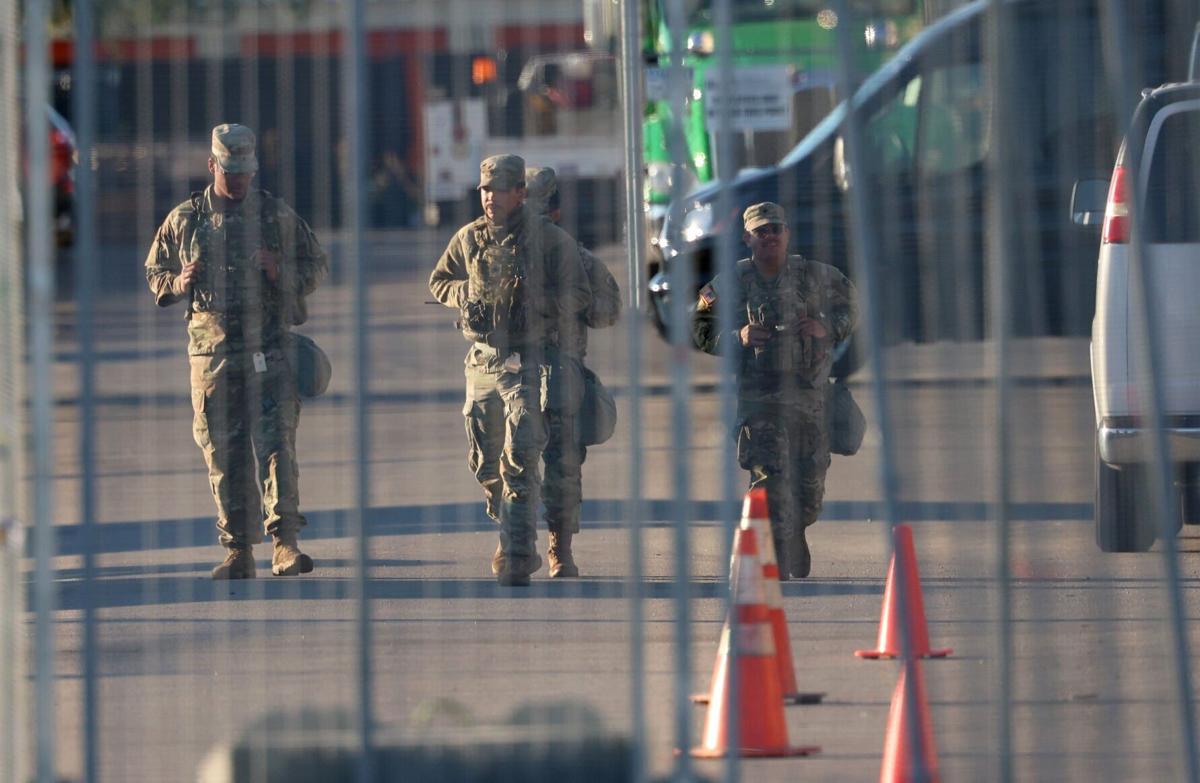
CHICAGO — National Guard troops were “employed” in the Chicago area early Thursday, according to a U.S. official, and Broadview officials said that apparently included a deployment to their village.
The Texas National Guard, which arrived in the area earlier this week, has been expected in Broadview and other locations but were not in plain view. Those troops were federalized by the administration following a series of intense confrontations between protesters and federal immigration enforcement officers taking part in “Operation Midway Blitz,” the mass deportation mission being carried out in Chicago and the suburbs.
A spokesman for U.S. Northern Command, overseeing the National Guard deployments, would not say Thursday morning whether the troops have actually been deployed to the streets in view of the general public, saying instead in a statement that as of Wednesday, “elements of the Texas National Guard, under Title 10 authority and the command and control of U.S. Northern Command, are employed in the greater Chicago area.”
People are also reading…
“These soldiers are employed to protect U.S. Immigration and Customs Enforcement and other U.S. Government personnel who are performing federal functions, including the enforcement of federal law, and to protect federal property,” the statement read.
Broadview Police Chief Thomas Mills told the Tribune that he was notified overnight that his officers spotted personnel at the ICE facility in the suburb that has been a magnet for protests who said they were with the National Guard awaiting further instruction.
The village issued a statement Thursday.
“Three vans with approximately 45 Texas National Guard soldiers arrived at the Ice Facility in the Village of Broadview late last night,” the statement read. “During their patrols, Broadview police officers observed the vans parked in the rear of 2000 25th Ave and all of the guards were sleeping. We let them sleep undisturbed. We hope that they will extend the same courtesy in the coming days to Broadview residents who deserve a good night’s sleep, too.”
In a letter sent to Broadview residents Wednesday night, Village Mayor Katrina Thompson offered no new specifics on the already heavily-publicized plans but condemned the move as “messed up” and said it was “rooted in the historic intimidation of African-American communities by government officials waving guns in our faces.”
Thompson on Monday signed an executive order limiting protest hours outside the processing center, nodding to the disruption the demonstrations and agents’ heavy deployment of chemical crowd controls have caused for Broadview residents.
“I understand that the provocation of the Texas National Guard in Broadview will inspire people to speak out against their presence,” she wrote. “I support that.”
She closed the letter with a plea to protesters to voice their opposition “with understanding and respect for the people who call this village home.”
The Guard’s presence in Broadview comes on the same day a federal judge in Chicago will hear arguments from a legal challenge by the Illinois attorney general’s office, which argues Trump’s deployment of the troops over the objections of Gov. JB Pritzker is unconstitutional. In addition to deploying some 200 Texas National Guard members to the Chicago area, U.S. Defense Secretary Pete Hegseth has ordered 300 Illinois National Guard to be federalized as part of the deployment.
In court documents filed Monday, Illinois officials argued “the American people, regardless of where they reside, should not live under the threat of occupation by the United States military, particularly not simply because their city or state leadership has fallen out of a president’s favor.”
On Wednesday, the lawyers for the Trump administration countered in court papers that escalating violence against immigration officials during the deportation operation justifies the deployment of National Guard troops.
A White House spokeswoman has said Trump has used “his lawful authority to protect federal officers and assets.” Pritzker maintains that there is no emergency in Chicago or elsewhere in Illinois that would warrant deployment of the National Guard and that Trump’s move to do so over his objections is unconstitutional.
With the state awaiting a ruling from a federal judge, possibly as soon as Thursday, on its request for a temporary order blocking Trump’s deployment of Texas and Illinois National Guard members in the Chicago area, Pritzker has said the Trump administration “has not communicated with our state in any way whatsoever about what their troop movements are going to be.”
“I can’t believe I have to say ‘troop movements’ in a city in the United States, but that is what we’re talking about,” he said.


