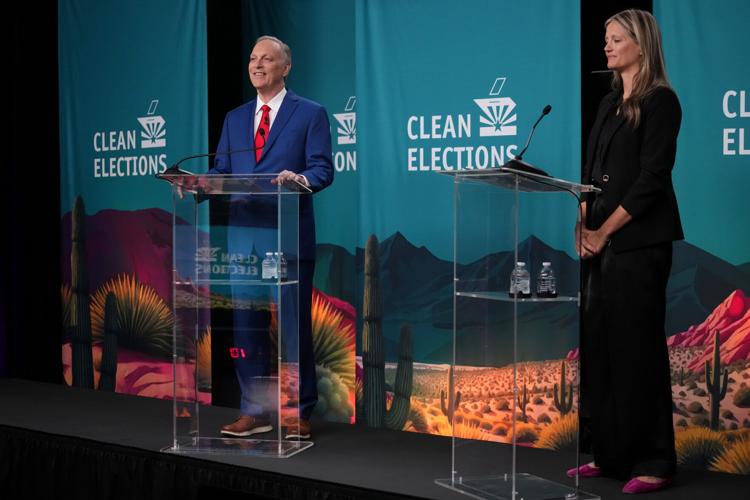
SCOTTSDALE — Two candidates for governor sparred for an hour over regulation of data centers, new restrictions on Medicaid and whether Arizona is running out of water.
Teri Ann Hourihan, the No Labels Party candidate, also put Republican Andy Biggs on the defensive over his role years ago as state Senate president in killing legislation proponents said would have helped halt child abuse in the polygamous community of Colorado City, as well as his initial refusal, as a current member of Congress, to support public release of the FBI files on convicted sex offender Jeffrey Epstein.
The pair did, however, find common ground on what proved to be the elephant not in the room: incumbent Democratic Gov. Katie Hobbs, who refused to join them on stage and publicly defend her own record.
People are also reading…
Hobbs skipped the debate Tuesday night. She said her multiple appearances have given the public a chance to know her positions and record even though most of these events have been campaign gatherings populated largely by her supporters.
"Katie Hobbs ... refuses to actually come out of her basement and debate with us,'' said Biggs. "That is disqualifying.''
He contrasted that with the fact that he and Hourihan did agree to participate in the debate, which was livestreamed, televised by some stations and aired live on radio.
"We get hard questions that we have to respond to,'' Biggs said. "We may have to defend our record. We may have to tell what our vision is. That's what we should be doing."
Hourihan said she blames many of the state's problems on elected officials, "including who I share the stage with here tonight, and the one who is hiding in her basement.''

Arizona gubernatorial hopefuls Republican Andy Biggs and No Labels Party candidate Teri Hourihan debating Tuesday night.
Data centers
One example of what she called Hobbs' failure to act involves data centers.
Hourihan said what's needed is a pause — perhaps of just six months — on new construction of data centers while the state considers what regulations are necessary, including on the use of energy and water. She also wants a study of potential effects on human health of these centers, which can emit noise and heat.
Instead, Hourihan said, Hobbs signed a state budget placing a three-year moratorium only on new tax breaks for data centers but allowing construction to continue.
That wasn't really effective, she said, as the Arizona Commerce Authority got 113 new applications for data center tax breaks just before the moratorium on them took effect.
"So what she did was actually hurt us,'' Hourihan said.
Biggs, for his part, questioned new limits.
"Everybody that's watching us is using a data processing center,'' he said. "Everybody who's got a cell phone in here has an app that's using one of those. That's not going away anytime soon.''
Biggs said it is time to get rid of tax breaks entirely, not just pause them.
That, however, was exactly what the governor sought when she proposed her budget in January. It was the Republican-controlled Legislature that refused to go along.
Biggs did say the state should not let new data centers use power or water that "encroaches'' on current and future needs by residential users and other commercial businesses. Then, at that point, the decision should be left to local communities, he said.
Biggs said that's what happened in the Vail area of southeast Tucson where plans for a data center were rejected. By contrast, he said, the Marana Town Council approved rezoning about 600 acres of agricultural land for a data center project.
Medicaid
The GOP candidate also was questioned about actions he took — twice — involving the scope of Medicaid.
As Arizona Senate president, he opposed a 2013 plan by then-Gov. Jan Brewer, also a Republican, to expand eligibility for the program to provide health coverage. At the time, only those making below the federal poverty level qualified, a figure that equaled about $23,500 for a family of four. The plan sought to boost that to 133% of the poverty level.

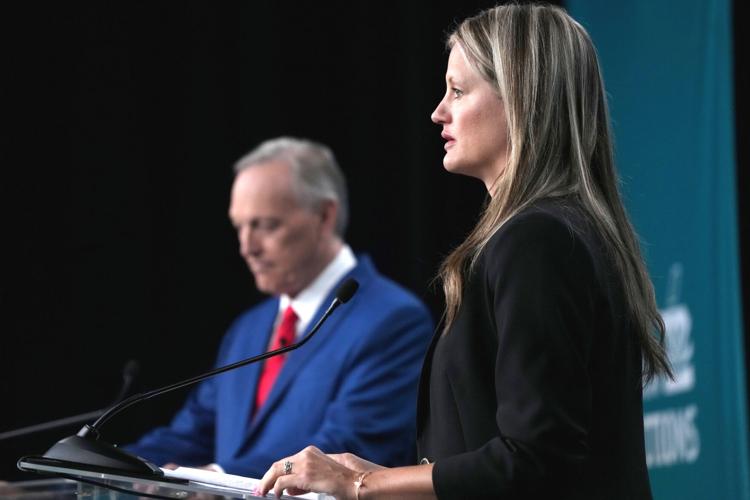
Republican Andy Biggs and No Labels Party candidate Teri Ann Hourihan at Tuesday night's debate.
Brewer had found a way to have the additional costs picked up by hospitals after they concluded that more people with health insurance would mean fewer people showing up at their doors without money for their care. Biggs opposed the move but was outmaneuvered by Brewer, who cobbled together enough Democrats and Republicans to approve the plan.
"I support giving help to those who are truly in need,'' Biggs said Tuesday. But he said the biggest source of fraud in the Medicaid program are those who are able to work but choose not to.
More recently, Biggs supported last year's federal legislation that will impose new restrictions on Medicaid eligibility.
Hourihan called Biggs "one of the most dangerous people when it comes to Medicaid.''
She also said Medicaid is not like some programs which are designed to provide only temporary help. Instead, it is based strictly on income, which means there are working people who, because of the wages they are paid by their employers, actually qualify for state-provided health care.
On a larger perspective, Hourihan said the state needs to revamp eligibility for other programs, such as subsidized child care.
She said there are people who want to work. But they find that once they get a job, the income pushes them just past the point where they would qualify, putting them in a position where they can no longer afford the care.
Hourihan said a better alternative would be a program where caregivers can continue to receive some assistance for a certain period after they get employment.
For Biggs, the answer to getting people to work is his plan to phase out entirely the state income tax, which currently generates about $6 billion of the $18 billion Arizona takes in each year. He insisted that the change, if done gradually, will not result in lost revenues or force cuts in state services.
"You jump start the economy,'' Biggs said. "People want to work. They can get jobs because the economy is moving faster. The result is more tax revenue.''
Water supplies
Biggs acknowledged that the state took a big hit when the U.S. Bureau of Reclamation, facing declining flows in the Colorado River, slashed river water supplies to Arizona, California and Nevada. He said he worked in Congress with Democratic U.S. Rep. Greg Stanton of Arizona to mitigate the damage, getting cash for drought relief.
"But what people forget, and when they start panicking, they forget that Arizona has massive and copious amounts of underground water supply storage,'' Biggs said, putting the figure at 660 million acre-feet.
"If you were to treat that water and distribute that water, it would support a population of between 12 and 15 million people for 250 years if you didn't add any other drop,'' he said. The key is how it's managed, he said.
Hourihan sniffed at his predictions. "Andy Biggs is not an expert on this,'' she said.
What's needed, Hourihan said, is a change in how Arizona uses water. "We need to ensure that conservation methods are more strict in Arizona,'' she said.
Hourihan also wants to expand the number of "active management areas'' there are in the state, areas where businesses and residents are limited in how much water they can pump from the ground.
Law and order
But the debate over policy issues got sidetracked after Biggs promised he would protect the state's international border.
"You're the person, I would tell you, that I would least trust to protect our borders,'' Hourihan said.
She pointed to a vote by the Arizona House in 2013 that was designed to let the state disband the marshal's office in Colorado City. That followed allegations that officers were taking their orders from Warren Jeffs, leader of the polygamous Fundamentalist Church of Latter-day Saints, and ignoring reports of underage girls being married off to adult men.
Biggs, state Senate president at the time, used his power to assign the House-passed bill to two separate committees, a tactic often used to throw hurdles in the path of unfavored legislation. And the measure died.
"It essentially allowed, likely, hundreds of children to be married to adult men,'' Hourihan said, until a federal grand jury took action.
Biggs said Tuesday he had supported a narrower bill in 2012, pushed by Republican then-Attorney General Tom Horne, which would have specifically allowed Mohave County to establish the Colorado City police department. But that bill died in the House.
As to the 2013 plan, Biggs said he heard from other police departments that the bill was too broad and could affect them.
But Hourihan said the death of that bill had consequences for the women and girls of Colorado City.
Biggs called that "an outrageous lie.'' He questioned whether passing the 2013 bill would have done anything to curb the powers of Jeffs, who, beginning in 2006, was already serving time in prison. Hourihan noted, however, there is evidence Jeffs used his phone privileges and letters to continue to exercise control over the sect and events in Colorado City.
She also faulted Biggs for initially voting in Congress against a measure to require the Department of Justice to release its files on Jeffrey Epstein, though Biggs said he eventually did come around and supported the final measure.
Hobbs was not the only no-show. Green Party nominee Risa Lombardo had agreed to attend but canceled at the last minute.
Howard Fischer is a veteran journalist who has been reporting since 1970 and covering state politics and the Legislature since 1982. Follow him on X, Bluesky and Threads at @azcapmedia or email azcapmedia@gmail.com.