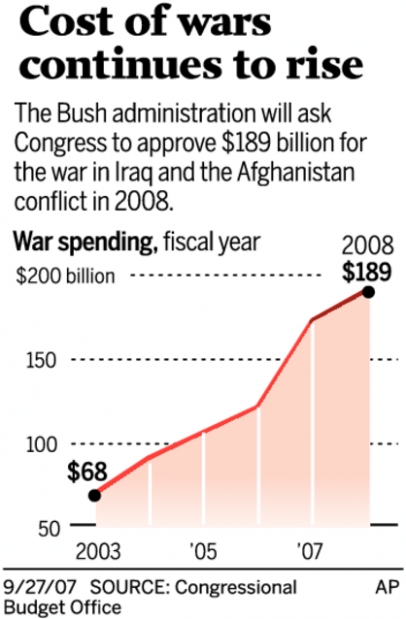
WASHINGTON — The Bush administration asked Congress on Wednesday for $42 billion more next year for the wars in Iraq and Afghanistan, an increase that would raise spending on the wars to $189 billion in 2008.
War spending would be higher in 2008 than any year since the Iraq war began in March 2003.
Sen. Robert Byrd, chairman of the Appropriations Committee, vowed Wednesday not to "rubber-stamp" the request and said it was time to get Bush's policies in check.
The tough rhetoric was reminiscent of last spring, when Congress passed and Bush vetoed a bill funding the war through September but ordering troop withdrawals to begin by Oct. 1. Democrats still lack the two-thirds majority needed to override a veto.
If the funding is approved, Congress will have appropriated more than $760 billion for the two wars, having already approved of $450 billion for Iraq and $127 billion for Afghanistan.
People are also reading…
Testifying before Byrd's panel, Defense Secretary Robert Gates acknowledged that America's "difficult choices" on the war "will continue to be a source of friction within the Congress, between the Congress and the president and in the wider public debate."
But Gates said he hoped Congress would approve money that is needed by the troops.
"Under some of the most trying conditions, they have done far more than what was asked of them, and far more than what was expected," he said.
The Pentagon had already requested $147 billion for the wars; Gates went to Capitol Hill to ask for an additional $42 billion. The money would pay for the wars in Iraq and Afghani-stan in the 2008 budget year, which begins Monday.
Gates said the extra $42 billion is necessary to buy vehicles that can protect troops against roadside bombs, refurbish equipment worn down by combat and consolidate U.S. bases in Iraq.
More specifically, the request includes $11 billion for 7,000 mine-resistant vehicles. This is in addition to the 8,000 vehicles already planned for fielding.
Security contractors an issue
Gates outlined for the first time Wednesday his concerns about oversight of private contractors in Iraq, telling Congress that he sent a fact-finding team to Baghdad and reminded U.S. commanders they have the authority to discipline private workers.
Gates also said he was troubled by security contractors' practice of luring soldiers out of uniform by offering them higher salaries. He said he was looking for ways to put legal limits on that practice.
Gates told the Senate Appropriations Committee he understood the reason for having 137,000 private contractors in Iraq — their presence allows U.S. troops to focus on combat while simpler tasks like providing food and laundry services and guarding fixed sites are done by private hires.
"But we clearly have to have proper oversight procedures and oversight activities in place to make sure they're doing what they're supposed to," he said, adding: "My concern is whether there has been sufficient accountability and oversight."
Senate vote on Iraq gov't
On Wednesday, the Senate passed its first war-related bill in months: a nonbinding measure suggesting Baghdad limit the power of its federal government and give more control to Iraq's ethnically divided regions. The White House said it was unbothered by the 75-23 vote because the resolution made clear that Bush should press for a new governing system only if the Iraqis want it.