

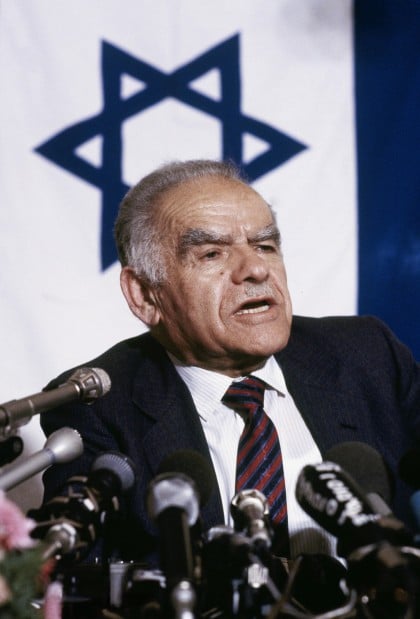
JERUSALEM - Former Israeli Prime Minister Yitzhak Shamir, who clung throughout his life to the belief that Israel should hang on to territory and never trust an Arab regime, died Saturday. He was 96.
Israeli media said Shamir died at a nursing home in the town of Herzliya, north of Tel Aviv.
Shamir served as prime minister for seven years, from 1983-84 and 1986-92, leading his party to election victories twice, despite lacking much of the outward charisma that characterizes many modern politicians.
Barely over 5 feet tall and built like a block of granite, Shamir projected an image of uncompromising solidity during the first intifada, or Palestinian uprising, in the West Bank and Gaza that demanded an end to Israeli occupation.
Politicians across the Israeli political spectrum mourned the former leader's death Saturday.
People are also reading…
"Yitzhak Shamir was a brave warrior before and after the founding of the state of Israel," said Israeli President Shimon Peres. "He was loyal to his views, a great patriot and a true lover of Israel who served his country with integrity and unending commitment. May his memory be blessed."
Prime Minister Benjamin Netanyahu also paid tribute to Shamir, saying he "led Israel with a deep loyalty to the nation and to the land and to the eternal values of the Jewish people."
Defeated in the 1992 election, Shamir stepped down as head of the Likud party and watched from the sidelines as his successor, Yitzhak Rabin, negotiated interim land-for-peace agreements with the Palestinians.
The agreements, including Palestinian leader Yasser Arafat's recognition of Israel, did nothing to ease his suspicion.
In a 1997 interview with the New York-based Jewish Post, he declared: "The Arabs will always dream to destroy us. I do not believe that they will recognize us as part of this region."
Shamir embraced the ideology of the Revisionists - that Israel is the sole owner of all of the biblical Holy Land, made up of Israel, the West Bank and Jordan.
The Labor movement, in power for Israel's first three decades, agreed to a 1947 U.N.-proposed partition plan to allow the creation of the Jewish state alongside a Palestinian entity. To Shamir and other Revisionists, that was tantamount to treason.
In later years, asked his view of territorial compromise for peace, Shamir said often that Israel had already given up 80 percent of the Land of Israel - a reference to Jordan.


