

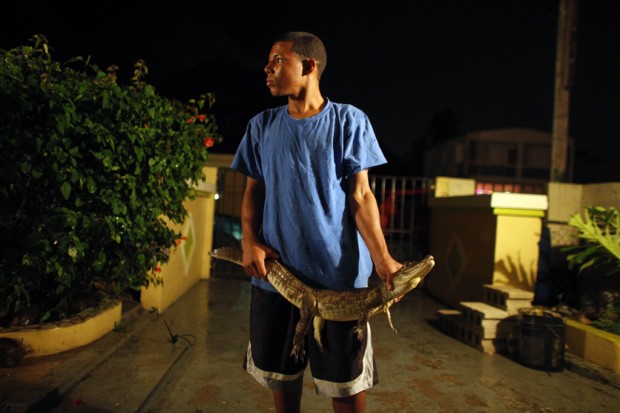
VEGA BAJA, Puerto Rico - When heavy rains begin to pelt a flood-prone neighborhood along Puerto Rico's north coast, people start sharpening their knives and preparing their lassoes.
The floods herald the arrival of caimans, a close relative of the alligator, whose population has exploded in and around the lagoon next to Los Naranjos neighborhood in the coastal city of Vega Baja.
The scaly reptiles have been spotted prowling around schools and crawling into flooded yards after rains, causing both widespread panic and curiosity in the community.
Calls to government officials to help catch the reptiles and take measures to prevent further flooding have been futile.
So now, the residents of Los Naranjos have been forced to face their fears and become caiman catchers themselves in this community of scarce resources where some still ride horses bareback as transportation. Among the rudimentary equipment at their disposal: Wire, duct tape and metal poles.
People are also reading…
People taught themselves the trick to hunting caimans, sometimes learning from others how to rope them in and tape their mouths shut.
They've also mastered the art of flashing lights into the brackish waters of the nearby lagoon until they spot pairs of squinty green eyes gleaming just above the surface.
Ask anyone in this coastal neighborhood if they know someone who traps and kills caimans, and the reply is likely a peal of laughter. The question is akin to asking who hunts for crabs, neighbors say. Everyone does it.
Caimans are found across Puerto Rico, especially its north coast, but the island's biggest population is in Vega Baja, site of the Tortuguero Lagoon, a natural reserve, said Angel Atienza, wildlife director of the island's Department of Natural Resources.
"They have always lived there. They have always reproduced there," he said. "There are thousands there."
After seeing a caiman cross a road near the elementary school where she's the director, Johanna Rosado ordered chaperones to accompany children when they go to the bathroom following heavy rains, just as a precaution.
She said the school is surrounded by a chain-link fence but is trying to raise money to build a concrete wall.
"It's one thing to hear about it, and it's another to see it with your own eyes," Rosado said. "I lived it. Now I believe it happens."
The creatures are native to Central and South America, but were introduced to Puerto Rico by stores such as Woolworth's that sold baby caimans the size of lizards as pets during the 1960s and '70s, Atienza said.
When the caimans began to grow, people released them into the wild, where females rapidly reproduced, laying up to 40 eggs at a time.
The island's government authorizes hunting caimans since they're considered non-native species.


