


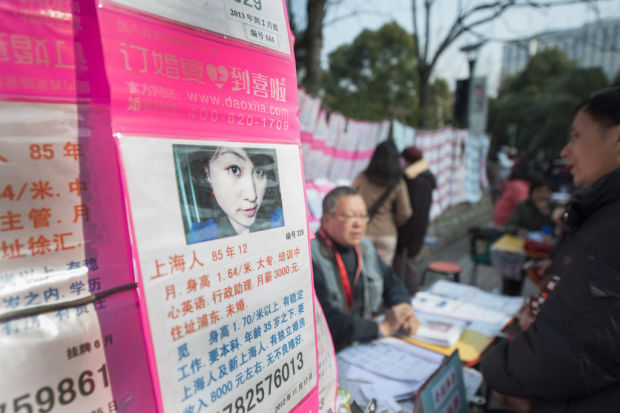
SHANGHAI - Shanghai native Huang Wei's weekends are routine by now. Every Saturday and Sunday morning he travels to People's Square to scan the walls of personal advertisements in the hopes of finding a woman he thinks would be a good match for him.
Usually he fails and walks home feeling defeated.
But not today. This time, Huang, who divorced his wife 10 years ago, thinks he's finally found a woman who's a good fit for him. The 18-year-old whose photo stares at him from crinkled paper is 32 years his junior - and everything Huang has ever wanted.
"I need a woman who will be able to give me a son or daughter and also won't embarrass me by being better than me in terms of education or salary," Huang explains. "I am on the lookout for women between the ages of 18 and 20 who don't have the chance to make me look bad yet."
People are also reading…
People's Square is the last hope for many thousands of Chinese parents who desperately want to see their daughters get married.
In a society with a growing number of women seeking education, many urban women are postponing marriage to have careers, which has many parents going to extreme measures, such as the "marriage market" in People's Square, to pair up their sons and daughters.
According to a census analysis by Wang Feng, the director of the Brookings-Tsinghua Center for Public Policy in Beijing, 5 percent of urban Chinese women in their late 20s were still single in 1982. Today, that figure has risen to 27 percent.
Unmarried women in their late 20s commonly are referred to as "leftover." Having postponed marriage, many of them have a difficult time finding partners for strictly cultural reasons: Many Chinese men would rather be with young women who are less successful than they are, according to Xu Anqi, the executive director of the Family Study Center at Shanghai Academy of Social Sciences.
There are now an estimated 7 million Chinese women who've remained single beyond age 25, mostly living in urban areas.
China will continue to urbanize, and more women will work in higher positions and most likely will follow the model of other East Asian countries, such as South Korea, Japan, Taiwan and Singapore, where this trend is even more common, Wang said.
"Most Chinese women will agree to marry an older man as long as he is rich and can give her a nice home to live in," Xu said. "But the 'leftover ladies' don't want that life yet."
To the 50-year-old Huang, marrying a woman his own age is out of the question. In one glance at the information on display, he can learn much about a prospective fiancee - her name, height, father's salary and the name of the secondary education school she attends - but none of that really matters to him.
"She will need to be able to care for me when I am older and the child we will have, so she needs to be young," Huang said. "A woman my age couldn't do that."
Competing with Huang is a crowd of thousands of parents who descend on the park's "marriage market" every Saturday and Sunday, rain or shine, scouring the area for the best options. Holding single sheets of paper that list basic characteristics about their children, parents attempt to find suitable partners for sons or daughters, many times without their children's approval or knowledge.
"Most Chinese women will agree to marry an older man as long as he is rich and can give her a nice home to live in. But the 'leftover ladies' don't want that life yet."
Xu Anqi,
executive director of the Family Study Center at Shanghai Academy of Social Sciences


