

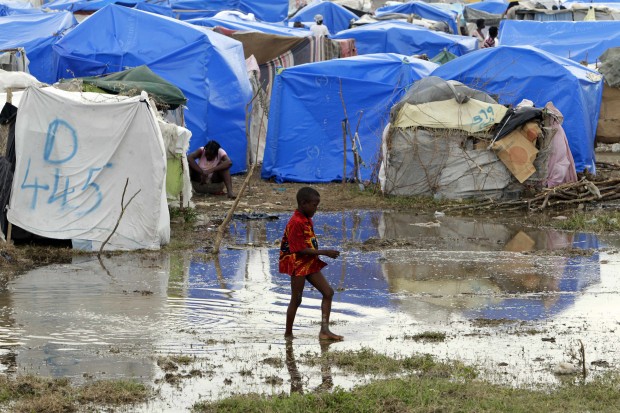
PORT-AU-PRINCE, Haiti - With forecasters warning of Haiti's first big rainstorm since the earthquake, relief officials have delayed plans to build big refugee camps outside the capital.
They are telling the homeless to pack up their tents and tarps and return to destroyed neighborhoods.
People who lined up at a downtown site Thursday to register for the campaign to resettle more than 1.2 million Haitians expressed skepticism and were dismissive of the plan, and relief officials acknowledged its immense challenges.
The rainy season is less than a month away, with forecasters saying Haiti's first big storms since the Jan. 12 quake could arrive by this weekend. Many dwellings are severely damaged or clinging to hillsides, vulnerable to mudslides if heavy rain comes.
"There will be flooding. There will be discomfort, misery. And that's not avoidable," a top U.N. official for Haiti, Anthony Banbury, told a New York news conference this week.
People are also reading…
Gerald-Emile Brun, an architect with the government's reconstruction committee, agreed.
"Everything has to be done before the start of the rainy season, and we will not be able to do it," he said Thursday.
Brun suggested that Haitians, who expect little of their corrupt and inefficient government, may be left to sort it out themselves.
Camp dwellers - the capital alone has 770,000 - welcomed the idea of swapping flimsy, makeshift tents in the city's fetid center for something more stable. But that didn't mean they wanted to return to their quake-ravaged neighborhoods.
The International Organization for Migration began registration at the plaza Wednesday, collecting people's old addresses in hopes that most can be resettled relatively quickly in their old neighborhoods.
The camp is home to 60,000 people and was chosen to begin registration because 45 percent of its residents come from a single Port-au-Prince neighborhood, Turgeau, said U.S. Air Force Lt. Col. John Blackwell, who is involved in coordinating the plan.
Mark Turner, spokesman for the International Organization for Migration, said, "This is ... our big push right now" - to decongest overcrowded and unsanitary camps. "Most people have some kind of tent or structure. We want to be able to tell people, 'Just pack it up and take it home.' "


