“The main thing is to keep the main thing the main thing,” said Stephen Covey, a renowned organizational consultant.

Paul Steidler
With artificial intelligence legislation, what matters most is common sense. That means not killing or stagnating the benefits of AI with cumbersome and contradictory laws in 50 states on how AI models develop and run.
Sensible federal guidelines are key.
Both parties in Congress recognize that AI provides profound benefits to American society, including better health care, reducing tedious tasks and spawning discoveries. To get there, AI development cannot be handicapped by regulatory uncertainty, which is the most likely way to sabotage AI's bright future.
People are also reading…
Hundreds of state legislative proposals across the country would require tech companies to produce voluminous state reports and modify their technology to comply with state mandates. This encompasses sharing how models work, how they were tested and evaluated, and what type of energy they use, among many other factors.

Big technology companies can pay for these legal and regulatory costs, though billions will go to bureaucrats and lawyers instead of being invested in AI. Left unchecked, these state laws will stifle and end AI innovation at many mid-size and small enterprises. American technological progress and leadership will slow.
If a bunch of states had regulated the production of innovations such as steel, electricity and the automobile -- as some are trying to do now with AI model development -- those technologies would have taken many more years to come to fruition. We might still be riding horses over wooden bridges with lanterns.
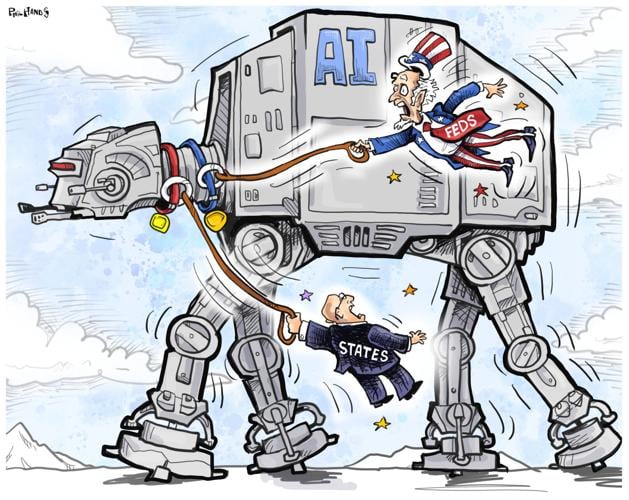
The White House on March 20 issued a widely anticipated framework to govern AI. It also issued a Dec. 11 executive order stopping the states from making their own AI rules.
Preempting states from taking action on certain things is a core legal doctrine of the Constitution. Federal law takes precedence over conflicting state laws. This promotes interstate commerce by preventing a balkanization of laws from stifling technology and innovation. It has been central to America’s 250 years of prosperity.
The Trump administration's framework includes several important points, including that “Congress should preempt state AI laws that impose undue burdens to ensure a minimally burdensome national standard consistent with these recommendations, not 50 discordant ones. … Preemption must ensure that state laws do not govern areas better suited to the federal government or act contrary to the United States’ national strategy to achieve global AI dominance.”
The framework covers many areas, including energy issues, job training and copyrights. Indeed, AI affects many areas of American life.
With preemption, states still have considerable leeway to govern AI, including how it affects insurance rates, which are regulated by states. Also, commerce laws already govern AI. Fraud committed with AI is still fraud, subject to rigorous prosecution.
To curtail regulatory uncertainty, the United States needs AI federal rules, particularly on model development, to be enacted this year. Not executive orders or study groups. Laws.
Core components of the legislation should give the National Institute of Standards and Technology a clearer, more powerful role in determining the best practices in AI modeling. Stronger whistleblower protections for employees at tech companies are needed.
Since the White House announcement, Washington’s political tribes have gone to their own silos on AI legislation. Conservative groups are gathering together. Democrats are caucusing and meeting with stakeholders to hear their priorities. It seems like every issue related to AI is now in legislative play.
That may prove helpful in galvanizing policymakers to “do something” legislatively about AI. Without preempting the states, costs and delays in AI development rise needlessly, placing an unnecessary drag on our economy and bright future. Preemption legislation gets us past this.
Steidler is a senior fellow with the Lexington Institute, a public policy think tank in Arlington, Virginia. He wrote this for InsideSources.com.