Socialism gets rebranded every generation with new faces and a catchy slogan. But the pitch stays the same: This time will be different.

Eric Ventimiglia
It never is, because socialism’s problem isn’t bad luck or bad leadership. It’s just a bad idea.
Socialism assumes that government planners can better determine what millions of people need than individuals, families and businesses can determine for themselves. History offers little reason to believe that assumption.
Prices communicate scarcity. Profits reward businesses that create value. Competition pressures producers to improve quality, control cost and respond to consumers. When governments suppress those signals and replace them with political directives, shortages and stagnation inevitably follow.
Consider Venezuela. In the 1950s, it ranked fourth globally for per-capita gross domestic product, which is the sum of all goods and services. As recently as the 1980s it ranked in the top 25. Then socialist leaders Hugo Chávez and Nicolás Maduro nationalized industries, seized private businesses and imposed sweeping price and currency controls.
People are also reading…
The result? Under Maduro, economic output fell by more than two-thirds. At the height of the crisis, a national survey found that 96% of Venezuelan households were living in poverty.
A country with some of the world’s largest oil reserves could not reliably keep its lights on or its stores stocked. That’s not bad luck. That’s a very bad idea — socialism — in action.

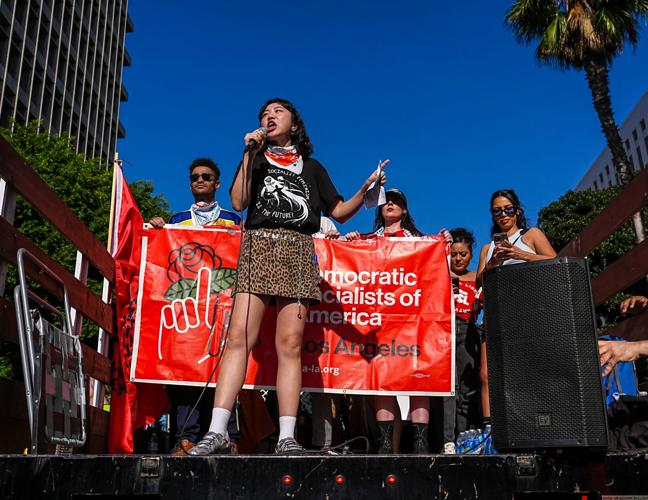
Leslie Chang of the Democratic Socialists of America supports a general strike in Los Angeles earlier this year. Younger generations of American are expressing more interest in socialism, though its success in elections is mixed.
Cuba offers another warning. Once the gem of the Caribbean, a study this year in the Journal of Development Economics concluded that Cuba’s economic performance deteriorated sharply after the 1959 revolution and that the loss of Soviet subsidies exposed the depth of that weakness.
The Soviet Union provides the clearest example of central planning’s inability to coordinate a complex economy. In 1990, bread disappeared from Moscow stores despite an enormous grain harvest. The problem was not a lack of wheat. It was a decaying system that could not reliably transport, process and distribute food.
By the first quarter of 1991, Soviet gross national product was 8% lower than a year earlier. Central planners could issue production targets, but they could not reproduce the information, incentives and coordination generated by markets.
Defenders of socialism often respond that these examples were not “real socialism.” The theory was sound, they say. It was the execution that failed.
But execution is the point. An economic theory must be judged not only by its promises but also by the institutions and incentives it creates. Concentrating economic power in government repeatedly produces political allocation, weak accountability and resistance to correction. When failure comes, officials rarely surrender authority. They demand more of it.
The U.S. chose a different model. It protected private property, encouraged entrepreneurship and generally relied on markets to allocate capital and labor. The government established rules, funded basic research and built public infrastructure, but it did not replace the private sector as the economy’s principal engine.
That combination helped produce extraordinary prosperity and innovation. According to the National Science Foundation, U.S. knowledge- and technology-intensive industries generated $3.3 trillion in value in 2024, accounting for 11% of the nation’s gross domestic product.
The impulse to transfer more economic power to government has not disappeared.
California voters will consider a measure this year imposing a one-time “wealth tax,” allowing the state to seize up to 5% on assets exceeding $1 billion. Washington state has enacted a 9.9% tax on income exceeding a $1 million deduction, effective in 2028. Michigan’s Democratic nominee for U.S. Senate, Abdul El-Sayed, won his primary while supporting a Medicare for All and higher taxes to finance expanded government benefits.
These policies are economically disastrous breadcrumbs on the path to socialism.
Ronald Reagan warned in 1967 that “freedom is a fragile thing and it’s never more than one generation away from extinction.”
A new generation is being offered old ideas wrapped in modern language. It should not be asked to ignore what happened in Caracas, Havana and Moscow. Freedom and free enterprise must be defended in every generation, including this one.
Ventimiglia is executive director of Pinpoint Policy Institute, which advocates for American prosperity. He wrote this for InsideSources.com.