
In order to keep readers updated and informed on the fast-happening local, state and national news of the day, our opinion writer Edward Celaya and editor Sarah Garrecht Gassen will be posting their takes here in our new section called the Daily Word. Be sure to check here for new content each week, and let us know what you think by visiting our Facebook page, or by writing us a "letter to the editor" at tucson.com/opinion. *Note: The views expressed in this space are not necessarily those of Lee Enterprises.
At large universities, every department gets its due. The University of Arizona journalism community decided to get in on the act Friday, Sept. 20 for the annual Zenger Award for Press Freedom presentation.
This year's award recipient, the inimitable Christiane Amanpour, was honored for her two-and-a-half decades worth of work for CNN and ABC News. A surprise Junior Zenger Award was also presented to 12-year-old reporter Hilde Lysiak for her contributions to the field.
People are also reading…
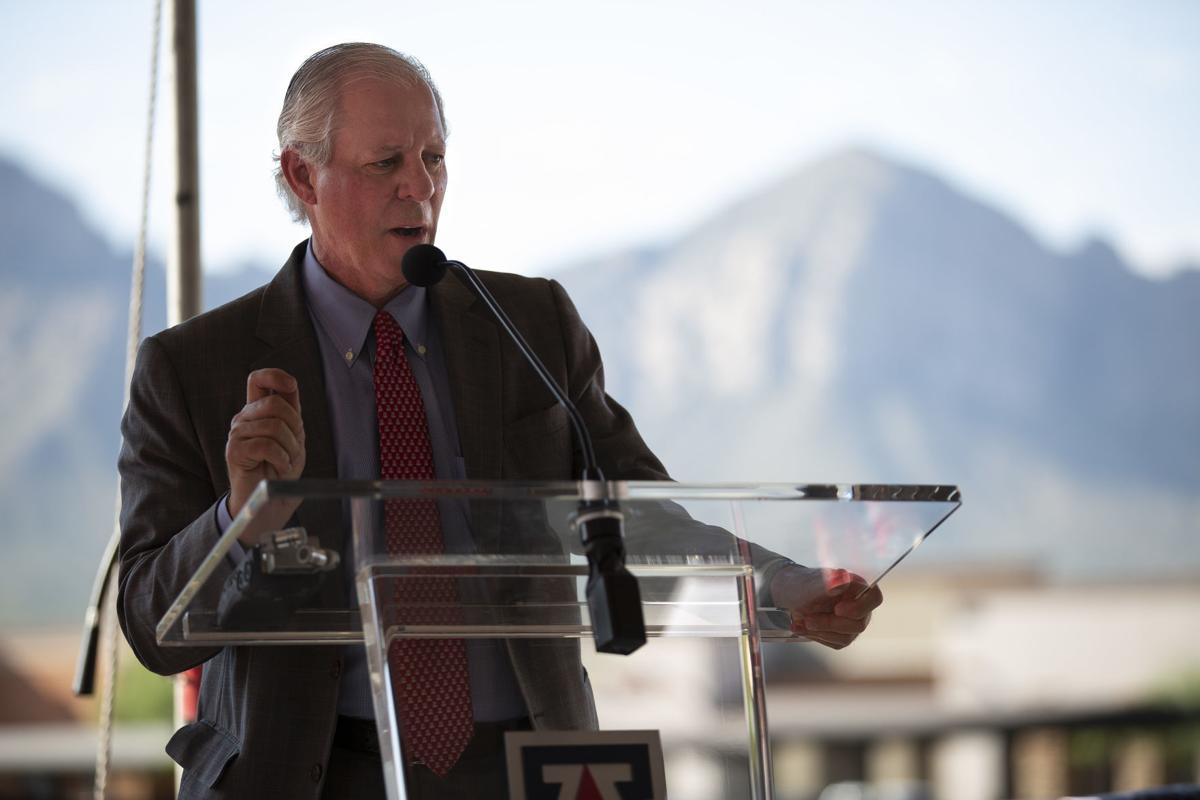
All the requisite dignitaries were present, including University of Arizona President Robert Robbins, who introduced Amanpour by extolling the benefits of a free press, before transitioning into a story about his first visit as UA president to the journalism program.
“They said, ‘You’re the first president who has ever been over here, because most of them — the presidents — are afraid of us,’” Robbins told a room filled with journalists.
Although probably a joke, Robbins’ relationship with the school stands in stark contrast to his predecessor, Ann Weaver Hart. For comparison, Hart is best known in UA journalism circles for walking out of a scheduled interview with the Daily Wildcat in 2016.
But for supporters and alumni of the j-school (including myself), there is a larger, ever-present 500-pound gorilla in Tempe and Phoenix impeding the departments visibility — and if the UA wants its journalism program noticed, it will take more than mere administrative support to overcome it.
Although UA boosts a competent faculty and staff, comparisons between it and ASU's Walter Cronkite School of Journalism are a study in contrasts. The difference between the two programs is glaring.
ASU boasts multiple semester-long programs through Cronkite News (not just Summer classes or internships) in Los Angeles, Washington D.C. and with professional sports teams. UA has none of that. Part of it has to do with geography, but another part has to do with prestige. It doesn’t end there, either.
There are also more student media options at ASU, which are vital to students looking for professional exposure and experience, especially those who can’t afford to take unpaid, off-campus internships. While UA offers student media options, they aren’t as comprehensive as ASU's offerings.
To add insult to injury, near the end of last year, the Arizona Board of Regents, the body that oversees the states’ three universities, approved ASU's purchase of the old Los Angeles Herald Examiner building, with “plans to house several educational departments, including journalism,” according to a Bisnow.com article.
This isn’t to say UA’s journalism program is in the doldrums. On the contrary, many alumni are making their marks on the industry. Multiple grads and professors brought home West Region Emmy’s for their work last week, and some of the best local work across platforms is done by former Wildcats including here at the Star.
But in order to keep up with the ASUs, USCs and Missouris of the world, something is going to have to give. On Friday, Robbins hinted something just might.
After relating a story about how donations were raised to put together Andrew Weil’s new, modern Center for Integrative Medicine, Robbins mentioned the journalism schools’ current home, the Marshall Building.
“I might be getting in trouble here, but I think you need your own building and something big to really put a spotlight on our school,” he said. “Now I’m getting in trouble, but I’m just speaking the truth. Because the truth is the truth.”
Say word, preacher! Perhaps the biggest difference between UA’s journalism department and those like ASU's is its lack of a dedicated building or center to hold most, if not all, of the school’s classes and extra-curricular opportunities.
ASU’s Cronkite is located in downtown Phoenix inside a $71 million state-of-the-art building that houses the region's PBS/NPR-affiliate, along with lab and classroom spaces across 223,000 square feet on six floors.
Currently, UA’s j-school shares the third floor of the Marshall Building with the Racetrack Industry Program. Not exactly ideal for synergy.
Plans for a standalone building that would include a home for PBS and NPR-affiliate Arizona Public Media, the j-school, the Communication Department and the School of Information have been kicked around since 2012, according to Carol Schwalbe, the current director of UA’s school of journalism.
“Nicknamed the iHub … The idea is to create a building that is collaborative, innovative and interdisciplinary,” Schwalbe said. “It would contain a converged newsroom, a control room, broadcast studios, labs, classrooms, offices, meeting rooms, gathering spaces for students and more.”
That’s more like it. Plans are still in the conceptual stage and, according to Schwalbe, there is no dollar estimate on the potential cost. Having the support of Robbins, however, is the first step. “He has always been in our corner,” Schwalbe said.
That's evident in an email Robbins sent following up on his Friday comments. Calling UA's journalism program the "New York Times' West" for its reputation of bringing on former Times' reporters as faculty, Robbins said it's time fore the university to step up.
"We have to build on that reputation by advancing the study of journalism just as we are in space science and the arts."
Now if only the j-school had a football team …