

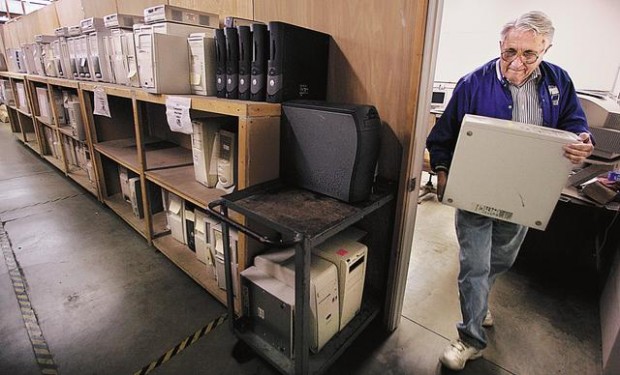
Two local nonprofit agencies have a reminder for those who bought a new computer during the holidays: The community and Mother Earth both benefit when people don't put old computers in the trash barrel.
"When you recycle a computer, you can help the environment and less fortunate groups of people," said David Perrin, manager of a Chaparral Foundation Computer Hospital, 4585 E. Speedway, Suite 104, which operates a program to refurbish and recycle computers.
About 10 tons of discarded personal computers, unwanted printers and forsaken monitors arrived at Los Reales Landfill between July 1 and early October this year.
Local computer recycling programs want that mountain of junked computers to come to them, instead. The recycling programs say they give new homes to old computers, conserve landfill space, and help properly dispose of hazardous chemicals.
People are also reading…
Recent beneficiaries of computer recycling include about 115 low-income students participating in a program involving the Tucson and Amphitheater school districts and Desert Waste Not Warehouse.
The students took home Windows-based PCs earlier this month after meeting school achievement standards, said Linda Leatherman, a director of the nonprofit Desert Waste Not Warehouse.
Funded by grants from Pima County and Waste Management Inc., the nonprofit group collects computers at its building at 2550 N. 14th Ave. It also helps recycle computers deposited at landfills, including Los Reales.
Amid the tons of trashed computers, there's gold — literally. Gold is found in some computer components, as are hazardous metals such as lead. The average computer monitor contains 6 pounds of lead, according to U.S. Environmental Protection Agency.
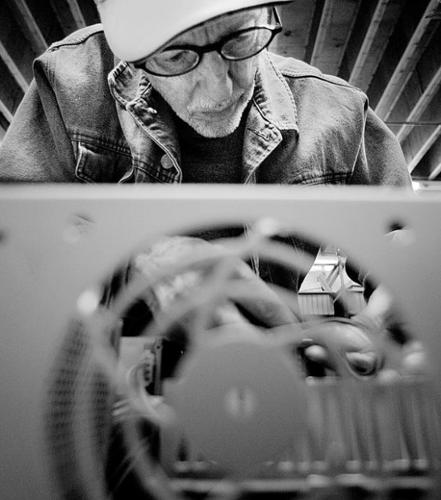
Local recyclers salvage useable components to build refurbished machines. And they help ensure that hazardous materials in computer parts receive special care.
Desert Waste Not supplies computers to nonprofit groups and families with low incomes, Leatherman said.
Computer Hospital's refurbished computers go to local nonprofit programs, Perrin said, including ones operated by Goodwill and Habitat for Humanity.
Both local recyclers said their unusable parts and machines are shipped to Gold Circuit Inc., a Chandler-based company that specializes in recycling and safely disposing of hazardous materials in computers.
The local recyclers also take care to protect donors' hard drives against theft of personal information.
Computer Hospital and Desert Waste Not routinely format — or erase — hard drives of the PCs they recycle, although donors may want to do their own formatting before donating..
Formatting offers better protection than just deleting files because it makes it much more difficult for anyone to recover data, said Noah Badyl, a network technician for Law2000 Inc., a Tucson firm that does forensic data recovery.
Since both the Computer Hospital and Desert Waste Not Warehouse are nonprofit organizations, computer donations to the groups are tax-deductible.
● The U.S. Environmental Protection Agency suggests that people ask the following questions before deciding where to recycle:
l Do you accept my equipment? Some companies refurbish Windows-based computers, but not machines that use Mac operating systems. Also, check whether they accept computer peripherals and accessories.
l Do you charge a fee? Check on the cost of donating computers, monitors and peripherals. For instance, Desert Waste Not Warehouse in Tucson charges recycling fees for monitors that cannot be used, for Macintosh monitors, and for printers and scanners. The organization's fees range from $6 to $18 for monitors and $2.50 to $10.50 for printers. The fees cover the costs of safely disposing of lead and other hazardous materials.
l What happens to data on my hard drive? If hard drives are formatted before or during recycling, old data will be difficult to uncover. Computers donors may want to ask for details.
l What about donation pickups? If it's a problem to move your old computer equipment, see if the recycler can come to you. For instance, The Chaparral Foundation Computer Hospital offers pickup service for disabled persons and small businesses.