

By Joseph Barrios
ARIZONA DAILY STAR
Tucson is facing a shortage of industrial space, making it difficult for some companies to find new homes here.
Tucson's vacancy rate reached a record low of 5.85 percent in the last quarter of 2006, according to an analysis by CB Richard Ellis — Tucson. A year before, vacancy was at 7.87 percent. The company predicts Tucson's industrial vacancy will drop to 4.4 percent over the next two years.
With fewer and fewer choices, manufacturers and distributors are paying more. The average asking lease rate was $6.96 a square foot last year, an increase of more than 7 percent from $6.48 a square foot the year before.
While some companies can build space to suit their needs, construction costs make that a difficult option. Companies that can't afford to build have to make do with what's available.
People are also reading…
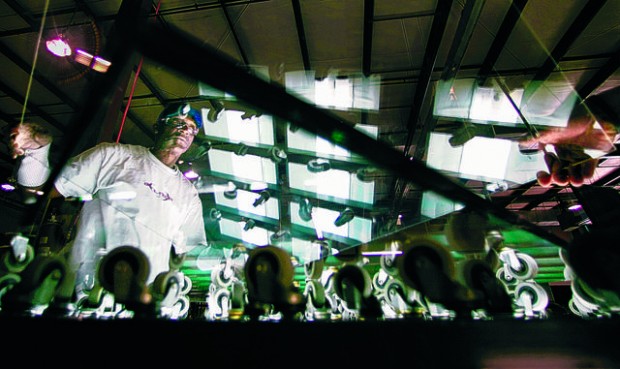
The shortage of industrial space proved to be a challenge for Glaz-Tech Industries, which manufactures glass products including insulated and custom-shaped glass.
The company, founded here about 17 years ago, has expanded into four other states. Glaz-Tech spent two years looking for a new headquarters before settling on a less-than-ideal building near Tucson International Airport, said President Peter Fazlollah.
"There's such a shortage, it's amazing," he said.
About 416,000 square feet of new industrial space was built last year. About 88 percent of that space was occupied by year's end and the rest "appears to have been rapidly absorbed," according to the analysis.
The main option for new companies moving into Tucson is to build custom space, said Bill DiVito, a first vice president and industrial specialist with CB Richard Ellis.
Still, employers that currently have no presence in Tucson are looking to move here, DiVito said. His office is working with three "very large and significant opportunities" involving companies that are considering buying land and building space to suit their needs, he said. DiVito declined to offer further details.
Developers hesitate to build industrial space speculatively here because while construction costs are high, not many companies will pay top dollar for new space.
"The problem with developers coming here and building space is, they look at at the construction cost, their land cost and what their rental rates are and they get a little nervous because they don't equal return needed," DiVito said.
Newly built industrial space is about 25 percent more expensive than existing space per square foot, said Pat Welchert, an industrial specialist with Tucson Realty & Trust. Rates will continue to increase this year. Tucson is definitely close to a shortage with vacancy rates in the 4 percent range, he said.
Glaz-Tech had been housed in a 10,000-square-foot building at 1762 W. Grant Road for several years when the company started looking for a bigger place about two years ago so it could expand here. It would take about a year before the company found a 40,000-square-foot building at 2207 E. Elvira Road. Even then, the company leased the building for a year to try it out and to spend more time looking for a better spot.
Glaz-Tech bought the building in late January for about $1.9 million. Even now, there's space available in the building for expansion. But its location is less than ideal — Fazlollah said something near the freeway would be much better.
"There's just nothing out here that fits our needs," he said. "I've been looking essentially for this last year. There's just nothing."
Fazlollah leased the building with an option to buy. He said he "tried to get out of our deal and I couldn't find anything and I'm stuck here."
While Tucson needs more industrial space, the city is also "pretty much in balance" because the amount of industrial space that will be built this year — roughly 1 million square feet — will be occupied, DiVito said.
"We need to be resupplied. At 4 percent vacancy, to support any kind of growth you need to have some new supply," he said.
● Contact reporter Joseph Barrios at 573-4237 or jbarrios@azstarnet.com.


