The fight for eligibility in courtrooms has come to an end for Arizona running back Ismail Mahdi and linebacker Max Harris, among others. So has their eligibility as college athletes.
After filing for a temporary restraining order against the NCAA in the Pima County Superior Court via Ryan Downton of Texas Trial Group and Tucson-based Farhang and Medcoff, LLC, Judge Randi L. Burnett denied the order that would prohibit the NCAA from making them ineligible to compete this season.
The preliminary ruling was made Friday evening, four days after Mahdi, Harris and several other “five-for-five” athletes were in a one-hour Order to Show Cause hearing at the Pima County Superior Court on Monday.
In the hearing, Downton noted the side in favor of the ruling must submit “proposed findings (of fact) to support the preliminary ruling.”
People are also reading…
The Star's Justin Spears hosts a radio show with Farhang and Medcoff's Ali Farhang on ESPN Tucson.
The ruling was also made on the same day Texas Tech quarterback Thomas Castellanos was ruled ineligible by the Kentucky Court of Appeals.
Both Mahdi and Harris were held out of Arizona's Big 12 home opener against Cincinnati.
The other student-athletes and plaintiffs in this case include UA kicker and punter Sullivan Moon, UA sprinter Parker Duskin, Washington kicker Grady Gross, South Dakota State soccer player Lauren Eckerle, Northern Arizona defensive lineman Alani Ma'afu, Arizona State women's basketball player Makayla Moore and men's basketball transfer Jaeshon Thomas.
Arizona men's golfer Connor Hamm and UA women's swimmer Riley Botton, who both testified in the hearing earlier this week, were added as plaintiffs. UA men's golf coach Jim Anderson attended Monday's hearing to support Hamm.
Arizona baseball standout and relief pitcher Garret Hicks, who led the Wildcats in saves last year, was added to the list of plaintiffs. Arizona baseball head coach Chip Hale testified on Hicks' behalf and said the former junior college pitcher never received a “Pavia Waiver” at Arizona.
The “Pavia Waiver” is from the class-action lawsuit in Tennessee that allowed former Vanderbilt quarterback and Heisman Trophy finalist Diego Pavia a sixth year of eligibility last season after the quarterback argued his junior college years were unfairly counted towards his eligibility clock.
Hicks, a Buckeye, Arizona native, played two seasons at Pima Community College before transferring to the UA for two seasons.
In August, the United States Court of Appeals for the Tenth Circuit granted a stay request in the Wisne v. NCAA class-action lawsuit in Colorado, pausing the preliminary injunction that allows high school athletes from the 2022 recruiting class — like Mahdi and Harris — the ability to participate as five-for-five players.
The stay temporarily paused Harris and Mahdi’s eligibility to play in games this upcoming season, along with other athletes nationwide.
U.S. District Court Judge Charlotte Sweeney’s federal ruling in Colorado in August allowed class of 2022 student-athletes, who weren’t grandfathered in the NCAA’s new five-for-five rule, to compete in the upcoming 2026-27 sports season.
The five-for-five rule allows student-athletes to use up their eligibility in five years — with their eligibility clock starting upon their freshman year in college or after their 19th birthday. Several 2022 athletes competed in four years, but weren’t granted an additional year of eligibility until the federal ruling in Colorado last month allowed them to return.

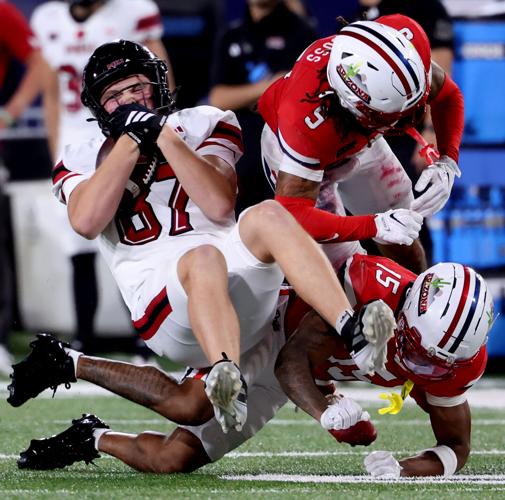
Arizona linebacker Max Harris (5), top, and safety Malcolm Hartzog (15) put a double whammy on Northern Illinois tight end Liam Russo (87), Tucson, Ariz., Sept. 19, 2026.
Mahdi and Harris did not participate in Arizona's season-opening win over NAU, but became active starting Week 2 against No. 15 BYU after filing for a temporary restraining order against the NCAA in September.
Harris recorded 10 tackles in three games at linebacker for the Wildcats and played in 108 defensive snaps. Mahdi, who was Arizona's leading rusher last season, has 12 carries for 72 yards in two games for the Wildcats — 63 yards were against Washington State last week, including 43 in the fourth quarter.
The TRO filed last month said language regarding the 2022 class being excluded from the “five-for-five” rule doesn’t exist in the 2026-27 NCAA Division I manual, meaning the NCAA can't prohibit the plaintiffs from competing this season.
NCAA Rule 12.6, which was printed in the new NCAA Division I manual that came out in August, states: “The regular academic term (semester or quarter) of an academic year in which the individual enrolls in a collegiate institution (domestic or foreign; see Bylaw 14.02.4) in a minimum full-time program of studies and attends a class in that term while enrolled full time; or the beginning of the regular academic year immediately after the individual’s 19th birthday.”
“That's been our main argument, but then we found out more that the NCAA finally published the 2026-27 bylaws, which contain the new five-year rule,” Downton said on ESPN Tucson last month. “They told us for the last two months that the five-year rule excludes the class of 2022. Well, now we have the text. And it doesn't. It explicitly says they can play. They're still within five years of graduating high school and going to college. They're still within five years of their 19th birthday. Under the rule, they can play.
“It's easy for the judge to look at the plain text and say, ‘There's no exclusion here, so, NCAA, you are breaching your contract if you don't let them play.’ ... All of these guys should be eligible now.
“The NCAA should drop these lawsuits and stop spending tens of millions of dollars to fight against their own bylaws that they passed.”
Downton noted Mahdi and Harris have competed against other football players who received a waiver for the pandemic-influenced, in addition to redshirt years.
Former Arizona linebacker Justin Flowe, who's now playing his seventh season of college football at UNLV, was used as an example of players who've exercised every loophole since the pandemic to maintain eligibility. Montana linebacker Solomon Tuliaupupu, who's had numerous injuries, is playing in his ninth season this year. There are many other examples of football players in their sixth-plus year of eligibility.
Mahdi and Harris make a compelling case to be eligible, considering neither of them were drafted or signed with an NFL team. Mahdi started his post-playing career by taking over ownership of the Dickey's Barbecue Pit in Tucson. Harris participated in the Denver Broncos rookie minicamp, but never signed a training camp deal or received compensation from the Broncos.
Mahdi, Harris, Moon and UA chief of staff Ben Thienes testified in the hearing on Monday. Thienes explained Arizona didn’t cut any players or open roster spots to add the aforementioned players. However, Mahdi and Harris are receiving a fraction of what they would’ve received from Arizona’s revenue-sharing and NIL budgets.
Harris said he made just over $2,250 in his junior season at Texas State. At Arizona, Harris made $175,000, he said, which would’ve escalated to $275,000 if he was grandfathered in the five-for-five ruling.

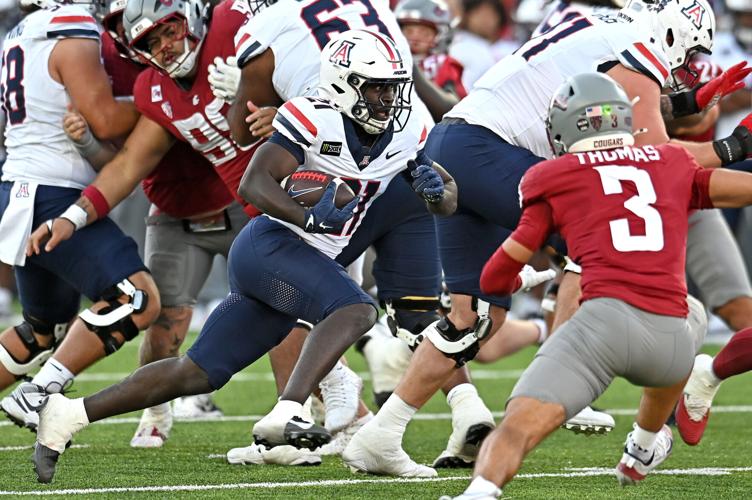
Arizona running back Ismail Mahdi carries the ball against Washington State during the first half at Gesa Field at Martin Stadium, Sept. 26, 2026, in Pullman, Washington.
Mahdi made $250,000 in 2025, which would’ve moved to $300,000 in 2026, he said. Since they were added in August, Mahdi and Harris’ current contract has them earning $10,000 per game for a minimum of $120,000 apiece.
That’s a 60% reduction for Mahdi and 56% for Harris. Regardless of the pay decrease, the six-figure payments for this season are “life-changing” money, Downton argued.
Taylor Askew, a defense attorney for the NCAA in this case, said pushback from athletes was inevitable no matter what recruiting class the five-for-five rule excluded.
“You gotta figure out where in the pond you want to drop that rock, because there's going to be ripple effects,” Askew told Burnett on Monday. “You can't avoid it. Where do you draw the line?”
The 2022 recruiting class “was the only place to draw the line that would not take anything away from anybody,” Askew said.
“Just because the rule changed at the end of their career and a new line was drawn and they didn't have everything they were entitled to before, it doesn't make them lesser,” Askew said. “They're still Division I athletes and that's incredible. But we have to be able to govern the sports world the way we're supposed to — and the way the schools have asked us to.”
Contact Justin Spears, the Star's Arizona football beat reporter, at jspears@tucson.com. On X(Twitter): @JustinESports

Justin Spears
Sports Reporter