Arizona added elite size to its pass-catching corps in the offseason. Keyan Burnett, AJ Jones and Tetairoa McMillan are all listed at 6-foot-4 or taller. Those playmakers undoubtedly will help the Wildcats score more in the red zone, where they were the most inept team in college football last season.
But aerial prowess isn’t the key to red-zone effectiveness, UA coach Jedd Fisch said. Arizona must win the ground war first.
“The biggest thing about scoring in the red zone — and I said it every week last year — is you have to run the ball in the red zone,” Fisch said. “If you’re not running the ball very well, you’re going to struggle . You can’t just (make the opponent) defend three passes in the red zone — that’s the worst red-zone teams.
“The best red-zone teams are the ones that run it the most and throw it the least when you get inside the 10. So hopefully the difference maker will become, are we better at running back? If we are, then they’ll have to defend us differently to open up some of the passing.”
People are also reading…
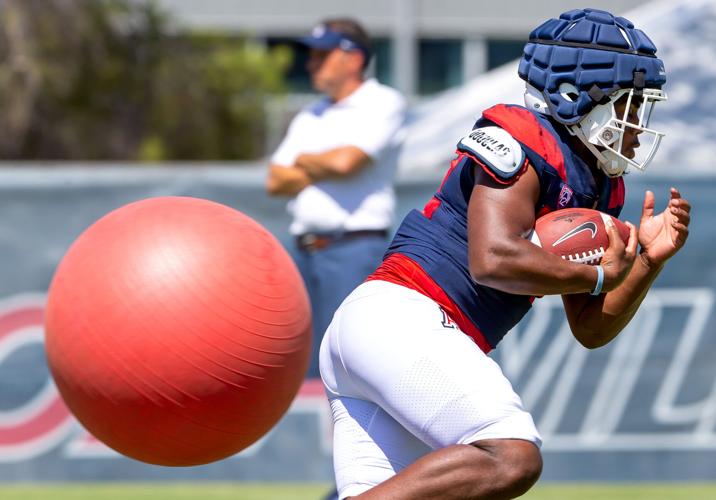
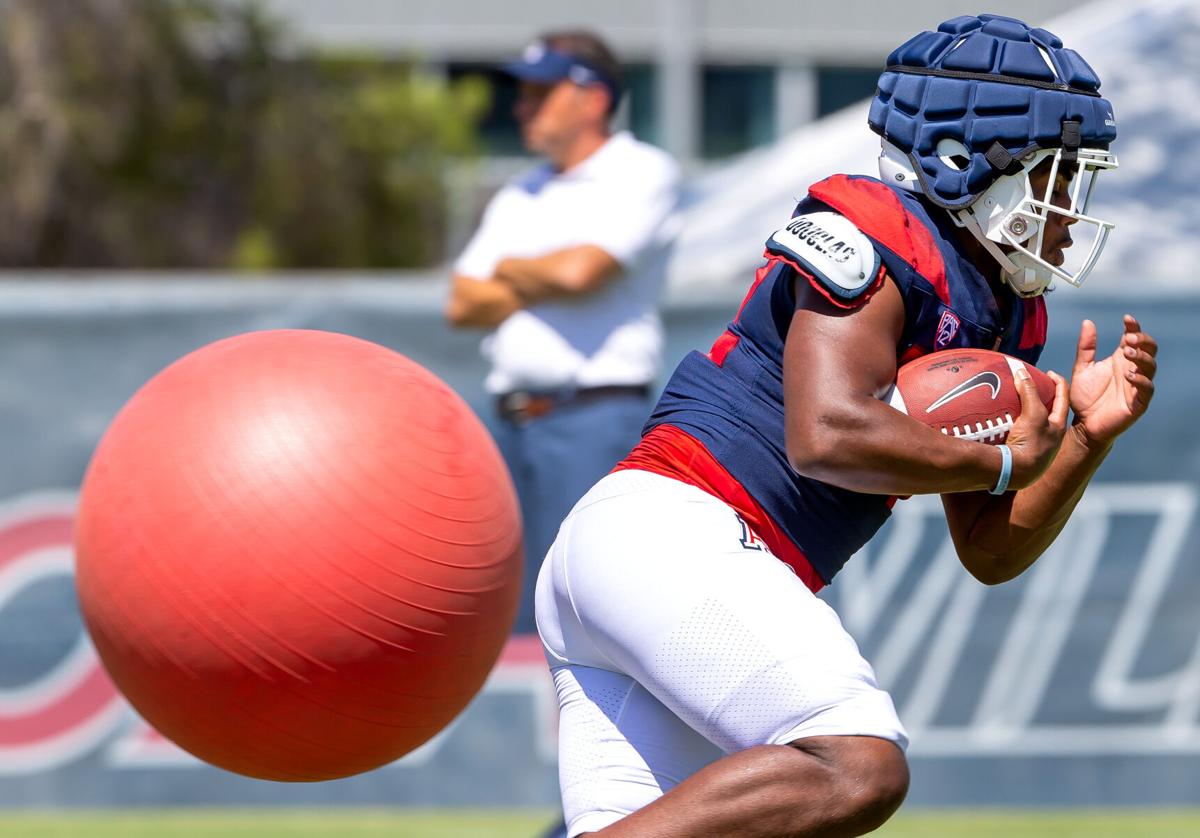
The Wildcats have added talent at tailback. Transfer D.J. Williams and freshman Jonah Coleman can break tackles. Freshman Rayshon “Speedy” Luke is a legit burner. Combined with Arizona’s returning backs — led by veteran Michael Wiley — the group can attack defenses in a variety of ways.
“You choose,” running backs coach Scottie Graham said. “If you load the box, we got a jet. If you lighten the box, I got a hammer. So you got to pick your poison. But it’s coming.”

Rayshon ‘Speedy’ Luke
The Wildcats scored a pair of rushing touchdowns in the red zone during their scrimmage Saturday — one by Luke, one by Coleman. The offensive line performed well against a somewhat depleted defensive front — and really, that group’s production is as big a key as anything.
Arizona struggled in every aspect of red-zone offense last season, ranking last in the nation in touchdown rate at 30.8%. To put that figure in perspective, the next-worst Pac-12 team was USC — at 54.9%.
UA running backs averaged 2.4 yards per rush on carries from the 19-yard line and in, according to ESPN.com. On all other rushing attempts, they averaged 4.3 yards.
Of course, the former always will be lower than the latter because the longest possible run inside the 20 is 19 yards. But that 2.4 figure is one the Wildcats desperately need to improve.
As Fisch noted, the best red-zone teams are able to run the ball in tight quarters, forcing opponents to defend more than one element. Each of the top 18 teams in red-zone touchdown percentage last season scored at least 46.8% of their TDs on the ground. Eight of those teams — including Coastal Carolina, the country’s most efficient club in the red zone — were at 60% or higher.
Physicality is a must when it comes to red-zone running; the field is more compacted, and safeties don’t have to worry as much about receivers sprinting past them. But Wiley believes focus and precision are just as important.
“That’s when I’m alert,” Wiley said. “That’s when I feel like I’m at my best.”
Wiley was Arizona’s most effective runner inside the red zone last year, rushing 10 times for 27 yards and two touchdowns. Drake Anderson also gained 27 yards on 10 attempts, with one score.
Recognizing the need for a more powerful presence, Fisch and his staff added Williams, a 225-pound thumper.
“I love running downhill,” Williams said. “I love contact.”
Williams has averaged 3.41 yards after contact per attempt during his college career, according to Pro Football Focus. The only returning UA back with a mark higher than 2.87 is Stevie Rocker Jr., who averaged 4.16 yards after contact as a freshman last season.
Williams scored five touchdowns on 20 rushes inside the 20-yard line at Auburn in 2019 and ’20.
“We go in the red zone, we’re not throwing it; we’re gonna hit you right in your face,” Graham said. “Ready? Brace yourself. Because we’re gonna hit you. We’re gonna hit you hard from every single angle.”
‘Where I’m supposed to be’
Although he didn’t arrive in Tucson until late July, Williams quickly has acclimated to the UA offense and has gotten reps with the first unit.
Williams thought he had enough credits to graduate from Florida State in the spring, but he needed to post a grade in one more class. Once he did that, he headed for Arizona, where he had committed earlier in the summer.
Williams missed the first practice of training camp and cramped up at the end of his debut the following day. Since then, his conditioning and comfort level have improved daily.
“He has experience, which is a huge difference than if you just got here and you’re a freshman,” Fisch said of Williams, a former four-star recruit who spent his first two seasons at Auburn before playing for FSU last year.
“He’s a nice addition for us. We’re excited about how he runs downhill for sure.”
Williams’ football background also helps. He was a dual-threat quarterback at Sebring High School in Central Florida.
“He understands concepts,” Graham said.
“I believe being a quarterback helps you see the field a lot (more) clearly,” Williams said. “Just knowing what the line’s doing and the flow of the linebackers. I think that helped me out a lot.”
Williams had never traveled to the West Coast before coming to Arizona. He rushed for 599 yards in two seasons at Auburn, electing to transfer after coaching changes there.
Williams didn’t get many opportunities at FSU, carrying 10 times in six games. He entered the transfer portal for a second time, leading to a third chance at Arizona.
“It was a long process, but I feel like the right people put me in this place,” Williams said. “I’m thankful for Coach Fisch and Coach Graham. People just pointed me in the right direction, where I’m supposed to be.”
Extra points
Quarterback Will Plummer, on the mend from shoulder surgery, threw passes in individual drills during Sunday evening’s practice. Plummer, who started seven games last season, had his throwing shoulder repaired in early April and was expected to be out 4-6 months. Barring a series of injuries — which happened to Arizona last year — Plummer still is likely to redshirt this season.
The team ran only two series of 11-on-11, both in hurry-up mode. Jayden de Laura capped the first one with a touchdown pass over the middle to Burnett. Noah Fifita‘s best pass on the second series saw him thread the ball to Kevin Green Jr. between two defenders.
The quarterbacks attempted several deep passes in 7-on-7, and it took them a while to get the timing down. After overthrowing Luke and Dorian Singer (twice), de Laura connected with McMillan down the left sideline; McMillan made a pretty leaping catch over Christian Roland-Wallace to secure the pass. On the final play of practice, Jones made a terrific leaping grab over fellow freshman Tacario Davis, who had tight coverage down the right sideline.
Players who did not participate included tailback Jalen John, receiver Jacob Cowing, offensive lineman Anthony Patt, defensive lineman Tiaoalii Savea, linebacker Jacob Manu and cornerback Treydan Stukes.
Defensive tackle Kyon Barrs, who sat out Saturday’s scrimmage, was limited. Cornerback Isaiah Mays again practiced with a red, no-contact jersey.
The players had the day off Monday. They’re scheduled to return to the practice field Tuesday morning. The next practice that’s open to the public is a mock game at 6:30 p.m. Saturday.
Contact sports reporter Michael Lev at 573-4148 or mlev@tucson.com. On Twitter @michaeljlev

Michael Lev
Sports Reporter/Columnist