


DECEMBER 13, 1976: ARIZONA INVITED
TO JOIN PAC-8 CONFERENCE
Presidents and athletic directors of the Pac-8 required a unanimous vote to expand the conference in 1976 but first there was a lot of huffing, puffing and bluffing to be done.
“I’ve consistently said I’m opposed to the two Arizona schools joining the league,” Washington president John Hogness said.
But Cal athletic director Dave Maggard said that adding ASU and Arizona “might save the conference.”
That’s because USC chancellor Charles Young, the most influential man in the league, threatened to move the Trojans to a “super-conference,” with UCLA, Penn State and possibly Notre Dame if the league did not expand.
To make it more confusing, ASU was uncertain if it wanted to leave the WAC and join the Pac-8.
People are also reading…
“We’re a big fish in a small pond,” said ASU football coach Frank Kush, who was the most respected (and feared) athletic voice in the state. “I don’t see any reason to leave what we’ve got.”
But powerful USC football coach John McKay, whose school refused to play Washington State in small-town Pullman — the Trojans insisted on playing WSU in Seattle in 1972 and 1976, and in Spokane in 1970 and 1974 — said he welcomed the addition of the Arizona schools.
There was no unanimity. In November of 1975, the Arizona Board of Regents voted 5-1 to give the Wildcats and Sun Devils permission to leave the WAC.
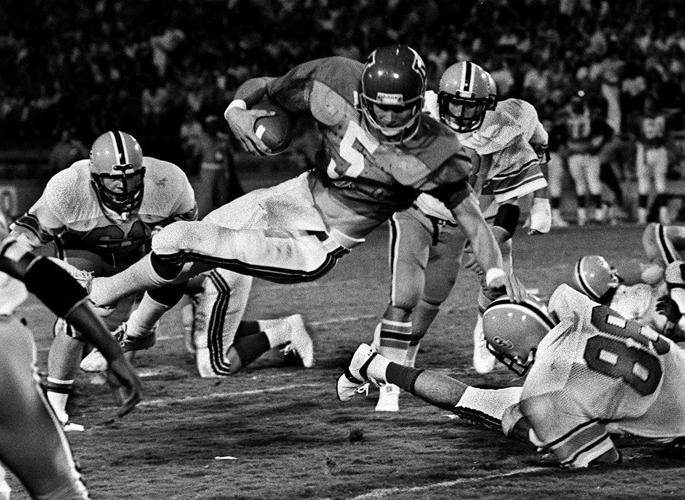
ASU was the big fish in WAC sports; under Kush, the Sun Devils had gone 62-9 from 1970-75 and were ranked Nos. 2, 6, 8, 9 and 13 in the final AP football polls. They were dominant in track and baseball.
UA athletic director Dave Strack conceded that joining the Pac-8 would give the Wildcats more academic prestige and more athletic clout, but admitted “we are happy with the WAC, and it’s probably more fun in the WAC.”
Pressure mounted; New Mexico pleaded with the Wildcats to stay, and Strack listened. The basketball rivalry between the Lobos and Wildcats was among the best anywhere.
As amazing as it seems four decades later, the WAC of the late 1960s and most of the 1970s was a superior basketball league to the Pac-8, which had been UCLA and the seven ghosts.
Star sports columnist Tom Foust was concerned that Arizona’s 1970s rise to national relevance in baseball, basketball and football would be diminished. What would happen when thrown in against the wolves at USC and UCLA?
“The two Arizona schools are the kingpins of the WAC; they have it made,” wrote Foust in 1976. “It’s a young league with a future.”
Intentional or not, Arizona and ASU had been moving toward the Pac-8 since the WAC began. The Wildcats played 15 football games against Pac-8 schools between 1961-76, and ASU played Pac-8 schools 20 times. The growth of Phoenix and Tucson as metropolitan centers — and the geographic nearness to Los Angeles — made it more appealing to the Pac-8 schools, many of whom had fought internally for 20 years.
The genesis for the partnership was an academic junket to Taiwan in 1975 when UA president John Schaefer and UCLA president Jack Hubbard reduced the issue to its most common theme: USC and UCLA were losing money playing football at WSU, Oregon and Oregon State.
“To many, the Arizona schools were more attractive financially,” Schaefer told the Star in 1978. “But to me, our academic affiliations were first.”
Arizona’s Schaefer and USC’s Young were given most credit for making expansion possible. Momentum grew; Stanford president Richard Lyman, who earlier said he didn’t view Arizona and ASU as academic equals, helped to persuade the last holdout, WSU, to make the vote 8-0.
Schaefer worked in harmony with ASU’s administration and shared his academic-first vision. Ultimately the rival schools fully understood the value of moving into a league with Stanford and UCLA, abandoning long partnerships with UTEP, Wyoming, Utah and BYU.
On September 16, 1978, Arizona played its first Pac-10 game, beating Oregon State 21-7 at Arizona Stadium. Two years later the Wildcats stunned No. 2 UCLA and in 1981 the Wildcats rocked No. 1 USC.
The good old days of the WAC were quickly forgotten.
Where are they now: Schaefer, 81, was president of the UA from 1971-82. He has operated a research firm and been involved with biotech corporations and founder of the UA’s Creative Photography Center, among other pursuits. He lives in Tucson.
How they did it: Strack, who died three years ago in Tucson at 90, left his job as athletic director in 1983. The last time I met with him, Strack said ASU athletic director Fred Miller was initially reluctant to leave the WAC.
“I told Fred, ‘Well, that’s your decision. We’re going,’” Strack said. “‘You want to stay? That’s OK with me. We’ll be one-up on you in scheduling and recruiting.’ ”
ASU soon joined Schaefer and Strack’s effort to change conferences.



 5 takeaways from Arizona football’s 29-28 comeback victory over TCU | Michael Lev


