
Just when you thought the clock had struck midnight on Arizona’s season, that happened.
A tumbling third-and-goal touchdown catch from the 15-yard line. A pooch kickoff recovered by the Wildcats. A go-ahead field goal by the much-maligned Michael Salgado-Medina. A clinching interception.

Michael Lev is a senior writer/columnist for the Arizona Daily Star, Tucson.com and The Wildcaster.
No. 22 Arizona was on the brink of a crushing defeat against underdog TCU Friday night. The clock literally ticked toward midnight. The Wildcats needed something akin to a miracle.
And they managed to pull it off.
Arizona rallied for a highly improbable, utterly stunning 29-28 victory over TCU at Casino Del Sol Stadium. It was the Wildcats’ most astonishing fourth-quarter comeback since the “Hill Mary” game in 2014. Poor Sonny Dykes was on the opposite sideline for both.
People are also reading…
Where do we even begin with this one? Let’s start this edition of Five Takeaways at the end.
1. Strategy, Part 1
After a perfectly placed pooch kickoff by Ian French that TCU’s Ed Small mishandled and Arizona’s Zuri Watson recovered, the Wildcats took over at the 26-yard line with 1:41 to play.
Brent Brennan and his staff then had to decide how to proceed.
Do you run it three straight times and put the game on the leg of Salgado-Medina, Arizona’s inconsistent junior placekicker? Do you mix in a play-action pass or an RPO, putting the ball in the hands of Noah Fifita, your best player?
I would have chosen the latter. Brennan picked the former. He wanted to bleed as much time off the clock as possible. Even if someone popped a run, Brennan instructed them to go down at the 1-yard line.
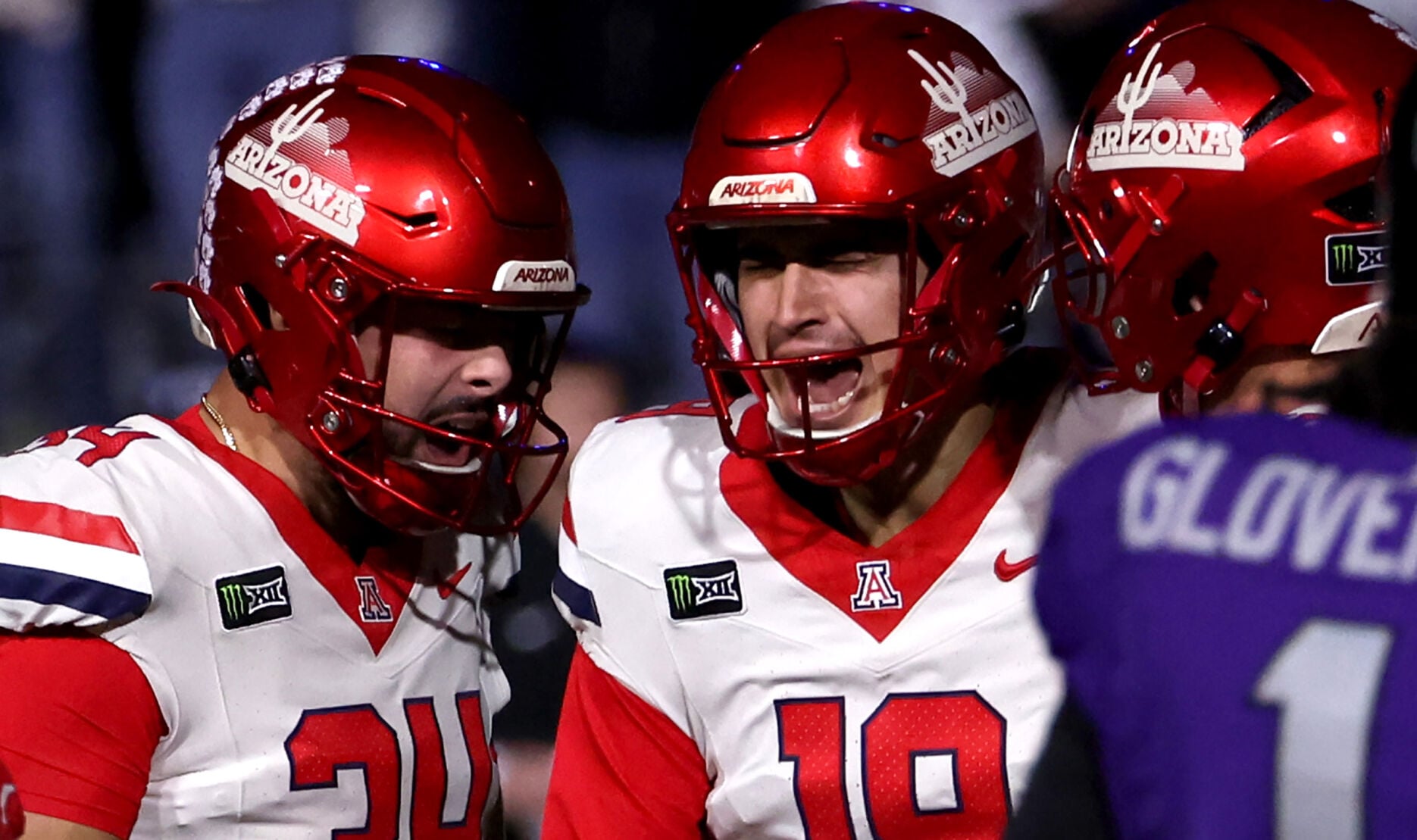
Arizona kicker Michael Salgado-Medina (19), center, exults with holder Carter Schwartz (34) after his field goal put the Wildcats up 29-28 in the last minutes of their Big 12 game, Tucson, Ariz., Nov. 6, 2026.
The three runs netted 6 yards. Brennan called time out with 43 seconds remaining.
Now, you could argue that it’s never a smart idea to settle for a field goal in college football. How many times have we seen guys miss in situations just like this?
You could argue it was especially risky to put Salgado-Medina in that spot. He hadn’t exactly been Mr. Reliable. He had a 63.6% career success rate entering Friday.
“Michael's been up and down,” Brennan acknowledged. “But we believe in Michael. That's why we keep putting him out there. And when it mattered, he nailed it.”
He most certainly did. Salgado-Medina hit a gentle draw through the uprights. Arizona had the lead.
TCU still had time. Thirty-nine seconds remained. The Horned Frogs only needed a field goal of their own.
It became a moot point seconds later when Tyrese Boss intercepted Jaden Craig.
Out came the Turnover Sword. Down went TCU.
2. Strategy, Part 2
How to manage the offense after recovering the kickoff wasn’t the only massive decision Brennan and his staff had to make.
They also had to figure out what to do with the kickoff itself.
Arizona scored with 1:45 remaining. The Wildcats’ two-point conversion attempt failed. They trailed 28-26. But, critically, they had all three of their timeouts.
That meant they didn’t have to try an onside kick. They could kick deep, stop TCU and get the ball back with decent field position and enough time to drive for the winning field goal.

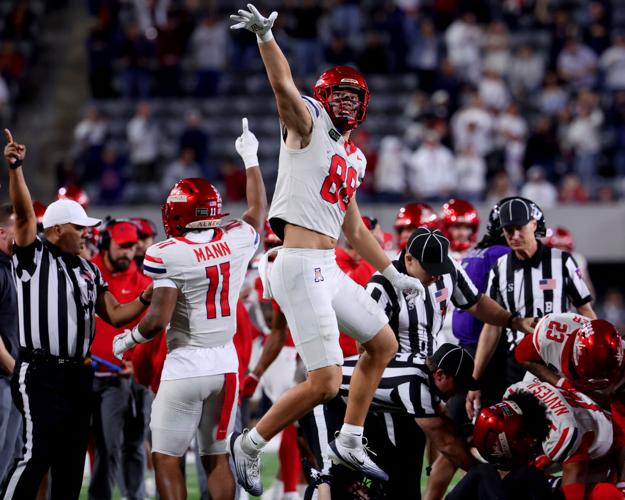
Arizona tight end Henry Gabalis (88) jumps for joy after the Wildcats recovered an onside kick in the last minutes against TCU, Tucson, Ariz., Nov. 6, 2026.
That’s what I would have done. That’s not what Arizona did.
Brennan huddled with special-teams coordinator Craig Naivar, defensive coordinator Danny Gonzales and general manager Aaron Knotts, who advises Brennan on clock-management decisions. They chose Door No. 3 — the pooch kick.
“Let's put it in play,” Brennan said of the group’s decision.
Here’s why that made the most sense of the three options:
Traditional onside kicks are a low-probability proposition. If they had recovered the ball, the Horned Frogs would have been on the edge of field-goal range. Even if they didn’t move it much, they could have dropped a punt inside the 10. TCU’s John Hoyet Chance had done that very thing earlier in the game.
Kicking deep would have been fine, but odds are that it would have resulted in a touchback. Even if French had kicked the ball short of the goal line, Dykes likely would have told his kick returner to call a fair catch. Either way, there’s basically no chance of a miscue.
The pooch was a brilliant compromise. It left open the possibility of something crazy happening without the downside of yielding prime field position. Even if Small had fielded the ball cleanly, TCU would have started inside its own 30.
3. Tre bien
Sixth-year defensive end Tre Smith entered Friday without a sack. That’s not what anyone expected from someone who’s supposed to be Arizona’s best defensive player and top pro prospect.
Smith left the TCU game with his first sack of the season and a whole lot more.

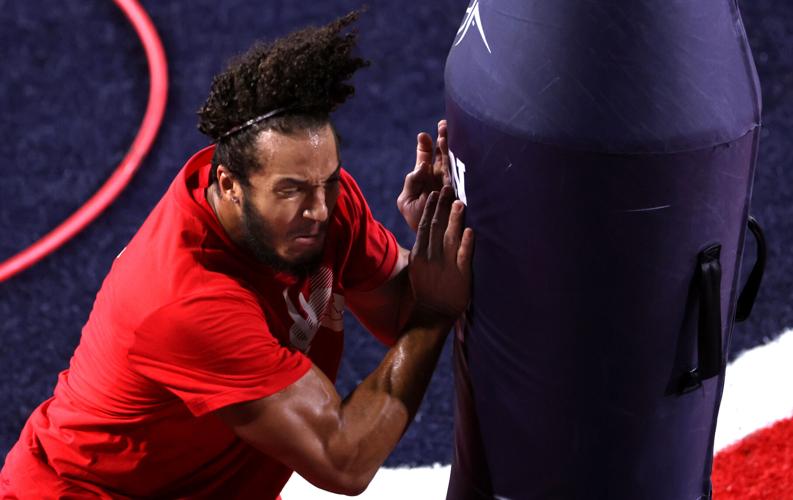
Arizona defensive lineman Tre Smith (3) hits a target pad during the team’s warm-ups for TCU, Tucson, Ariz., Nov. 6, 2026.
It’s safe to say that the Wildcats wouldn’t have beaten the Horned Frogs without Smith. His contributions were many. And they were mostly noticeable — unlike the dirty work he regularly does that doesn’t show up in highlights or on the stat sheet, such as stonewalling rushing attempts or occupying blockers so his teammates can make plays.
The first big play he made Friday night was classic Tre Smith — understated but effective. On TCU’s first field-goal attempt early in the second quarter. Smith shot through a gap and was in prime position to block Kyle Lemmermann’s 37-yard attempt. Lemmermann pushed it right — at least in part because the 6-foot-5 Smith was right in front of him with his arms outstretched.
Lemmermann would get another try in the third quarter. TCU led 14-10 at that point and had all the momentum.
Smith had other ideas. He again wedged his way between blockers. This time, though, he swatted the ball right back at Lemmermann. Arizona responded with a touchdown to reclaim the lead.
Smith’s sack came early in the fourth quarter on third-and-12. It forced a TCU punt.
He authored the grand finale on the game-clinching interception. Smith got pressure on Craig. TCU’s quarterback struggled to throw accurately when he had pass rushers in his face. He went just 2 of 7 for 13 yards when pressured, according to Pro Football Focus’ initial game review.
Sure enough, Craig threw high toward Jordan Dwyer, who had run a stop route near the left sideline. The ball sailed into Boss’ hands.
Give Smith the assist. It was his season-high fourth pressure of the game, per PFF.

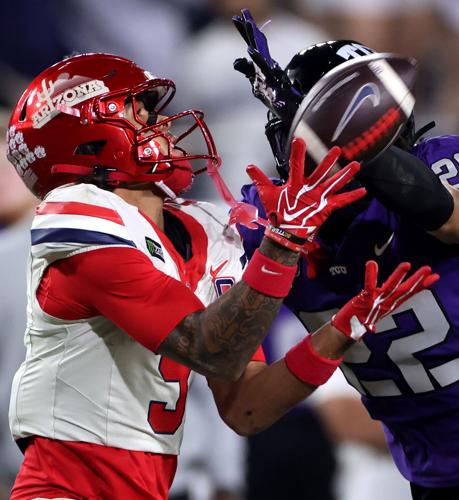
Arizona wide receiver Giovanni Richardson (5) hauls in the long pass after slipping by TCU safety Jordan Lester (22) to put the Wildcats into the red zone in the third quarter, Tucson, Ariz., Nov. 6, 2026.
It wasn’t quite a second sack, but it was a winning play. In other words, classic Tre Smith.
4. Gio and Isaiah
Isaiah Mizell’s streak of 100-yard receiving games ended against TCU.
No worries. Giovanni Richardson had his back.
Richardson had a career night, catching 11 passes for 171 yards. Mizell wasn’t exactly shabby, totaling six catches for 78 yards and a touchdown.
The sophomores are becoming a potent one-two punch. Their playmaking partnership might not have materialized if not for some misfortune.
At the outset of the season, Richardson was one of three starting wide receivers alongside Tre Spivey and Chris Hunter. In Week 2, Richardson got hurt. A few weeks later, the entire starting trio went down.
Those injuries created opportunities for Mizell, who blossomed. But it wasn’t until the Texas Tech game on Halloween that the Mizell-Richardson pairing became a real problem for opposing defenses.
Richardson returned to and stayed in the lineup against the Red Raiders, catching six passes for 90 yards. Mizell one-upped him, going off for seven catches, 182 yards and a touchdown.
With both of them on the field, it’s a pick-your-poison dilemma for the other side. Double-team one and risk giving up a big play by the other.
While both have displayed excellent run-after-the-catch ability, their overall skill sets are just different enough. Mizell (6-1, 170) is a long and lean speedster who can run past just about anyone. Richardson (5-10, 180) is built more compactly and thrives in high-traffic areas, excelling on in-breaking routes.
Together, they’ve been unstoppable the past two weeks.
Assuming they’re all back and healthy next season, can you imagine a receiving corps led by Mizell, Richardson and Spivey? That’s a mighty appealing prospect for Fifita’s successor — and a scary thought for defensive coordinators throughout the Big 12.

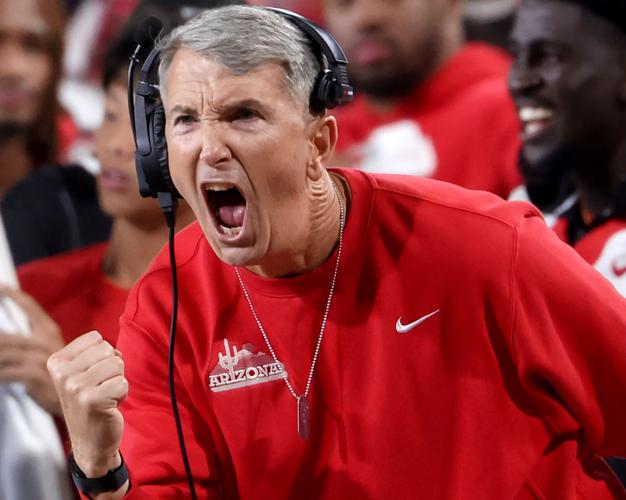
Arizona head coach Brent Brennan shouts encouragement to the offense trying to get in the end zone in third quarter against TCU during their Big 12 game, Tucson, Ariz., Nov. 6, 2026.
5. Don’t stop believing
Wins like this don’t happen very often. They can change lives.
Minimally, they can change the trajectory of a season.
Arizona’s promising season was in real danger of being derailed. The Wildcats were mere minutes away from a two-game losing streak that had the potential to devolve into something far worse.
Arizona will be the underdog next week against Utah, which entered Saturday’s “Holy War” vs. BYU ranked third in the country. A trip to Manhattan, Kansas, to face Kansas State follows. That has trap game written all over it.
If things had continued to go sideways Friday night/Saturday morning, Arizona could have been facing the prospect of a four-game losing streak. That thought crossed my mind more than once. It doesn’t take much to turn 9-3 into 7-5 (assuming a season-ending win over Arizona State either way).
Instead, the Wildcats survived and improved to 7-2. That coveted 9-3 record remains in play. Heck, so does 10-2.
Arizona certainly can play better than it did vs. TCU. Frankly, it will have to against Utah to have a chance.
But in terms of heart, determination and resilience, you can’t ask for more from these Wildcats. They played without three starting defensive backs for two-plus quarters. They repeatedly hurt themselves with penalties. They overcame all of it.
“The players kept believing,” Brennan said. “The sideline was electric, even in the tough moments of the game. Everybody kept finding ways to support each other, to love each other, to pour into each other. And it was just magic the way that thing finished.”
It was magical. It was memorable. It was Arizona’s Midnight Miracle.
Contact sports reporter/columnist Michael Lev at mlev@tucson.com. On X (Twitter): @michaeljlev. On Bluesky: @michaeljlev.bsky.social
Michael Lev
Sports Reporter/Columnist


 On Arizona football’s alternate reality and other Big 12 thoughts | Michael Lev