
The temptation is so strong, worse than the sirens in Homer’s Odyssey. It is not just about the beaucoup bucks. It may be easy to think it is, convenient even, but it’s not. It’s the realization of the dream. Who could possibly deny a man his dream, one a dozen years in the making?
Aaron Gordon heard the call and jumped faster — and higher — than he did even in his NBA Slam Dunk Competition showcase.
Stanley Johnson got caught up in the whirlwind, and though he took a bit longer to declare his intentions, he, too, eventually left Tucson for the glitz and glamour of the NBA.
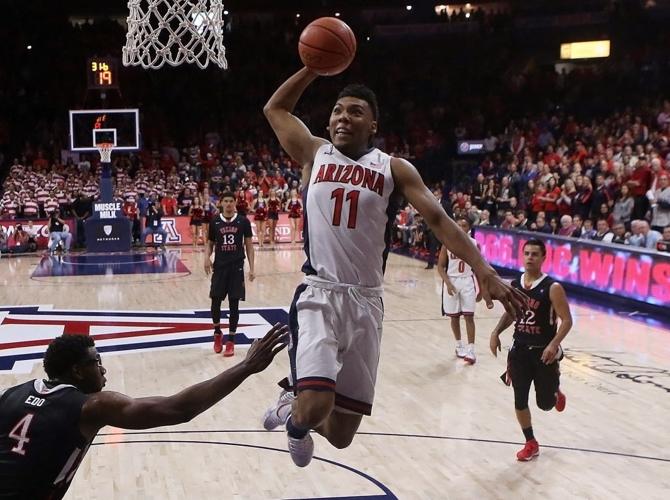
Arizona’s latest freshman sensation scores 15 points a game, more than Gordon and Johnson did during their lone seasons in cardinal and navy. He has eclipsed 20 points eight times — more than Gordon and Johnson did, combined.
While he has received far less hype than either of them this season, he now faces the toughest dilemma of the three.
People are also reading…
For Allonzo Trier, these are trying times.
•••
Better than crying times, though, no?
Trier buried his head into his elbow in the locker room last Friday night, shattered by the Wildcats’ 95-89 overtime loss to Oregon in the Pac-12 Tournament semifinals.
No one took the loss lightly, but Trier looked as if someone kicked his puppy in the face.
“I came here to win,” he said in the locker room. “I came here to be an elite-level player. That’s what Arizona is known as: an elite-level program that has elite-level players. It’s usually known for being in the winner’s circle and making deep runs in the tournament, winning the conference, winning the conference tournament.
“We fell short of that.”
Trier came here to win, yes, but will he stay here to win?
Up until Sunday night, all indications were yes.
For an entire season, the hype machine that churned out Gordon and Johnson seemed to be jammed when it came to Trier. He wasn’t as big or as strong or as ready as those two chiseled gods, or at least, that’s what the lack of buzz told us.
As opposed to the Wonder Twins, who spent their freshman seasons ranked near the top of consensus mock drafts, Trier has toiled in, well, not obscurity, but certainly not unanimous adulation.
The 6-foot-6-inch, 210-pounder is older for a freshman — 20 in January — and his game is a known commodity. He’s a scorer and driver, but he has some defensive limitations and he’s got to improve his passing.
NBADraft.net currently has Trier listed as the No. 35 prospect in this class, and as the 24th pick of the 2017 draft.
DraftExpress.com had Trier listed as a second-round pick in the 2017 NBA Draft for most of the season. It still has him listed there.
“A lot of it is upside and potential as a two-way player,” said Mike Schmitz, a video scout for Draft Express. “With Stanley, you’ve got a guy who is 6-foot-7, 245 pounds who can handle the ball, and he was two years younger than Trier at this point.
“While you can look at them as the same place, the two years is a big difference, and the physical attributes, too — Aaron Gordon is one of the most athletic players in the NBA and professional sports in a lot of respects.”
Yet it was Draft Express’ Jonathan Givony who sent Arizona fans into a frenzy on Sunday night, when he wrote that, according to sources, Trier was “likely to enter the 2016 NBA Draft.”
Sitting in that locker room after his Pac-12 Tournament title hopes were dashed, Trier was noncommittal.
“Of course, everybody has dreams and aspirations to play in the NBA, and when that time comes, I’ll answer that call and make that decision,” he said. “But right now, all I can focus on is the present. I can’t look past and regret how I play here, regret my effort, how hard I played, how well I played and if that cost our team.
“I don’t want to have to live with that.”
•••
In 1986, a former Cholla High School star turned in one of the great freshman seasons in Arizona and Pac-12 history.
Though Sean Elliott would go on to bigger and better things — a Wooden Award, a pair of All-American nods, a then-Pac-12 career scoring record, a Final Four berth, two NBA All-Star appearances, an NBA championship — he was once a 19-year-old star facing a decision.
It wasn’t much of one.
Timeout for a brief history lesson on brief college careers.
In the 1986 NBA Draft, not one freshman was selected, and just two sophomores and one junior were picked. Every other player was either a college senior or foreign. The next year, one sophomore, four juniors. The next year, three sophomores, two juniors. It wasn’t until 1995 that more than 11 sub-seniors were drafted, including high school phenom and certain Hall-of-Famer Kevin Garnett.
It’s fair to say that 1996 ushered in a seismic shift in potential over-production, as 19 players were drafted before starting their senior season, including high school phenom and certain Hall-of-Famer Kobe Bryant, and in 2000, the number jumped to 21.
Then: 23 players in 2001; 28 players in 2002; 14 players plus 20 international prospects in 2003; 22 in 2004; 26 in 2005.
In 2006, the NBA stopped allowing high school players to directly enter the league, and 24 sub-seniors entered the draft. Only two were freshmen.
In 2007, three of the top five picks were college freshmen — Ohio State’s Greg Oden (No. 1) and Mike Conley (No. 4) and Texas’ Kevin Durant (No. 2). In 2007, seven of the first 14 picks were college freshmen.
Between 2010-2014, just under nine freshmen were selected per year.
“A lot of these teams at the top of the lottery, they’re teams that need a piece, somebody you can build around,” Schmitz said. “If you’re selecting in the top eight, you want a guy who is younger with a lot of upside. If you’re in the mid-teens or the 20s, sure, you want a guy who can step in right away and give you solid production and maybe the ceiling is not as high.”
Last year, another leap took place: 14 freshmen were picked, including the first three picks and nine of the first 15 players selected.
Stanley Johnson went No. 8 to Detroit.
•••
So what has changed? Ask Elliott.
“I didn’t have the false confidence a lot of people have,” Elliott said. “Every kid thinks they’re ready, and they’re not ready. You see it with everybody coming out early, they really struggle. I had a firm grip of reality, and I knew I needed to get better.”
Harsh words, but entirely accurate for the kids of today.
We had Generation X, then Generation Y and now it’s Generation My. If present icons don’t get all they want, things they didn’t even know they want, and they don’t get them today, or, preferably, yesterday, well, you don’t want to know what comes next.
You don’t sense that entitlement with Trier.
He’s been at this thing since the age of 8, when his mother Marcie started shagging his loose rebounds and D-ing him up. He would attempt 500 shots a day, and it was no surprise when he was considered the best seventh-grader in the country.
“My mom is a huge focal point, the reason why I’m here today,” Trier said. “She stuck with me, sacrificed a lot for me to follow my dreams. I owe it to her to give it my entire effort.”
He would love to give her all the trappings of NBA riches. Who wouldn’t?
All Elliott is saying is they will still be there in a year, and maybe even more of them.
After watching his Wildcats fall to the Ducks — he spent most of the game seated in the front row, chopping it up with fellow NBA and Pac-12 hero Gary Payton — Elliott shared his wish for Trier.
One plea:
Think twice.
“It makes good sense; another year isn’t going to hurt anyone, especially a kid like that who has a lot of skill, a lot of talent,” Elliott said. “The thing is, at this level, you’re going to play and you’re going to get better. The next level, that’s not guaranteed. Everyone is talented. Everyone is good. And they know how to play.”
Yeah, but truthfully, when it comes to dollars, it’s not always about what makes sense.
•••
When Elliott decided to return to Arizona, he was staring at a contract worth, what, $700,000 a year?
This year, the No. 25 overall pick will make somewhere north of $1 million.
“The money was the money back then, and it was still more than anything I ever had,” Elliott had with a laugh. “I certainly can’t begrudge these guys if they’re going to come out and sign a $10 million contract. Who could tell them to stay in school? But it can be so much more.”
It can, and it already has for Trier, in so many ways.
Arizona may have been down a bit by its standards, but the Wildcats had a successful regular season. And next year, a loaded recruiting class — guards Kobi Simmons and Rawle Alkins, big man Lauri Markkanen and more — could position the UA for a national championship run.
Trier could well be a part of that. He adores the Arizona fans who’ve willed the Wildcats to an 17-1 record at home and who showed up in droves to take over MGM Grand Garden Arena last week.
If anything, Trier sounds like he’d want to come back just to give the fans something to cheer for again.
“The Arizona fans, every time we play in McKale Center, they more than live up to expectations,” he said. “They give us life. They give us passion. They deserve better than what we’ve been giving them lately. They deserve a winning program, a winning team, a team that’s going to play hard. If we go down, we go down with a fight.”
That’s the thing.
For a kid who might just have one foot out the door, he sure sounds like he has unfinished business.
Could a deep NCAA Tournament run quench that thirst? Do the Wildcats even have that in them?
“All I’ve heard about is how many 30-win seasons they’ve had,” Trier said. “It’s really frustrating. You want to be part of a team that wins 30 games again, you don’t want to be a part of a team that’s known for not living up to expectations.”
The interview ends on a Friday night in Las Vegas as the faint sounds of Utah versus Cal wisp into locker room.
The interviewer walks away but looks back to see Trier bury his head in his lap, towel draped over.
He scored 16 points and grabbed four rebounds on this day, but committed three turnovers and fouled out.
Starting on Thursday in Providence, he’ll have one more shot at glory this season.
Arizona hopes it is not his last.