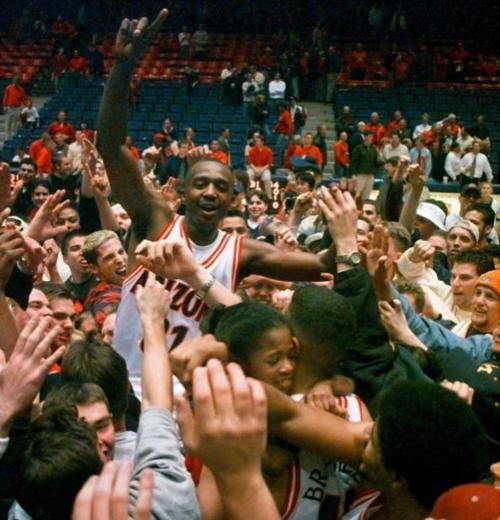
Jason Terry’s jersey is going to be retired tonight at McKale Center, so today’s NBA-focused teenagers are invited to gather ’round and listen.
It’s story time.
A long time ago, just when college players such as Mike Bibby began more often leaving college early for the NBA, Terry played four full seasons for the Arizona Wildcats.
He averaged less than 10 minutes as a freshman in 1995-96. Volunteered to be a sixth man in midseason as a sophomore. Continued that role as a junior. Turned into a star as a senior, when he qualified for a jersey retirement that was delayed until this year because of an old NCAA violation.
Then this: He began a 15-plus-year NBA career that’s still going with the Houston Rockets this season. And he has made over $100 million.
“I honestly believe four years at a Division I college, playing at a high level, is going to give you the necessary tools on and off the court that you need to survive in this league for a long time,” Terry told the Star after the Rockets played the Warriors last month.
People are also reading…
Terry said it can work “both ways,” noting that former teammate Miles Simon told him he would have been better off leaving as a junior in 1997 than returning as a senior. But Terry’s longevity in the NBA may say something, too.
Even if Terry didn’t get into the league quickly, as so many players want to today, he made it up on the back end. Bibby, who left UA as a sophomore in 1998, was done after 14 seasons in 2011-12. Gilbert Arenas, who left as a sophomore in 2001, stopped playing in the NBA after 11 seasons that same year.
So Terry’s story of NBA longevity is the kind of story that you’d think maybe UA coach Sean Miller could use as a pitch to keep guys from leaving school early but, well …
“Nope,” Miller said. “They’re not going to listen to that.”
He’s probably right, of course. It is a different era.
The end of Lute Olson’s reign at UA was plagued with early departures, and Miller has already felt the pain during his five-plus years: Derrick Williams left after two seasons in 2011, Aaron Gordon took off after only one last spring and a bunch of guys are expected to take off this spring.
But sticking around for four years isn’t the only thing that made Terry unusual by today’s standards. The other is in how he willingly moved back to the bench when Simon returned from an academic suspension in January 1997 — and stayed in that role as a junior in 1997-98.
Miller can only shake his head.
“Imagine, in today’s college basketball world, how many juniors would volunteer to be the sixth man? Doesn’t happen a whole lot,” Miller said. “Most are offended that they’re in school in their junior year. Shows you how much it’s changed.”
But again, it was a different time, and a different culture, that Terry was working his way through at Arizona as a guard from Seattle.
“What helped me was watching Steve Kerr’s career, watching Damon Stoudamire, even Reggie Geary when I came in,” Terry said. “I watched how those guys came in, waited their time and then Coach Olson handed the key to the vehicle, and it was like, ‘Wherever we go, you take us.’ Watching that process really helped me along the way.”
Even so, Olson said he knew early on that Terry had a selfless streak ingrained in him. Olson recalled Wednesday watching Terry at an old BCI (Basketball Congress International) recruiting event where players who played the first quarter of a game weren’t allowed to play the second, so as to guarantee playing time for everybody.
Olson watched Terry play in the first quarter — and really noticed him in the second.
“I sat behind their bench and I couldn’t get over how enthusiastic he was for everyone, cheering his teammates,” Olson said. “It didn’t make any difference who they were. That’s the kind of guy Jason Terry is. He really cares about everyone he comes into contact with.”
Throughout his UA career, Terry became a fan favorite for his skills as well as that personality. He had a smile like few others. Slept in his uniform the night before games.
And he was so religious about wearing his knee-high “CATS” socks that he once blamed an 0-for-9 NCAA tournament shooting performance in 1998 on the fact that they mistakenly didn’t make the trip. He tried to wear substitute knee-highs, but it didn’t work out.
“Fake CATS socks,” Terry grumbled.
But after the core of UA’s national championship team broke up in 1998 — Bibby, Simon and wing Michael Dickerson all took off — Terry had to add an extra layer of intensity to his game.
The Wildcats didn’t have a point guard in 1998-99 and didn’t really have a proven go-to guy.
Terry would have to be both.
Not surprisingly, he turned to Josh Pastner for help. The workaholic Pastner, now the Memphis Tigers’ head coach, became known as a freshman for working out privately with Bibby and didn’t hesitate to turn his attention to Terry in the summer of 1998.
Pastner said the two worked out every morning, starting at 6:45, and didn’t leave at least until Terry had made 200-300 shots.
“I thought he changed,” Pastner said. “He took the game more seriously as a senior. He really had a great focus about himself. He was on a mission. … He saw guys like Simon, Bibby and Dickerson and wanted to be like them.”
As a senior, he was. Terry averaged 21.9 points and 5.5 assists per game, but his most important stat might have been this: 38.2 minutes a game. Nearly all of them. Mr. Dependable.
Among other heroics was a jumper he hit with 3.4 seconds left to beat third-ranked Stanford 78-76 at McKale Center.
“He was the point guard, and the leader and everything else,” said then-associate head coach Jim Rosborough. “As I recall, it was kind of a natural evolution. I don’t remember that there was any big transition where it was, ‘You’ve gotta take over.’ But all of a sudden he was taking big shots, and hitting big shots. Hit that big one against Stanford. That year, there was nobody better.”
The pressure he was under, the leadership he needed, and the stamina that was demanded, all helped Terry as a pro. He needed all of those things to slip into 1998 NBA draft lottery, and to last as long as he has.
“That year definitely prepared me,” Terry said. “I think I heard whispers my junior year — ‘Oh, he might be a late first-round pick’ — and when I started believing that, I worked extremely hard my senior year, tireless hours before school and with Josh. That prepared me for what I was to face in the NBA.”
The Atlanta Hawks wound up making Terry the No. 10 overall pick in the 1999 NBA draft. He spent five seasons with the Hawks, eight with the Mavericks, and one year each with the Celtics, Nets and now Rockets. Known as the “JET,” with the Mavericks, Terry picked up an NBA Sixth Man Award in 2009 and an NBA championship in 2011.
But during all his long, productive years in the NBA, Terry’s name never surfaced on the McKale Center walls. He had qualified to have his jersey retired in 1999 when three major media outlets named him the national Player of the Year — UA requires a national award of some sort for a jersey retirement — but the school was prohibited from honoring him.
After Terry was found in 2000 to have received $11,500 from agents while playing for Arizona, the school made an agreement with the then-Pac-10 that he would be banned from the UA Sports Hall of Fame and ineligible for a jersey retirement, while Terry had to repay $45,363 in forfeited NCAA tournament revenue.
Terry says he paid the money back quickly out of his NBA paychecks, but the way for tonight’s ceremony wasn’t fully cleared until UA athletic director Greg Byrne successfully asked Pac-12 school presidents and chancellors for permission to remove the jersey retirement stipulation.
“Can’t worry about why it didn’t happen for so long,” Terry said. “Just gotta be honored and blessed that it’s happened now. More so than for me, it’s about people who helped me out along that journey.”
Maybe that’s JT, once again. Patient and selfless. As usual.