

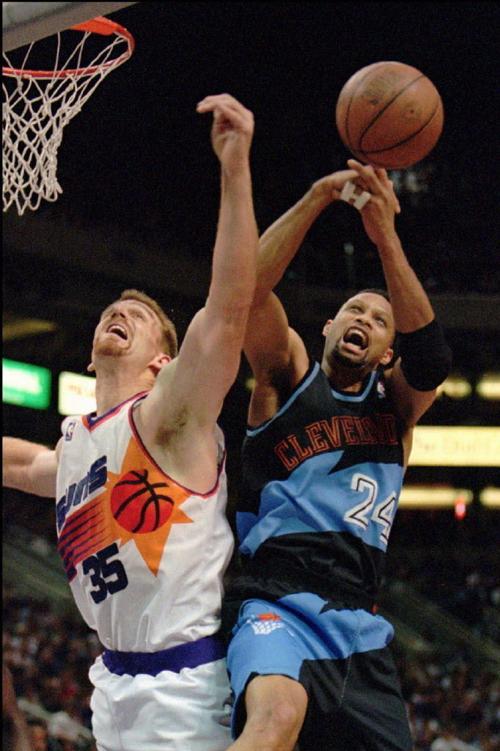
Chris Mills came to Arizona carrying some baggage.
Mills was forced to leave the University of Kentucky after his father allegedly received $1,000 from a UK assistant coach, getting caught as the money supposedly fell out of an envelope at a delivery office.
After Mills’ career at the UA ended, some more allegations arose.
One that, again, his father was given “unlimited use” of a former sports agent’s cars. And also, allegations arose that Mills — or someone close to him — forged signatures to change a failing grade to passing to allow him to graduate.
In part because of the drama, people forget how good Mills was on the court.
He was consistently Arizona’s best player on a team that included seven future NBA draft picks, including college stars like Khalid Reeves and Damon Stoudamire.
People are also reading…
A 6-foot-7-inch forward with scoring and rebounding ability, he was as talented a Wildcat as there maybe ever was, and it helped his stock as he entered the 1993 NBA draft.
Here’s a look back at Mills’ path to the NBA draft.
At Arizona: Mills was among the nation’s most sought-after high school recruits. A two-time California state player of the year at Fairfax (Calif.) High School, Mills averaged 33 points, 13 rebounds and four assists per game as a senior, and picked Kentucky over UCLA, UNLV and Syracuse.
When it came time to leave Lexington — after a freshman season in which he averaged 14.3 points and a career-high 8.7 rebounds per game — Mills considered UCLA and Arizona. The Bruins backed out, so Arizona was an easy choice. He committed to the Wildcats in June 1989.
“I knew coach Lute Olson had an outstanding program and I have watched Arizona play on television,” Mills said. “I like the style they play. I like the team concept. Coach Olson knows exactly what it takes to win.”
Olson compared Mills favorably with UA legend Sean Elliott.
“He’s quiet, he’s well-mannered, he’s intelligent, he’s talented as an individual,” Olson said, “but the name of the game is team play, and he’s a team player.”
After sitting out the required year as a transfer, he made his Wildcats debut in 1990, already leading the UA in scoring (15.6) with 6.2 rebounds and 2.0 assists per game. That season, the Wildcats went 28-7 and reached the Sweet 16.
After that, though, as Mills improved, the Wildcats suffered two of the worst NCAA tournament exits in program history.
When Mills was a junior, and led UA in both scoring and rebounding, No. 3-seeded Arizona was eliminated by 14-seeded East Tennessee State.
The next year, Mills averaged 20.4 points per game, was named an All-American and won Pac-10 player of the year. But the No. 2-seeded Wildcats suffered an unprecedented first round loss to 15-seeded Santa Clara, led by Steve Nash.
Those two losses were no fault of Mills, though — he averaged 18 points and seven rebounds in the defeats.
The draft: Most pre-draft projections had Mills in a tier below the 1993 draft’s elite players, which included Chris Webber, Shawn Bradley, Jamal Mashburn, Anfernee Hardaway and now-ASU coach Bobby Hurley.
Mills visited with half of the league’s teams for workouts, and early projections had him going to the Detroit Pistons (with picks No. 9 and No. 10) or the Los Angeles Clippers at No. 13.
Elgin Baylor, the Clippers general manager and an NBA legend as a player, said: ““He can play. He is a basketball player.”
Mills fell further than expected, dropping out of the top 20 before the Cleveland Cavaliers drafted him at No. 22.
After the draft, he signed a five-year rookie deal worth $5.22 million.
From the archives: “I was back there wondering, ‘Where am I going to go?’ I guess I’ll have to (work hard and) let those teams that passed on me know they made a mistake.” — Mills on the TNT broadcast of the draft.
As a pro: Before his career even started, Mills had a cameo alongside a number of other NBA players in the Nick Nolte-led basketball film “Blue Chips.”
He impressed early in his tenure with the Cavaliers, leading one local beat reporter to write: ““This guy is a 6-6 athlete with a 23-year-old body and a 33-year-old head. He doesn’t need to be told to rebound. Tell him to double-team and when to stay with his man on defense, and he’ll remember. Even better, he follows his jumper to the backboard, making him a rarity in the NBA — a player who doesn’t assume every shot he takes is going in.”
Mills would spend four seasons with the Cavs, the best of which came in 1995-96 when he scored a career-high 15.1 points per game.
Then he started bouncing around the league. In 1997, he was traded to the New York Knicks; in 1999, he was moved to the Golden State Warriors; in 2003 he was traded to the Dallas Mavericks and a few months later, to the Boston Celtics. Finally, he was traded again in 2004 to the Atlanta Hawks but was cut one month later, ending his NBA career.
He wound up playing 10 seasons in the NBA, with a career scoring average of 11.2 points.


