

Good communication again will be critical for the Buffalo Bills’ offensive line Sunday against the exceptionally fast Carolina Panthers’ defense.
Carolina has two of the fastest edge rushers in the NFL in Haason Reddick and Brian Burns. Reddick runs the 40-yard dash in 4.52 seconds, Burns in 4.53. That’s wide receiver speed.
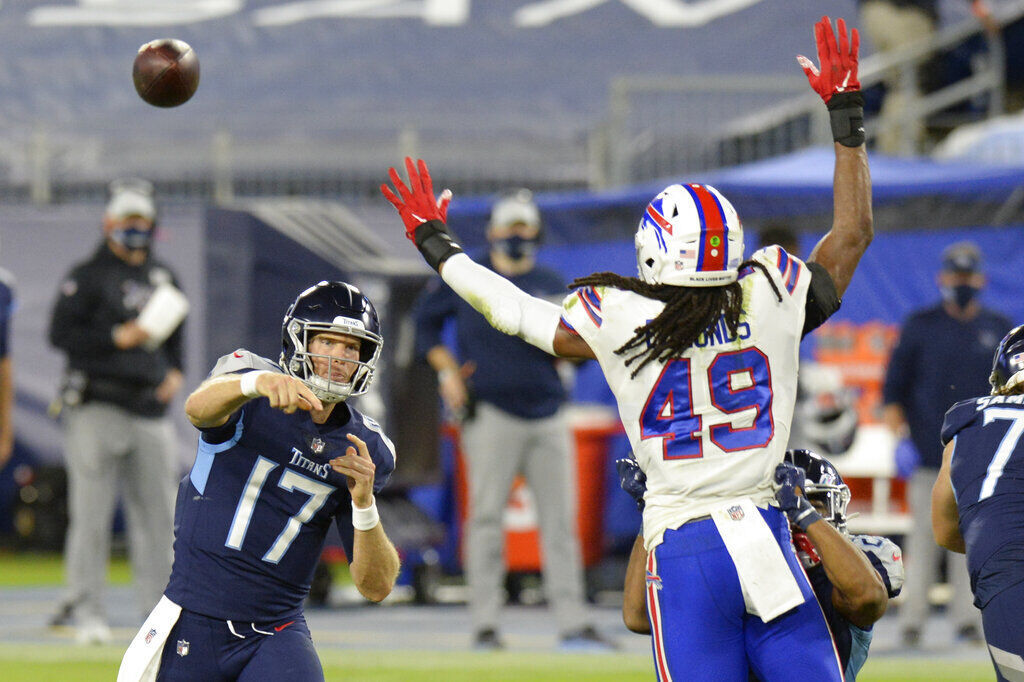
"Take a deep breath on Edmunds," writes Mark Gaughan. "Did we mention he’s only 23? The Bills need more out of him. But he still has growth potential."
The Panthers rank fourth in the NFL in sacks per pass attempt. When they get offenses in third-and-long situations, they will “spin the dial” late, creating a lot of false pressure looks, moving guys in and out of rush lanes.
What exactly does the center communicate at the line of scrimmage? The Bills’ Mitch Morse and former Bills center Eric Wood offered some insight this week.
Every play has a blocking scheme or a pass protection built into the call. If it’s a pass play and the Bills need to switch the protection call, the Bills have quarterback Josh Allen call the change. That’s the way New England always did it with Tom Brady, and Bills offensive coordinator Brian Daboll was trained in the New England system.
People are also reading…
When the linemen get to the line of scrimmage, most of the time the center is saying something to the guards next to him, even if it’s just confirming the call.
“Absolutely, you say something most plays,” Morse said. “What’s being said is dependent on the play, the situation you’re in. One of the old sayings is, ‘No secrets need to be kept on the field.’ You’d rather the guy across from you know what you’re doing and all five of your guys knowing than have four of your guys know and one of your guys not knowing. You’d rather have everyone on the same page.”
“Even though we should all know the play call, I’m confirming, hey we’re going to slide in this direction,” Wood said. “The reason you double-confirm it is when you have the most valuable asset in your organization at quarterback, you want to make sure we’re all on the same page.”
Obviously, the defensive linemen and linebackers line up in different spots on a lot of plays. This requires communication by the center.
“So when the center comes up, often times there’s this process of identifying the Mike linebacker,” Wood said. “The Mike linebacker generally is the middle linebacker, but it doesn’t always have to be. Then, some offenses use a count system off of that. The Mike linebacker is zero, then the next guy at the linebacker or secondary level might be one and so on. ... You’re identifying the Mike linebacker, and then who we’re going to go to on that particular play, and each individual person’s blocking assignment is generally based off of that.
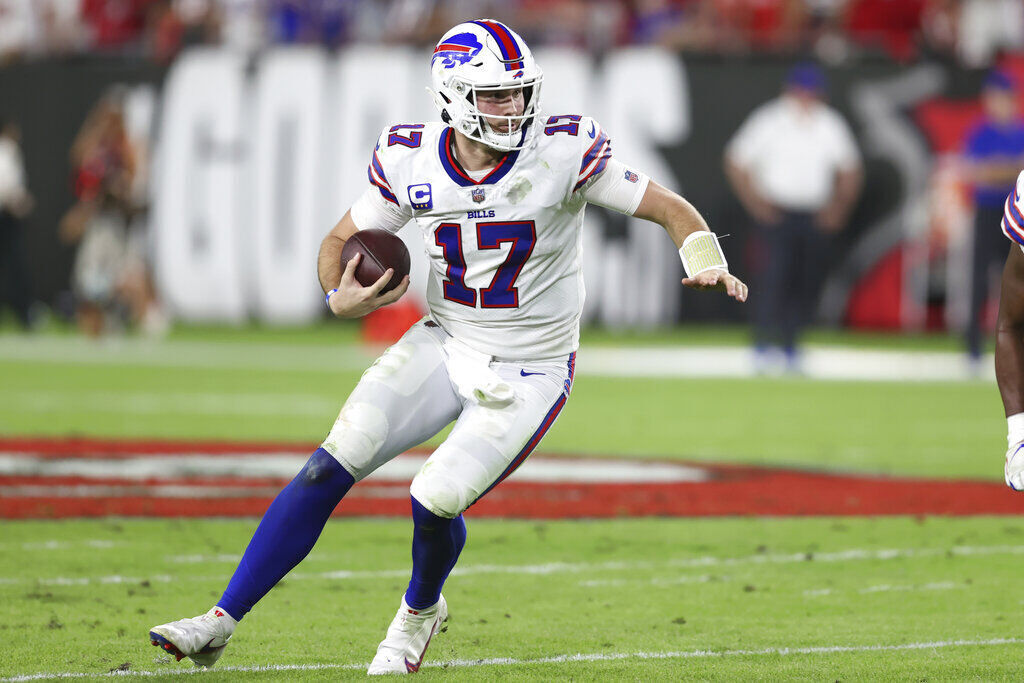
However, Allen's teammates thought he continued to improve as the team prepared for Sunday's game against the Carolina Panthers at Highmark Stadium.
The line is recognizing whether the defense has more players on one side of the formation or the other.
“For a run play,” Wood said, “a lot of times what a center is talking is A: who we’re going to block on the play; and B: what the combinations are going to be. So, do I need a little bit of help from my guard before he makes his way to the linebacker on this play? Or, can I get him one on one, and now you go help the tackle?”
If the line is facing a great player like the Los Angeles Rams’ Aaron Donald or the Tampa Bay Buccaneers’ behemoth Vita Vea, and that guy lines up over Morse’s shoulder, then the center might signal to his guard he needs a little more help. But the center probably only needs to say a word to his guard to signal that kind of help.
“I’ve clocked in hours with Ike during the week, for instance,” Morse said, referring to video studying with Ike Boettger. “Maybe Ike and my verbiage on the line might not be expansive. Maybe it’s just one word or two words, understanding each other, because we’ve put time on task together. That just locks us in. We’re on the same page. It’s not anything lengthy, especially with guys you’ve played with.
“You shape a whole game plan, run and pass, around a player as generational as Aaron Donald. You have a game plan, run or pass, vs. him. You got guys like Aaron Donald, Vita Vea, you have to account for them. They’re just that disruptive in the run and the pass.”
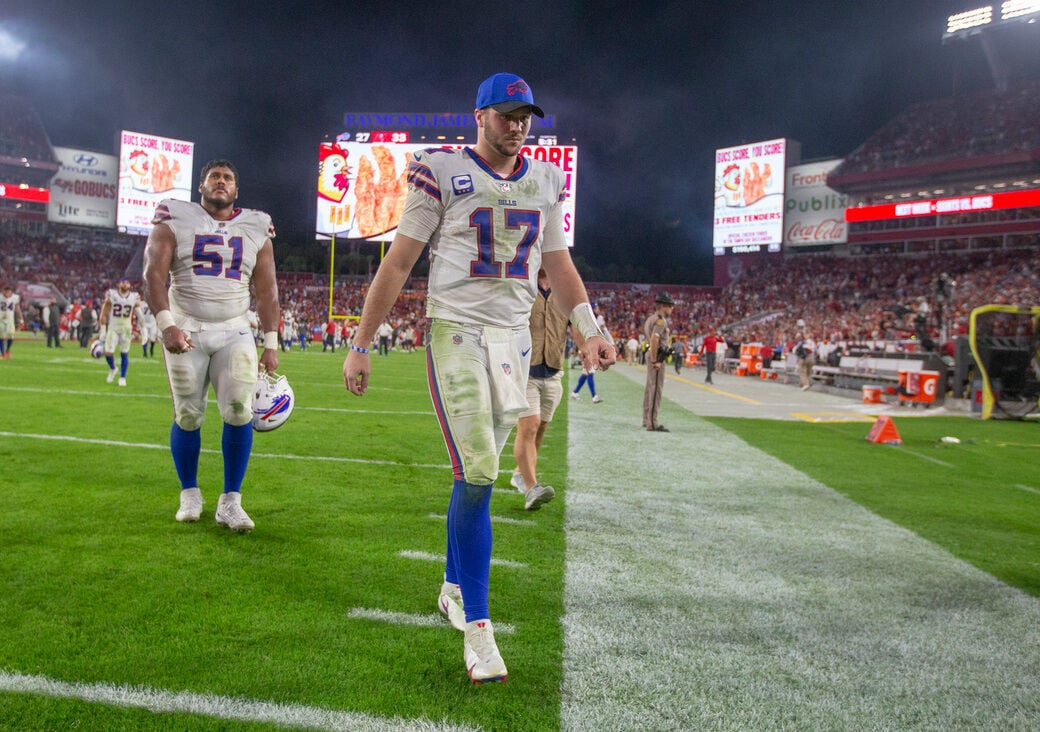
“He's working through it, he's a tough guy,” coach Sean McDermott said Wednesday.
Against Donald, the offensive line probably is going to slide in his direction a lot of the time in pass protection. That doesn’t mean all five guys slide in his direction. NFL teams rarely do that, because that would leave a running back to block a defensive end. It almost always means a half-slide in his direction. A lot of teams refer to that as a “jet” call. Three guys slide Donald’s way to pick up Donald and the defensive end, as well as the linebacker on that side (if he blitzes). Or maybe the running back is responsible for that linebacker. That leaves two offensive linemen to block man-to-man against the two defensive linemen on the other side in a five-man protection.
“The most popular protection, for terminology, is jet protection, which would be a half-slide protection, and it might be an R or an L word,” Wood said, referring to a three-man slide right or left. “This side of the line is man – they’re one on one. This side of the line is going to block the three most dangerous.”
During Wood’s Bills career, he was responsible for changes in protection calls, not the quarterback. But many veteran quarterbacks now take charge of the protection.
“On my first three teams in the league, including the Bills, the center was in charge of all the protections,” said Ross Tucker, who played for the Bills in 2003 and 2004 before going to New England. “When I went to New England, they were the first team where the quarterback handled all that, which was unusual to me. But now it’s become a lot more standard. The quarterback was in charge because they’re standing up, so they can see things a little better. No. 2, the quarterback needs to know who’s getting blocked and who’s not, anyway, if it’s a pass, and the quarterback can get you into a better run play if needed. Brady is phenomenal at that.”
Eat light. Burns and Reddick split their time almost equally on either side of the line. So Bills tackles Dion Dawkins and Spencer Brown will have to be ready for both. Dawkins was asked about preparing for their speed.
“Just watch what I'm eating in the week, honestly, truly,” Dawkins said. “Like if certain days I want to just enjoy a nice heavier meal, I'll just skip it, and I'll just wait until that following week. So in my mind, I'm mentally saying, well, I should be a little bit lighter and I should be moving just a little bit quicker. So salad over steak for this week. Salad over steak.”

How do The News' sports writers see Sunday's game against the Carolina Panthers at Highmark Stadium?
The 30,000-foot view. The Panthers still have to solve their quarterback problem. Owner David Tepper has been rumored to covet Houston’s Deshaun Watson, but the Panthers are short on draft capital if they want to get into the bidding for the sidelined QB. In the 2022 draft, they have no second- or third-round picks. Their second-rounder went to the Jets in the deal for Sam Darnold. Their third-rounder went to the Jaguars for cornerback C.J. Henderson. They may have to include a young star to try to outbid others for Watson. Darnold has underwhelmed this year. He’s 4-5 with seven TD passes, 11 interceptions and a lowly 35.4 passer rating. Darnold is virtually guaranteed to be on the Panthers’ roster next season, because his salary for 2022 is a fully guaranteed $18.8 million. There’s no benefit to releasing him.
Sixth-round pick. The Bills are due to get Carolina’s sixth-round pick in 2022 as a result of the August deal that sent defensive end Darryl Johnson to the Panthers. Johnson has appeared in only two games for Carolina and has seen only 10 snaps on defense. He was on injured reserve for six weeks.


