
The month the Pac-12 Networks officially launched — August 2012 — I was living in the Bay Area.
I started paying attention to the Pac-12’s efforts to build a full-scale television network the moment the league secured space in the building on Third Street in San Francisco. I know that block well; I’d regularly park in the lot right across the street from the networks' futuristic headquarters to walk to San Francisco Giants’ games at nearby Oracle Park.

PJ Brown is a sports reporter for the Arizona Daily Star, Tucson.com and The Wildcaster.
Personally, I was all in from the start, knowing that while the University of Texas-centric Longhorn Network and the Chicago-based Big Ten Network had preceded it to the airwaves, hitting television sets in this manner had the potential to be a game-changer for the former Pac-10, at that point 12-campuses strong now for a full year.
I followed along with the news as the space was built into the studios and even took a tour early on as part of a sports class I took at Stanford. The tour was led by Gary Stevenson, former President of Pac-12 Enterprises, who coincidentally helped launch the networks.
People are also reading…
Everything seemed ahead of its time. Within the walls of that startup, new and innovative ways to broadcast were developed, elite on-air and off-air talent was discovered and nurtured and quality production became the hallmark.
It’s easy to bash the Pac-12 Conference for not securing a distribution deal. And, yes, the lack of a worthy media rights deal is one of the main reasons that 10 of the 12 schools are leaving for other leagues at the end of the year.
While we learned last week that the Pac-12 Networks' studios won’t exactly go dark this June — the conference’s newest commissioner, Teresa Gould, shared that the network’s production capabilities would still be in use for holdovers Oregon State and Washington State as they move into quasi-independent status — just about anyone who has been or continues to be associated with the networks will tell you that not getting on DirecTV from the start, or at any time, was the leaky hole in the bottom of the boat.
On the flip side, what those of us who watched the Pac-12 Networks religiously have witnessed is stellar storytelling, top-notch analysis and, frankly, incredible production.
While other leagues have partnered with Fox (the Big Ten in recent years) and ESPN (Longhorn, SEC, ACC) in bringing their channels to life, the Pac-12 Networks stayed independent.
In many respects, it’s been the little engine that could in an ever-evolving era of distribution where debates of cable vs. satellite turned into linear vs. streaming right before our eyes.
As the Pac-12 Networks prepare to broadcast their final big-ticket matchups in the coming weeks — starting Wednesday and through the next two weeks it will air 18 of 22 Pac-12 Women’s and Men’s Basketball conference tournament games — those who work there continue to be guided by their ever-present daily mission: “to celebrate and showcase the student-athletes across all of the sports that make up the conference.”
Let’s take a look back at how the Pac-12 Networks were built, what makes this group tick and how they did so many cool things.
Three faces
When Mike Yam auditioned for the role to be front and center of the Pac-12 conference's new broadcast networks in May of 2012, he didn’t know how in the world they would be ready for launch that Aug. 15.

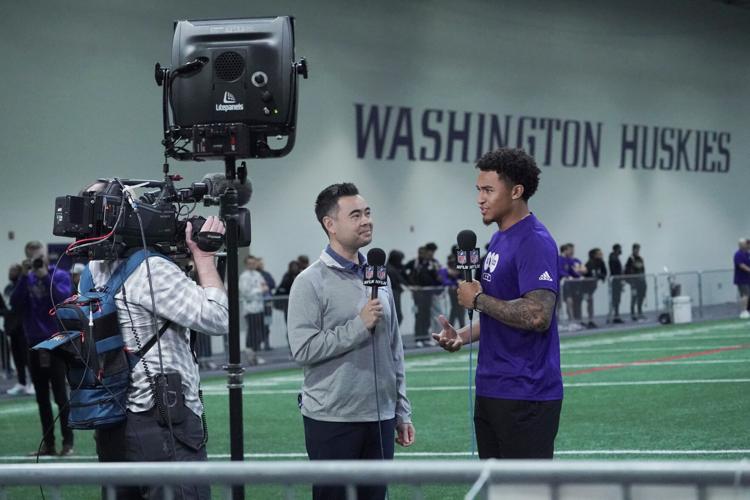
Mike Yam might not be with Pac-12 Networks any longer, but he still knows the conference's footprint well. Pictured, Yam, now with NFL Network, interviews Washington cornerback Trent McDuffie in March 2022 during the Huskies' Pro Day in Seattle.
“Our studio space was on the second floor and I remember (when) going and getting off the elevator we all had to wear hard hats and there were wires everywhere,” said Yam, now with NFL Network. “It looked like a bomb went off on that floor. There was a staircase from the third floor down to the second floor. That staircase didn't exist. There was a hole in the ceiling — they hadn't built the stairs. They brought me out onto the soundstage and there was nothing. It was an empty room. The control room looked like complete disarray. And I was thinking to myself, ‘You guys are launching in August, how is this even going to come together?’”
But there, he and Ashley Adamson stood, just a few short months later in a fully built-out studio, ready to go live (before and after some taped segments, of course).
Yam had come west from ESPN to work at the new network. He was looking to roll up his sleeves and build something from the ground up.
His partner, Adamson, was working local news at a station in Indianapolis. As soon as her dad sent her a story about Pac-12 Networks, she sent in her reel. This was a “chance of a lifetime.” She could live near her brother — actually in his basement to start — in a city she loved.

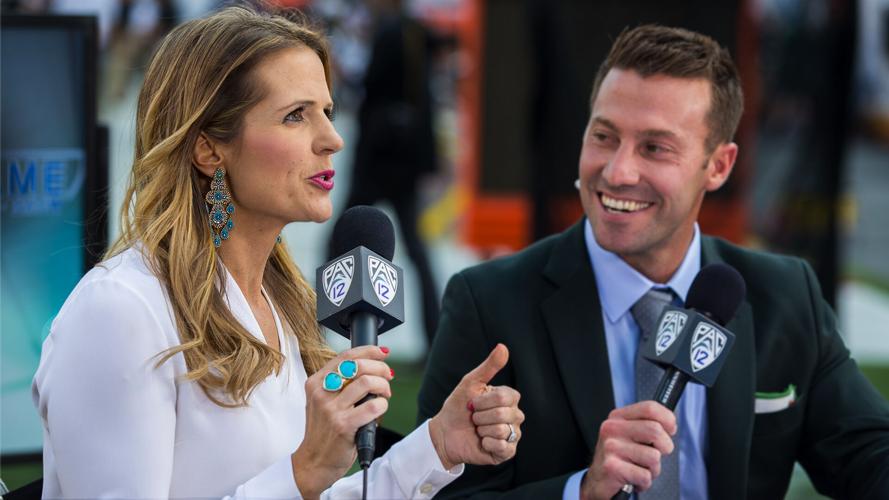
Two early Pac-12 Networks hires more than a decade ago, and to this day two of the conference’s most prominent on-air figures, Ashley Adamson and Yogi Roth are two of many who have brought the “it” factor to the broadcast operation both in front of and behind the camera.
Yogi Roth, who spent time as the quarterbacks coach on Pete Carroll’s staff at USC, was piecing together work for ESPN and Fox when he heard about what the Pac-12 Networks was trying to do to showcase the country's westernmost college sports programs. He asked for support from many, including Carroll, who called former Pac-12 commissioner Larry Scott on his behalf. For Roth, the opportunity to stay in Los Angeles, live near the beach and talk football, was a dream come true.
He was so ready and eager that he begged to be part of launch night and created his own social media role.
“I remember filming a little segment with Ashley Adamson and Mike Yam outside of the studio right before they walked in and we look like we're 15. It’s hilarious,” Roth said. “I didn't have that experience at the red light that Ashley and Mike did that first show. But I remember as they walked in, being like, ‘This is a historical time’ and I just go back to the first of something. I think that's really unique, and I think it bonded our group.”
And, as the story goes — one that has been shared many times — it was a night no one involved would ever forget.

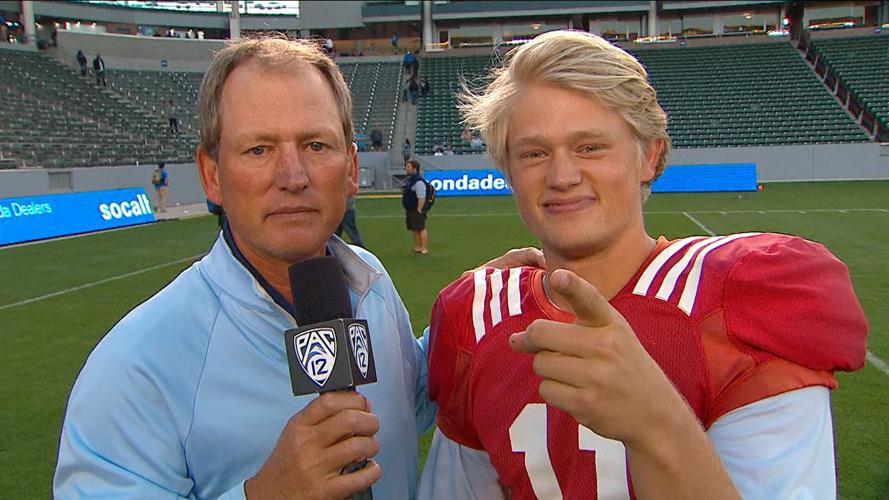
A longtime Pac-10/Pac-12 stalwart as a player and then coach Rick Neuheisel was among the marquee initial hires brought in when Pac-12 Networks took to the air. Pictured, the former UCLA quarterback (and later a head coach at Colorado, Washington and UCLA) interviews his son, Jerry Neuheisel — like papa, a Bruins quarterback himself — in 2014.
Afterward, in the green room, Rick Neuheisel, former head coach at Colorado, Washington and UCLA, brought out the Dom Perignon and waxed poetic: “I learned very early on in my coaching career that you celebrate every single win because you never know when the next one is going to come.
"And tonight, was an unbelievable win.”
As Adamson surveyed the room alongside Ronnie Lott and Summer Sanders — Lott a former USC star and eventual Pro Football Hall of Famer; Sanders a standout swimmer at Stanford before reaching the Olympic Games — she thought to herself, “How did I get here?”
Trying to hold back the tears, Adamson said "it was just one of those moments. Thinking back on that makes me smile so much.
“I didn't think I was going to get emotional about this but it's the people — it's always ... That's the most cliché thing to say because that's what everybody says, like, ‘oh, it's the people that make it special.’ But it really is. This conference has brought me to some of the most special people that I'll ever meet in my life. Some of my best friends that I've ever met, and we haven't even gotten into what we've been able to witness and watch and learn from the coaching legends and the different student athletes and the people in the league. All of that, of course, goes without saying but it's the people that I've been able to have in my life because of this job and this conference. That's 1A on my list of things I'm grateful for.”
Meanwhile, behind the scenes on this opening night, Ryan Currier was nervous. Everything was built from scratch — the technology, connectivity — to get to this moment.
“It was a combination of nerves. There were some white-knuckle moments, certainly, in the lead up to and the actual launch,” said Currier, the networks' senior Vice President of engineering and product.
“At the time there were a lot of lot of eyes on what we were doing. But once we launched and everything worked," he said, "I think there was just so much pride, but at the same time we had a lot of work to do."
It was just the beginning, but the Pac-12 Networks would go on to broadcast 850 events each year for the next 11-plus years, across at least 20 sports. The scale of that sort of undertaking, as well as the type of sports aired — a significant number of them the “Olympic” sports outside the realm of men’s basketball and football, and more than 50% of the total events being women’s sports — had never been done before.
That remains a point of pride for many who have worked at Pac-12 Networks.
“I've never worked around a group of people who cared more and who genuinely felt grateful for the work and the opportunity,” Adamson said.
Innovation
Among the multiple knocks on the Pac-12 over the years: The conference chose to have its headquarters in one of the most expensive cities in the country, San Francisco.
It's a fair criticism, from a financial standpoint. But for the endeavor that was Pac-12 Networks, it really was all about location, location, location.
The physical proximity of the Pac-12 Networks to the tech giants was invaluable from the start, Currier noted.
Twitter (now X) was in the neighborhood — just a 10-15 minute walk. And others like Google, YouTube, Apple and Facebook were just a short ride down the U.S. 101 or Interstate 280 freeways.
“Back in those days, the innovation was in the air in San Francisco, in the Bay Area,” Currier said.
And the Pac-12 Networks was right in the middle of it all, forming partnerships with many of these companies. It even helped the tech giants create new products, like Twitter Amplify.

The Pac-12, through Pac-12 Network, is said to have been one of the leading broadcast venues to figure out how to maximize a remote-camera operation that connected campus sites with the networks' Bay Area headquarters. This came long before the COVID-19 pandemic would make such a practice the norm.
“We worked with Twitter in the very early days creating a program that allowed us, and our schools as a collective, to have access to a certain number of highlights — basically short highlight clips that could be posted on Twitter. And then Twitter would sell ads against them. We would share the revenue,” Currier said. “This probably seems like the bread and butter of what is now Twitter, X, but at the time it didn't exist.”
It wasn’t only the partnerships; the Pac-12 Networks also became a hub of innovation on its own. Those who worked there say it was the first to develop and use the type of remote production that became central to broadcasting during the COVID-19 pandemic.
“This is a technology we have pioneered. A lot of other people have followed or are also doing it, you know, inclusive of the ESPN’s and Fox’s and NBC’s and many others of the world. I think humbly, people look at us as a leader in that technology and the ability to (have) cameras there, control room here (in studio),” said Larry Meyers, executive vice president of content.
Also called multi-cam or REMI (Remote Integration Model), this setup has allowed the Pac-12 Networks to have cameras and commentators on-site with the production done back at the studios. In some cases, the commentators are also in the studios. For fans, this means not seeing as many of those big production trucks at on-campus events. And for the league, it was a cost-efficient approach.
Currier said that the Pac-12 shared that and other innovations with various media companies, big and small, who would come to San Francisco to learn more about the processes and models that Pac-12-Networks used.
He said that knowledge sharing is typical in the broadcast engineering community. It’s even continued with what he called “cutting-edge technology” in the Pac-12 Networks' new studios in San Ramon, California (it moved out of San Francisco and across the Bay in 2023).
Other technological breakthroughs included the use of cloud and software-based production for live events and high-bandwidth internet-based connectivity with each of the league’s campuses.
And much of this goes hand-in-hand with the quality of each live event. Whether it’s something the middle of the day on a Wednesday afternoon or a marquee football game on a Saturday, the Networks' staff is “relentless and detail oriented," Currier said.
“We want it to be great,” Currier said. “It’s part of our DNA and something that is not an area that we've been willing to compromise. We've been able to maintain and achieve that while still creating efficiencies, reducing our operating costs over time through the use of these technologies.”
Nurturing talent
Innovation wasn’t the only area where things were moving at the speed of light. People were also moving up and around quickly.
One of the secrets to the success of the Pac-12 Networks in the early days; so many pitched in and were rowing in the same direction.
Roth was a prime example. Originally hired as a sideline reporter, only a few games in he was working in the booth, and soon became one of the top football analysts in the country.

Ashley Adamson and Yogi Roth of Pac-12 Network interview Arizona football coach Jedd Fisch during Pac-12 media day in Last Vegas in July, ahead of the 2023 college football season.
“They believed in me,” said Roth said known to be relentless in his preparation. “It wasn’t me saying, 'yes.' It was like me almost begging like ‘Hey, can I get invited to this party?
"Do you want me to mop the floors? No problem. You want me to be the Lyft driver? No problem or whatever I have to do to be involved, please,'" he added. "And thankfully they said yes. I think a lot of people showed up that way. They wanted to be a part of something that was one-of-one at the time — which is college football on the West Coast — at a really high level from a content standpoint.”
Roth wasn't the only one on a fast track.
Zohra Ziani was a freelancer and was working with CBS Sports on golf coverage when she heard about the Pac-12 Networks. She was interested in moving over to the production side and being back home in the Bay Area.
Ziani was originally brought on as a production assistant in the studio and in less than six years was a live events producer. That doesn’t happen this quickly on this side of the house. Now, she is a senior producer for remote events.
“Flying by the seat of your pants,” Ziani said of the startup environment. “We were doing things that wasn't necessarily the, quote-unquote, ‘traditional way’ — like if you came up at CBS Sports or Fox, or even at ESPN. You had all these opportunities to learn and it was up to you how much or how little you wanted. Anytime there was an opportunity I was like ‘I'm in; let's do it. Let's try it. We'll see what happens. Just throw me in the deep end. Let's see if I sink or swim.’"
Talents like Roth and Ziani were pulled in in the early days by director of talent and development Kristin Bredes LaFemina, and then by senior director of talent and development Odele Hawkins*.
“The secret sauce was having a great attitude,” LaFemina said. “(I was told) to go out and get the best people possible. Gary (Stevenson) was like, ‘Kristin, we want our faces, our people and it has to be our culture.’ I'm pretty good at figuring out how (put) to puzzle pieces together — that was always my superpower.”
This meant that the Pac-12 Networks would be creating its own stars from within. She was looking for team members who could be calm, no matter what was thrown at them, as well as those who loved the conference and college sports.
The three who became the faces of the Pac-12 Networks — Yam, Roth and Adamson — were the right fit.
Yam maintained that calmness, with LaFemina noting: “If the studio was on fire, Mike Yam wouldn't sweat like there would not be a bead of sweat on his forehead. You would never know."
She knew the minute she met Roth that “he was a star. There was nobody that had a bigger twinkle in their eye.”
Adamson was the other instantaneous, "I got-to-have-her moment." After watching her reel, LaFemina knew Adamson had "it" and offered her the spot without even meeting her.
“I wanted a one-two punch and I got that with Mike and with Ashley,” LaFemina said.
Roth added: “Ashley makes the room right. You walk into a room and she's not there. She walks in and you can feel her presence and she makes everybody better and makes everything better. And you add her talent on to it, of course, as an interviewer, as a host, as a broadcaster, she's phenomenal. Just from a skill set. She's got true mastery around it. But as a human, she's got a way to connect to people that I think is rarely seen in our industry and she makes you feel valued.”

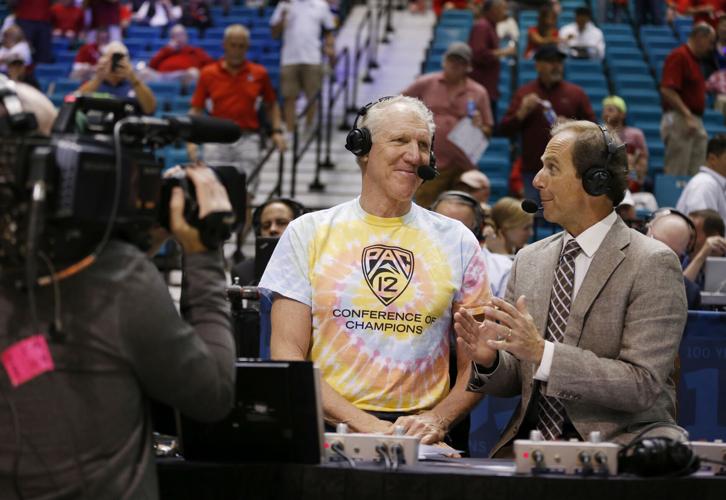
Analyst Bill Walton, left, speaks with play-by-play announcer Ted Robinson before a March 2016 Pac-12 men's basketball tournament game in Las Vegas. A Walton-called basketball game is like performance art, viewers left buzzing and sometimes even a little confused when it's over.
Many of the production crew and on-air folks have worked Super Bowls, Olympics, NBA, WNBA, NHL, NFL, MLB and more.
And many of the on-air faces have thrived while balancing other gigs at the same time. The non-exhaustive list includes play-by-play voices like Ted Robinson, Elise Woodard, JB Long, Cindy Brunson, Roxy Bernstein, Krista Blunk and Anne Marie Anderson, and analysts like former Arizona women's basketball coach Joan Bonvicini, former UA men's hoops great Matt Muehlebach and pioneering former WNBA coach Mary Murphy, among others.
Then, there is Bill Walton — one unto himself.
“The minute we hired Bill Walton I knew that was going to get eyeballs. I mean, that guy's a dynamo,” LaFemina said.
At this point, Walton's future broadcasting college games is unknown; he's been fairly mum on the topic, though it's possible, if not likely, that Saturday's Arizona men's basketball matchup at USC to close out the 2023-24 regular season and the handful of upcoming Pac-12 men's tournament games will wrap up Walton's exuberant tenure shouting and touting the "Conference of Champions."

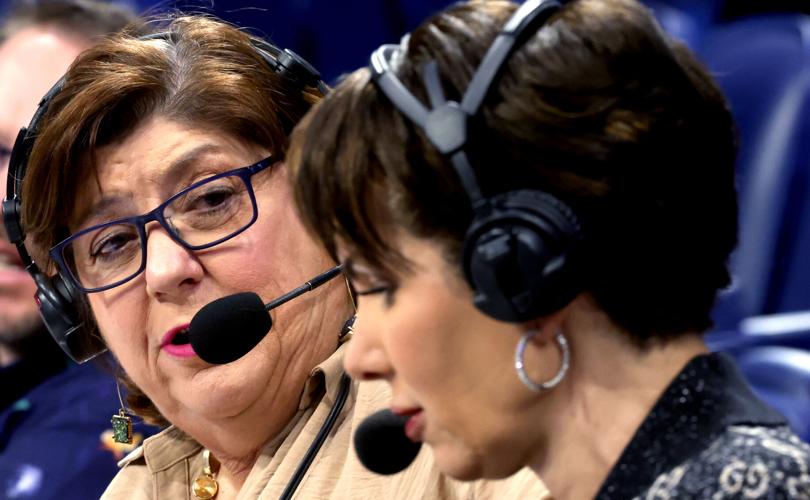
Working for Pac-12 Networks, former UA women's basketball coach Joan Bonvicini, left, and play-by-play voice Cindy Brunson get ready to call the final regular-season women's basketball game of the conference's current 12-school iteration, when Arizona hosted UCLA at McKale Center on Saturday night.
Among the many who who have gone on to other roles after their stints at Pac-12 Networks: former UA and NBA great Richard Jefferson; Matt Leinart; Ros Gold-Onwude; Dave Fleming; Cobi Jones; Steve Lavin; Danielle Lawrie; Lisa Byington; Coy Wire; Chiney Ogwumike; the Portland Trailblazers trio of Brooke Olzendam, Kevin Calabro and Lamar Hurd; and Kate Scott.
Like a proud mother watching her babies grow up, LaFemina gushed about her hires, and the network's talent as a whole. While LeFemina didn't hire Scott — Hawkins deserves that credit* — LaFemina noted how Scott stood out from the get-go.
“Kate Scott is iconic,” LaFemina said of Scott, now in her third season on the call for the NBA's Philadelphia 76ers, while also calling preseason games for the NFL's Seattle Seahawks this past fall. “(Scott) is one of the biggest rising stars that this industry will see and has seen. She is fearless. Fearless. The barriers she's been able to break.
"She’s just got it. She’s a superstar," she added. "She’s got an amazing, amazing voice. She preps like no other. She's got wonderful relationships with her analysts or sideline reporters, front office, the janitorial crew on the way up. Everyone knows her name.”

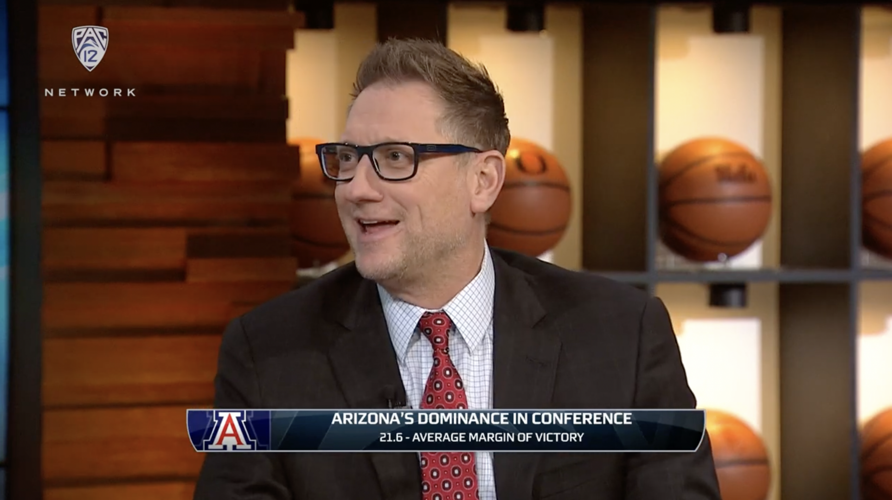
Former Arizona basketball player Matt Muehlebach (pictured during a studio segment in 2022), is an analyst for Pac-12 Networks and Fox. Muehlebach told the Star recently he knows “the realization of what’s happening with the conference” but that “for the most part, I try to stay in the moment and just do the games.”
It must be noted that LaFemina did go on to serve as Scott’s agent — she says “business partner" — until recently, when LaFemina joined MLS as Vice President, production management and talent.
Whether it’s Scott, Wire (CNN), Ogwumike (ESPN), Tammy Blackburn, Neuheisel or any of the others, LaFemina said what really was the differentiator at Pac-12 Networks was that “people just wanted it to be great.”
“At the end of the day, we all had one North Star goal and that was first to get on air and second to do it as a team,” LaFemina said. “Everyone was truly passionate about what we were doing. And we all wore an invisible badge of honor to be a part of it. The people were the best thing — absolutely the best thing ever. Still are.”
Strong ties, winning moments
It's the countless hours spent together laughing before, druing and after those iconic "Pac-12 After Dark," late-night matchups. Or a car ride up in Pullman, Washington. Or in and around virtually any of the Pac-12's existing 12 campuses across Arizona, California, Colorado, Oregon, Utah and Washington.

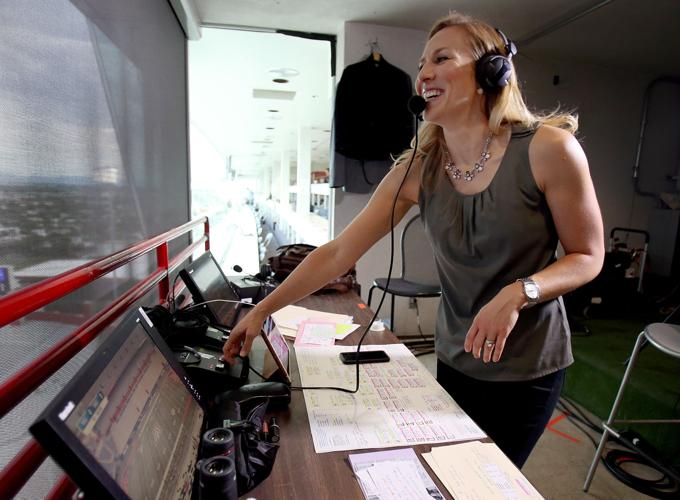
Kate Scott checks her headset communications and notes in the television broadcast booth at Arizona Stadium before NAU faced Arizona to open the 2017 college football season in Tucson on Sept. 2, 2017. That day Scott became the first woman to serve as lead play-by-play announcer for a Pac-12 Networks football broadcast.
For Yogi Roth, it's time spent with family.
When Roth’s mom passed away a few years ago, it was his Pac-12 Network family that was there for him.
He remembers attending Ashley Adamson’s wedding, and the night former Stanford offensive coordinator Mike Bloomgren asked him to hang out in the Bay Area after a spring football game instead of heading back to Los Angeles that night. The next day, Roth was on a flight he wasn’t supposed to be on and met his wife.
"Her smile lit up the entire airline." They now have two children — one who does 12 push-ups every morning in honor of the Pac-12.
And there's Ted Robinson, who Roth said, “might be the greatest influence on my life.”
Not only learning from him in the booth, which they shared on football game days, but Roth said Robinson helped navigate his roles of being a dad and a husband.
Listening to both Roth and Adamson, who also got married and had two kids during her Pac-12 tenure, it's clear their lives evolved significantly while they've grown into their roles as faces of the enterprise.
Adamson has been a true utility player; she's hosted studio shows, road-show coverage at football games, and has been the ringleader in Las Vegas for the men's and women's basketball tournaments — that along with podcasts, feature interviews and more.
Adamson said narrowing down her favorite moments or duties isn’t easy. She mentions the Pac-12 daily perspective during the pandemic, a feature on former Washington basketball standout Matisse Thybulle and the features on Stanford’s and Arizona’s runs to the NCAA women's basketball national title game (that won an Emmy, by the way).
But there’s nothing like the Pac-12 women’s basketball tournament.
“We've seen some of the biggest legends come through over the last 11 years, but what I love is the pure unadulterated joy that spills onto our set when a team upsets or beats somebody that they shouldn't, when there's some big win or buzzer-beating moment,” Adamson said.
“I just keep thinking about Washington State last year. We had the band on the set a couple times. We got (WSU coach) Kami Etheridge’s mom. It was it was such a beautiful celebration that entire run through the tournament for them. It was their first ever women's championship in any sport at Washington State. And I remember just being there and being like, ‘Man, I just feel so lucky that I get to sit next to you. This is unbelievable.’”

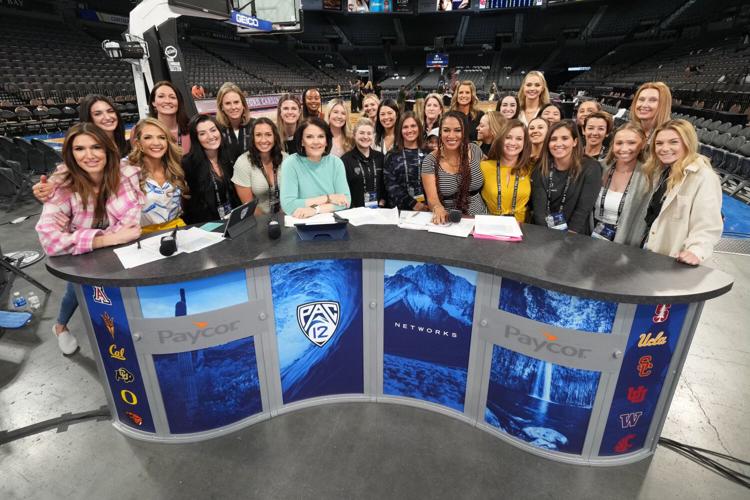
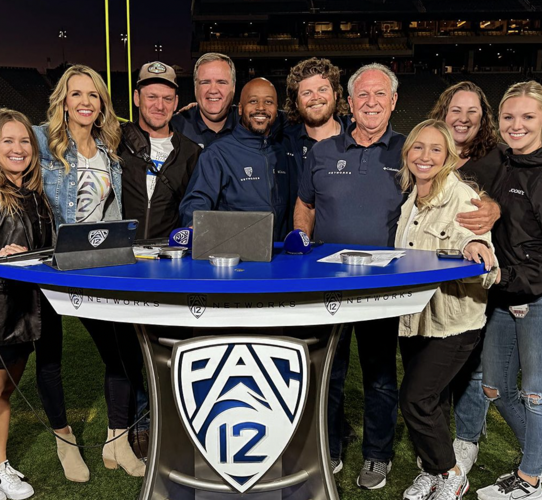
On-air talent and behind-the scenes staff pose for a group shot during the 2022 Pac-12 Women's Basketball Tournament in Las Vegas. Alongside the image on Instagram, Adamson's post ready: "Sports networks and conferences didn’t use to look like this. Beyond grateful to (Pac-12) for giving me the opportunity to work with so many inspiring women and shout out to the men who continue to support and push for change."
Adamson wasn’t the only one who claimed the women’s basketball tournament as a favorite event. Meyers said there is nothing that compares to that special moment after a game.
“The joy that comes out from that moment at that event on the court after the game — and I've been doing this for decades — is emotional. It brings tears to my eyes sometimes. This level of joy that we're able to translate from the court to the screen to the home is one of the great experiences of my career,” Meyers said.
“I look forward to it every year. Then you look at what the Pac-12 Networks has meant to Pac-12 women’s hoops," Meyers added. "(Stanford coach) Tara VanDerveer will in a second credit Pac-12 Network with the success that the conference has had.
"How many teams are ranked high and how many teams are in the NCAA Tournament? Look at the final with Adia (Barnes) and Tara a couple of years ago. When does that happen with two members of the same conference? And the fun moments of Aari’s (McDonald’s) proposal. I mean all these things don't happen in other places.”
There also have been moments that aren’t so joyous that have also helped define the Pac-12 Networks.
One feature that especially touched Adamson deeply was the Forever 22 series surrounding the losses of Utah football players Ty Jordan and Aaron Lowe. The feature was shared with Utah the night before they faced Oregon in the 2021 Pac-12 Championship game.
It was a reminder of why this “really matters that we can document and hold dear and have a record of these people's stories,” Adamson said.
Adamson got a text recently from Jordan’s aunt, who was feeling down about the Pac-12 not existing after this season. She shared with Adamson that they turned down a lot or reporters for interviews when Jordan passed away. They said ‘yes’ to Adamson and the Pac-12 Networks, who allowed them to tell their story in a special way. She thanked Adamson.
“I don't need anything else out of a professional career (other) than a moment like that,” Adamson said. “I am the biggest believer in the power of storytelling and what it can do. To unite people, to help people grieve, to help people processing, to help them make sense of the world. That's what we have done at the Pac-12 in a way that I'm super proud of.”
Soft landings
In 2021, Yam was laid off, along with many others. He landed at NFL Network, but it still hit hard. His family at the Pac-12 Networks and those within the Pac-12 Conference helped him through that time.
“(Ted) Robinson said, ‘Hey man, there's going to be a time where you're going to realize this is actually a good thing for you,’” Yam said. “There were a lot of people (who called). I remember (former Washington coach) Chris Peterson calling me, and we spent over an hour on the phone. It was like the greatest pep talk in the history of pep talks.
“But I was blindsided by it. Based off of the conversations that we were having, the previous month, this did not seem like it was on the table. And clearly it was for management. And it was really hard for me. In hindsight, it's probably the biggest favor that they could have done for me. I had an opportunity to go and search for another job. I was ridiculously fortunate that there was an opportunity on NFL Network. … But it did sting pretty bad.”
Now, many of his friends are staring down the end of their Pac-12 careers. Football season is over, and basketball is just weeks away from its end, too.
And though the announcement last week that the networks' facilities and production capabilities will continue in some form, specifically in support of WSU and OSO — though it's conceivable the conference could contract out services to the departing schools, too — many of the analysts and play-by-play folks and others are now out looking for their soft landings.
“It’s heartbreaking to see how it’s all played out,” Yam said.
While the handwriting was on the wall when USC and UCLA announced in 2022 they were eventually joining the Big Ten, the news on Aug. 4, 2023 that even more schools were leaving the Pac-12 was devastating to those on the inside. Some held out hope that a there would be a good media rights deal. Few thought the league and the Pac-12 Networks would go away almost entirely.
From the beginning, Roth has been the one to give everyone a pep talk, saying, “Let’s not miss a moment.”

On-air talent and behind-the-scenes crew pose for a photo at ASU's Mountain America Stadium in Tempe after the Arizona Wildcats defeated the host Sun Devils on Nov. 25, 2023.
It's a fitting message from Roth. Adamson said through all the ups and downs, it was always Roth who has been that voice of not forgetting “how lucky we are"; although Roth has admitted that it's a loss and he's been working through the stages of grieving.
Still, Roth, Adamson and others have tried to stay positive.
“It's been the greatest experience of my life because I got to grow so much while I was here,” Roth said.
“I got to grow into a husband. I got to grow into the analyst that I am. I got to grow as a friend, I got to grow relationships. It’s really just growth and there's a lot of pride," he added. "The job was to share the stories of the league to the Playoff Committee; share the stories with the fans. I really loved that. You felt like you were a part of something bigger than yourself.”
For Adamson, “It’s a gift," she said.
“Every time I go to a campus, I just I feel better,” Adamson said. “I take pride in the work that we were able to do and what that meant. I have no regrets. It's been unbelievable and I've had plenty of people say like, ‘Why are you still there? (It’s) like you're on the Titanic. Why don't you jump off that ship?’ And I'm like, ‘I'm going to stay here as long as they let me.’ It's important to me to be able to finish out this basketball season. I was lucky enough to utter the very first words on the air when we launched and I hope to be able to at least utter close to the last ones before we go dark.”
* — Editor's note (March 16, 2024): This story has been updated to reflect that Odele Hawkins served as senior director of talent development at Pac-12 Networks, beginning her role with the network in 2014; it was Hawkins who brought Kate Scott to Pac-12 Networks.
Arizona women's basketball beat No. 3 Stanford 68-61 at Maples Pavilion for the first time since 2001 on Feb. 23, 2024. Jada Williams led the Wildcats with 23 points. Kiki Iriafen had 21 for the Cardinal. (Pac-12 Networks YouTube)