
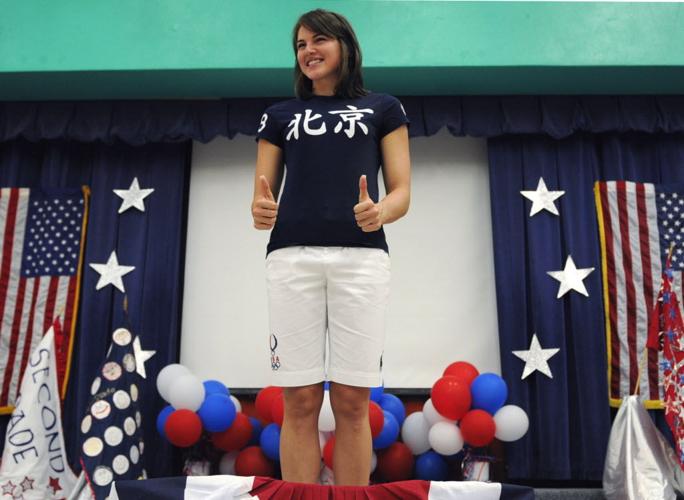
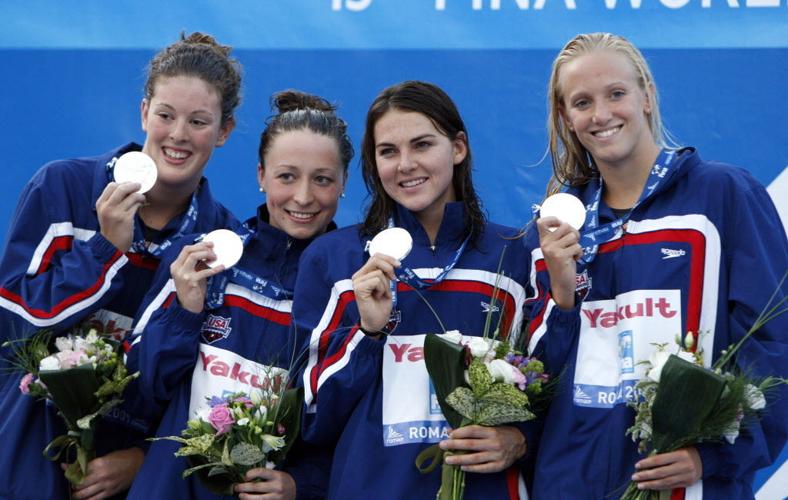
Lacey Nymeyer-John needed to get to the verge of the mountaintop to put her life, and the role swimming played in it, in the right perspective.
And countless Arizona Wildcats will be better off for it.
As Part 2 of our summer-long “Q of A” stroll throughout the Arizona athletic department — our first story was on new gymnastics coach Tabitha Yim — we caught up with Nymeyer-John, the former Mountain View High School and UA swimming star, a 2008 Olympic silver medalist, as she now serves a dual role within the department.
As the associate director for community relations-special events for Arizona athletics, Nymeyer-John helps coordinate tailgates for Wildcat football games, receptions for Wildcat basketball games and reunion weekends for former Wildcats. But it’s her work with the C.A.T.S. Life Skills Program that, she says, keeps her up at night.
People are also reading…
You have a good perspective on the role of a student-athlete, knowing the time commitment, what it takes to be successful; did you have to have gone through that as an athlete to do these jobs effectively?
A: “Being able to have been a student-athlete, to know the schedule and the routine, it has helped in community service. I know the benefit of it. I know the benefit of being able to walk into a classroom of fourth-graders and just because I’m wearing an Arizona shirt, they idolize me. They think I’m so cool. They don’t care how I swam in the meet beforehand. They just looked at me as a person and were excited for what I’ve accomplished already with no pressure to accomplish more.
“That was such a benefit for me, to be able to look at all I’ve accomplished, all I’ve done; so many times as athletes, we look at everything we’re not, everything we should have done, we can’t do. The pressure to be bigger, faster, stronger. When you walk into an environment where you’re giving back, they appreciate what you’ve done, and it helps you appreciate what you’ve done.
“But especially, it’s the life skills — as a student-athlete, I was a swimmer, a swimmer my whole life, and really it was part of my identity. As a student-athlete you get so sucked into that piece of your life, and it’s all-consuming. Seriously, everything is structured around practice and competition and recovery and food. When curveballs are thrown at you, and you’re injured, or your eligibility is done one day, what do you have? How do you value yourself and how do you move on and take those skills that made you so great in your sport and now transfer it to something that’s going to be — relationship, parent, job — all those things that are life. At the time, they seem so far away when you’re a student-athlete, but those days come, and they come pretty fast and furious.
“For me, being able to look at myself as more than just a swimmer helped my swimming, if that makes sense at all, because it took the pressure off. I knew that I could get up for a race and I had done everything I needed to do, I trained right, I ate right, I slept right — every sacrifice I needed to make, I did it. I could be proud at the end of the race, no matter my time, no matter my placement, because I was still going to be Lacey, I was still going to be loved for who I am. That was not going to be judged off hundredths of seconds.
“Finding that self-worth is so important for these student-athletes, and it is something I’m extremely passionate about.”
When did you learn that hard lesson? Because you sure sound like you learned it the hard way.
A: “I learned it my senior year. I graduated in 2008, right before the Olympics. In 2007, I got injured at the beginning of the season, and in swimming, you feel a difference in the water just by taking Sunday off. Monday is always a rough workout; you just lose the feel of the water. I try to put it in perspective with people — swimming is really a whole new world, with no gravity, constant resistance, not like walking on land. Just being out of water, a human being walking on two legs, is weird. People don’t understand it.
“For a swimmer to be out a week, two weeks, three months, is like career-ending. It’s very, very hard to come back. NCAAs were in March, Olympic trials in June and I was completely stressed I couldn’t swim. I was going through emotional, psychological issues, and it wasn’t until Frank Bush, my coach, (and) his wife started taking me out to lunch and we started looking at the bigger picture:
“ ‘This is just swimming, just a sport you do, not who you are.’ Trying to get perspective, having more fun, swimming better, I didn’t have the pressure of being an Olympian or winning a national championship on my shoulders. I started trusting that I trained my butt off for four years, and just because I was out of the water for two months isn’t going to take that back.”
For so many athletes, they get such a rude awakening when things don’t go as planned. How do you help them with that now?
A: “We did a series with football this year, and we definitely don’t want to squash those dreams — heck, you always shoot for the moon, even if you miss, because you land in the stars, that great quote, right? So go for the top, but don’t let it be everything. That’s what we’re trying to communicate. Yes, you’re going to be a football player and you’re going to be known as that for your whole life because of the four years you played here or less. But that doesn’t mean that is everything you are. Expand the perception of that self.
“We see them come in, and they know their sport. Swimming, athletics — it’s simple. You work hard, eat right, treat your body as a machine, and you’ll perform. It’s the same process, no matter the sport.
“But the real world is not like that. You can work your tail off and not get that promotion. It’s not cut and dried like sports, where there’s a winner and a loser. That’s not how it is in the real world. Getting that perspective, and trying to still keep that fire, that tenacity — we need that in our athletes. We expect that. We want them to have that swagger.
“But it’s a very thin line, where they have to be able to turn it off, and that’s where life skills come in. We’re trying to get them to open their eyes a little wider, to take the blinders off, that this is not going to effect their long-term, but who they are right now. Being able to take those failures, those setbacks, put it in the bigger picture and move forward.”
You went to the University of Arizona, you swam there, you represented the school. So for you, how important is it to be doing this here, at your alma mater?
A: “Well I’m from Tucson, and my grandpa (Ed) played here in the ’50s. He’s in the Hall of Fame for basketball, and back then, when you were a four-year starter, you got lifetime season tickets to football and basketball, so I’ve been a McKale gym rat ever since I can remember. Then my grandpa coached at Flowing Wells High for 30 years, and a lot of his women’s volleyball and basketball players came here to play. I lived at McKale. When I decided to be a swimmer, I was quite the disappointment for my family. Swimming’s not a real sport, right? It’s not really athletic. I still fight to this day to get them to understand.
“So Arizona was like the top for me. When I was going on recruiting trips, I was comparing everything to Arizona. ‘Wellll, we don’t do it that way in Tucson. That’s not how Arizona does it,’ and that’s how I judged everything.
“Arizona has such a perfect medium between what is out there and possible and what is real, but for a lot of people in Tucson, higher education is not even on their radar. So when you have a student-athlete come in and they share their story — I struggled in school too, and I had to work really hard to make the track team — they share their stories of struggle, and those kids can relate to it. Maybe I can do that. It breaks that barrier, like we sit up on this hill of higher education with a huge university and a huge campus.
“I mean — we don’t have bars, but for some people, the University of Arizona is untouchable. When student-athletes and coaches are able to get out in the community and show they’re real, that they have goal and dreams just like you, and they had challenges just like you, it’s possible.”
I imagine there are times when you take an Arizona athlete to a class and he or she walks out and says that’s so cool; do you see a change in the athletes when they have those experiences?
A: “We do a ton of hospital visits over at TMC, and part of one of the programs we’re really spreading through the department is Team IMPACT. Team IMPACT is a really cool program — we have a child with a pretty serious illness — and you get to see really what is hard. You think a practice is hard? Try walking in their shoes for a little bit, not having many friends, having to live in a hospital, seeing what’s going on with their family, parents, siblings. I love hearing our student-athletes talk about that. They really feel like they can make a difference. It’s all about trying to see something bigger than ourselves. We need to do more.
“Through life skills, part of our programming is these transition workshops. It is an uphill battle, with just the way sports is. It is everything. You need to be doing the slam dunks, and you need to be putting up world records, because that’s how you are then validated, right? It’s really hard, because there are a lot of external forces who are changing that perception, that image of what is a student-athlete.
“One program I’m working with is our PAL program — Peer Athletic Leadership — only with sophomores, juniors and seniors, any sport. We meet a couple times a semester, talk about mentoring, how to get freshmen to understand it’s not just about game time.”
In the five or six years since you graduated, a lot has changed for the college athlete.
A: “Yeah, I could hide. These days, they can’t. They are constantly in the limelight, and everything they do is blown out of proportion. Some things are good, and some are bad, but especially for female athletes it’s hard, because there is so much in the media about what you need to look like, what you need to say and still have that sex appeal, but be tough and strong in competition. That’s hard. They have it much harder and the expectations are much harder.
“The concept of winning is so much a part of athletics and the pressures, but also the recruiting process. We’re recruiting younger and younger, and you’re having to be on your A-game every time you’re on that field, on that court, because you never know who is watching.”
What you’re doing now, it sounds like you love it; it sounds like you’re great at it. Do you want to get back into that path? Do you look at AD in the long run?
A: “I still keep in touch with the sport of swimming. I do swim clinics with USA Swimming on the weekends, travel across the country, so I still do get to do that kind of coaching and I stay up-to-date with the sport, techniques and concepts of racing.
“But I kind of feel like I’m in a coaching role. It’s a life-coaching role. And to me, it’s more exciting. The rewards are a lot different, and a lot less measurable, but man, I get so excited when I can sit down with a student-athlete, or we’re working as a group to talk about our freshmen coming in, or having multiple identities. … I stay up at night because I’m so excited.”