

While college football enjoys a golden age of offense, Stanford is blissfully sticking to the stone age.
And it's working.
With a win tonight at Arizona Stadium, Stanford (4-2 overall, 3-1 Pac-10) would match last season's win total. The Cardinal's power-running offense is a major reason for its newfound success.
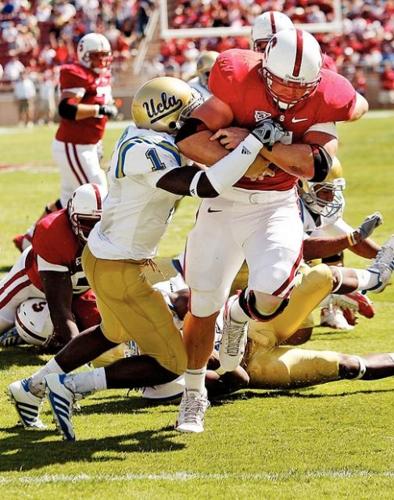
The Cardinal boasts the conference's leading rusher, senior tailback Toby Gerhart, and one of the country's top fullbacks, Owen Marecic. The Cardinal uses its attack to "shrink the game," controlling the clock and tempo.
"It's their system that presents the challenge," UA coach Mike Stoops said. "Everybody's gone to the spread; with them, you see a lot of downhill running and gap control."
The Pac-10's offense can be divided into a few well-defined groups: The pro-stylers (USC, UCLA, Washington, Cal, Arizona State), the spread-passers (Arizona, Washington State), the spread-runners (Oregon) and the fly-sweepers (Oregon State).
People are also reading…
And then there's Stanford, whose power-run attack is brilliant in its simplicity.
Coach Jim Harbaugh's attack features Gerhart mostly in power-run sets, with Marecic leading the way. Redshirt freshman Andrew Luck uses play-action and bootlegs to keep opposing defenses honest.
UA offensive coordinator Sonny Dykes believes Stanford's old-school attack is the result of practicality rather than a desire to be different.
"I think (Harbaugh's) got a freshman quarterback," Dykes said, referring to Luck. "More than anything else, he's playing to the strength of his offense, which is his offensive line and his running back."
THE LAST TIME
Unable to reach end zone or to keep Stanford out, Cats suffered baffling loss
Date: Oct. 11, 2008
What went down: Toby Gerhart punched in a 1-yard scoring run with 25 seconds remaining to lead Stanford to a 24-23 win over the Arizona Wildcats in a homecoming game held at Stanford Stadium. Arizona led 17-7 in the second quarter and 23-17 with less than a minute left but couldn't put the game away.
How it read: The Star's Greg Hansen lamented Arizona's inability to beat an inferior Cardinal team. He wrote:
The irony is that Stanford now has an unexpected winning record courtesy of an Arizona team that still can't win a game that will advance it into a Real Big Game. … This is where the esteemed Mr. Stoops may hit some resistance in the Tucson football community. In Game 52 of his head coaching career, year five of his reconstruction assignment, losing to Stanford and New Mexico two years in succession is, shall we say, not universally viewed as a good sign.
Turning point: Arizona quarterback Willie Tuitama threw an incomplete pass on third-and-goal from Stanford's 6-yard line with six minutes left. Tight end Rob Gronkowski, the Wildcats' biggest offensive threat, was open in the end zone when Tuitama threw the ball away. The UA was forced to settle for a field goal; Stanford then drove to win the game.
Stats that matter: Stanford posted 438 yards of total offense in its win, 286 on the ground. Third-string quarterback Alex Loukas led a 6-minute, 60-yard scoring drive to win the game. Arizona failed to score a touchdown in any of its three red zone attempts.
It's history: The Wildcats' 1-point loss dropped them to 4-2 overall and 1-1 in Pac-10 Conference play. They finished the regular season 7-5 and won the Las Vegas Bowl.
HAIR TODAY, GONE TOMORROW
Baxter's beard survived Iowa, but loss at UW brought out razor
Colin Baxter follows the sting of every big loss with something just as painful —razor burn.
The Arizona Wildcats' starting center shaved his beard Monday, days after the UA's 36-33 loss to Washington.
The reaction?
"I've got a little baby face," he said.
The shave-after-a-loss tradition is a tradition Baxter has been following since his days at Peninsula High School in Rolling Hills Estates, Calif., a suburb of Los Angeles. Baxter originally vowed to shave following the Cats' Week 3 loss at Iowa but let his beard live until the team's first Pac-10 Conference loss. The razor came out shortly after Washington's Mason Foster turned a 37-yard interception return for a touchdown into a Huskies win. Baxter didn't want to shave but — given the circumstances — had no choice.
"I was planning on waiting a little longer," he said with a smile.
WE ARE FAMILY
Brothers? Cousins? UA can really relate to that
The UA is inviting students to bring their parents, grandparents and siblings to Saturday's game as part of a yearly tradition.
But for the Wildcats, Family Weekend happens every Saturday.
Four sets of brothers dot the Wildcats' roster; a fifth pair — Ricky and Cory Elmore — are technically both part of the team, too. While Ricky is a starting defensive end, Cory Elmore hasn't played in two years because of a heart condition.
No UA players have more of a connection than the Tuihalamakas. Brothers Vuna and Apaiata are both rotation players in the Wildcats' defense — Vuna starts at linebacker. Their cousin Sione is a true-freshman defensive tackle.
"It's fun to have somebody you've been growing up with, and then playing with them," Vuna Tuihalamaka said. "I think it's great that we're all here. It's our home away from home."
ACUPUNCTURE, ANYONE?
Reed is willing to try anything to heal ankle
Brooks Reed has tried just about everything to get his right ankle healthy.
Electric stimulation. Heat. Cold. Stretching. Compression. Acupuncture.
Wait, acupuncture?
"They're poking needles in my feet, ears, face and stuff," he said. "I haven't really noticed a difference, but we'll see."
The Wildcats' defensive end is expected to play against Stanford today after missing most of the last three games with a high ankle sprain. Reed was injured at Iowa in Week 3; he traveled to Oregon State a week later but stayed on the sidelines in street clothes. Reed was listed as probable last week against Washington but did not play.
Reed said the injury "just kinda carried on."
"I thought it would heal a lot faster, but this is one of those things that take time to heal," he said.
Reed's desperation to get better led him to pursue acupuncture, a traditional Chinese treatment typically used to treat pain and promote healing. Arizona's trainers recommended a practitioner; Reed has been undergoing 20-minute treatments for a week. It's part of a routine that includes more than two hours a day of modern treatment.
"When I'm doing things, I'm in there getting treatment. When I'm going to my house, I'm icing it down and doing a bunch of stuff," Reed said. "It takes a long time to heal, but I'm willing to do anything."
C-GRONK BLUE ABOUT RED ZONE
H-back wondering whether he'll be part of offense again
The Arizona Wildcats' struggles in the red zone continue to raise the question: Where has Chris Gronkowski gone?
The UA's starting H-back has seen his role shrink this year, in part because of the Wildcats' newfound reliance on the shotgun formation. Through five games, Gronkowski has caught just three passes for 17 yards — 16 of them coming on one play. He has run the ball twice for 1 yard.
It's a far cry from Gronkowski's 2008 numbers. Playing in all 13 games as a junior, Gronkowski caught eight passes for 198 yards and three touchdowns. His 24.8 yards-per-catch average was by far the best on the team; no other UA player averaged more than 15.
"I think we're going more for those outside receivers now, using guys like Juron (Criner) to throw the outside fade," he said. "Maybe I'll get some more runs; maybe we'll try that again."
Regardless of who gets the ball, Arizona must improve in the red zone. The Wildcats have scored touchdowns on just 54 percent (13 of 24) of their trips inside their opponents' 20-yard line. Arizona's opponents are scoring TDs at an 85 percent (11 of 13) clip. Some of the Cats' troubles can be traced to another Gronkowski — Chris' brother, Rob. Rob Gronkowski, the UA's star tight end, will miss the entire season after undergoing surgery to repair a herniated disc and repair nerve damage in his lower back.
HEY, SMART GUY
Ask one who knows: There's smart, and football smart
David Roberts has heard about the Stanford stereotype — that, because of the school's rigorous academic standards, the Cardinal's players have an edge when they set foot on the gridiron.
The Wildcats' leading receiver isn't buying it — even if, as an aerospace engineering major with a 3.194 GPA, he's one of a handful of UA players who probably could have made it on The Farm.
"It'll help you, but being smart as a football player isn't necessarily the same as being smart," he said. "Being a smart football player is about doing things that will allow you to be smart in games — watching film, working hard, doing the right things. Jerry Rice was smart on the field because he did all the right things, all the little things.
"So much goes into the game, so much goes into one play. You do all the little things before you have an opportunity to make a play."
For Roberts, doing the little things mean catching more passes after practice, fine-tuning his blocking and footwork at the line of scrimmage, and running routes until they're perfect.
The sophomore wide receiver is finally starting to see the results of his hard work. Through five games, Roberts has caught 22 passes for 257 yards. His 12 catches and 138 yards in last week's game against Washington were both career highs. "When I got my opportunity," he said, "I knew I was going to make the most of it."
STANFORD AT ARIZONA • 4:30 p.m. • VERSUS (NOT AVAILABLE ON DIRECTV) • 1290-AM, 107.5-FM, 990-AM (SPANISH)


