

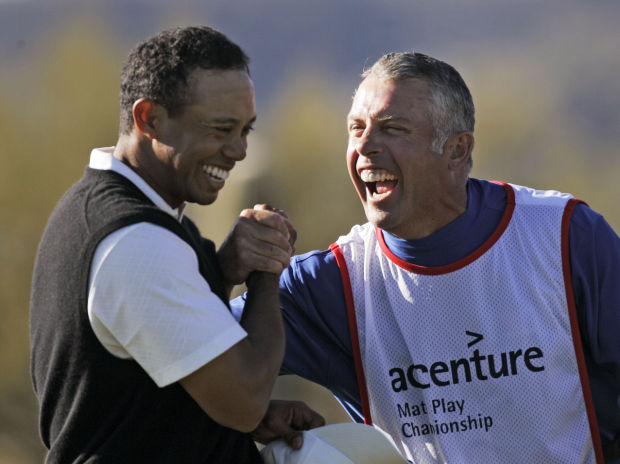
Thousands of golf fans will descend on Dove Mountain this week to see 64 of the best golfers in the world.
Nobody will be there to see the caddies.
But that doesn’t mean they aren’t important.
For the best golfers in the world, their caddy serves as a swing coach, psychologist and friend all rolled into one. There is no more important relationship in golf.
“I see a lot of player-caddy relationships working when there is mutual respect for each other and an understanding that both people are human and will make mistakes,” Matt Kelly, the caddy for Australian Marc Leishman, told the Star. “The player doesn’t always hit the perfect shot and the caddy doesn’t always give the best advice. But if you can reduce those mistakes, that’s when it will work well.”
People are also reading…
Most caddies on the PGA Tour earn a yearly salary and also make a percentage of their golfer’s winnings. It’s a vital job, even if it’s often thankless.
Before he became one of the best golfers in the world, Ben Hogan learned about the game as a caddy at Glen Garden Country Club in Fort Worth, Texas. There, he caddied alongside another all-time great, Byron Nelson.
Nowadays, the more success a golfer has, the more known a caddy becomes. In 2007, Forbes reported that Tiger Woods’ caddy, Steve Williams, made $1.27 million. Williams became a celebrity, giving his own interviews and lectures before he eventually split with Woods. He now works for reigning Masters champion Adam Scott.
But what makes a good caddy? How do you get better at the craft? What’s a normal week like?
We corresponded with two tour caddies, Kelly and Jon Yarbrough, the caddy for American Scott Stallings, to find out. Both Kelly and Yarbrough will be in Southern Arizona this week for the WGC-Accenture Match Play Championship.
How did you first become a caddy?
Yarbrough: “By total accident. I was playing mini tours in 1997 and became friends with a few girls who played on the LPGA Tour. One of them asked me to come out and caddy for them for two weeks. I liked doing it so much I never went back to playing.”
What are the two or three most important parts of being a caddy?
Yarbrough: “Chemistry between you and your player is the most important thing, besides the obvious ones, such as being punctual and being pretty good with numbers. You could be very good at what you do, but if the personalities of you and your player don’t mix, then more than likely the relationship will not last.”
Kelly: “One important thing of being a caddy is to know the rules of golf really well. There are so many silly and unknown rules that it’s important to know them all. Another important thing is to know how your guy reacts under pressure and what his tendencies are. That’s when the player needs a caddy to be cool and relaxed under pressure. So knowing how he reacts is key.”
What is a typical competition day like for you? Non-competition day?
Yarbrough: “A typical Tuesday for me is to walk the course by myself in the morning to make sure that there are no changes from the previous year. I meet up with my player after and practice for awhile, then go out and play nine or 18 holes, depending on the course.
“Typical Thursday through Sunday are show up couple hours before we tee off, grab some lunch or breakfast, meet up with Scott about 45 minutes before we play. After the round we usually have a small session on the range followed by a little bit of putting.”
Kelly: “A typical competition day involves getting to the course about two hours before our tee time, making sure the bag is stocked with balls, gloves, tees and some snacks. Also, cleaning the grips and getting a pin sheet with the days’ hole locations and transferring them into the yardage book to go. Then we take a look at each hole and make some strategy for each hole. Then a 45-minute warm-up with some putting and chipping then tee off. Maybe some post-round practice, but generally just rest.
“Non-competitive rounds are very relaxed with all the same things as a competitive round. We try to make it very similar to competition because that’s how the tournament is played, but it’s much more relaxed.”
When did you first get into golf? How much do you still get to go out and play on your own?
Yarbrough: “I started playing when I was 15 years old. My family moved to Dallas and I didn’t know anyone so I started going to the golf course with my dad and immediately was hooked.
“I never play when I am on tour. When I am home, I will try to get out at least once on a week off. My son is 8 and is starting to like to play more, so I am definitely starting to play more now with him.”
Kelly: “I first got into golf when I was 10 years old. Marc and I would meet at the local course after school and play together almost everyday. I don’t play much anymore because I like to get away from it when I’m not working, but I play around 10 rounds a year.”
How do you improve as a caddy?
Yarbrough: “I think openly admitting that you can always be better as a caddy and that you can admit that you don’t always have it figured out is a big step in improving as a caddy. Also, the longer you are out here, the more you learn the golf courses and you know where you can and cannot go, is a big positive. Being a caddy has changed so much in the last 16 years I have been doing this. I think you would be crazy to think you have this profession figured out.”
Kelly: “Improvement as a caddy comes from learning something each day on the course. It might not help you that day or week, but if you can use something you learned about the course two years ago, that’s huge. Something happens everyday that you can put into the memory bank, whether it’s good or bad. Learning from mistakes or good days is very important and can help when you least expect it.”


