

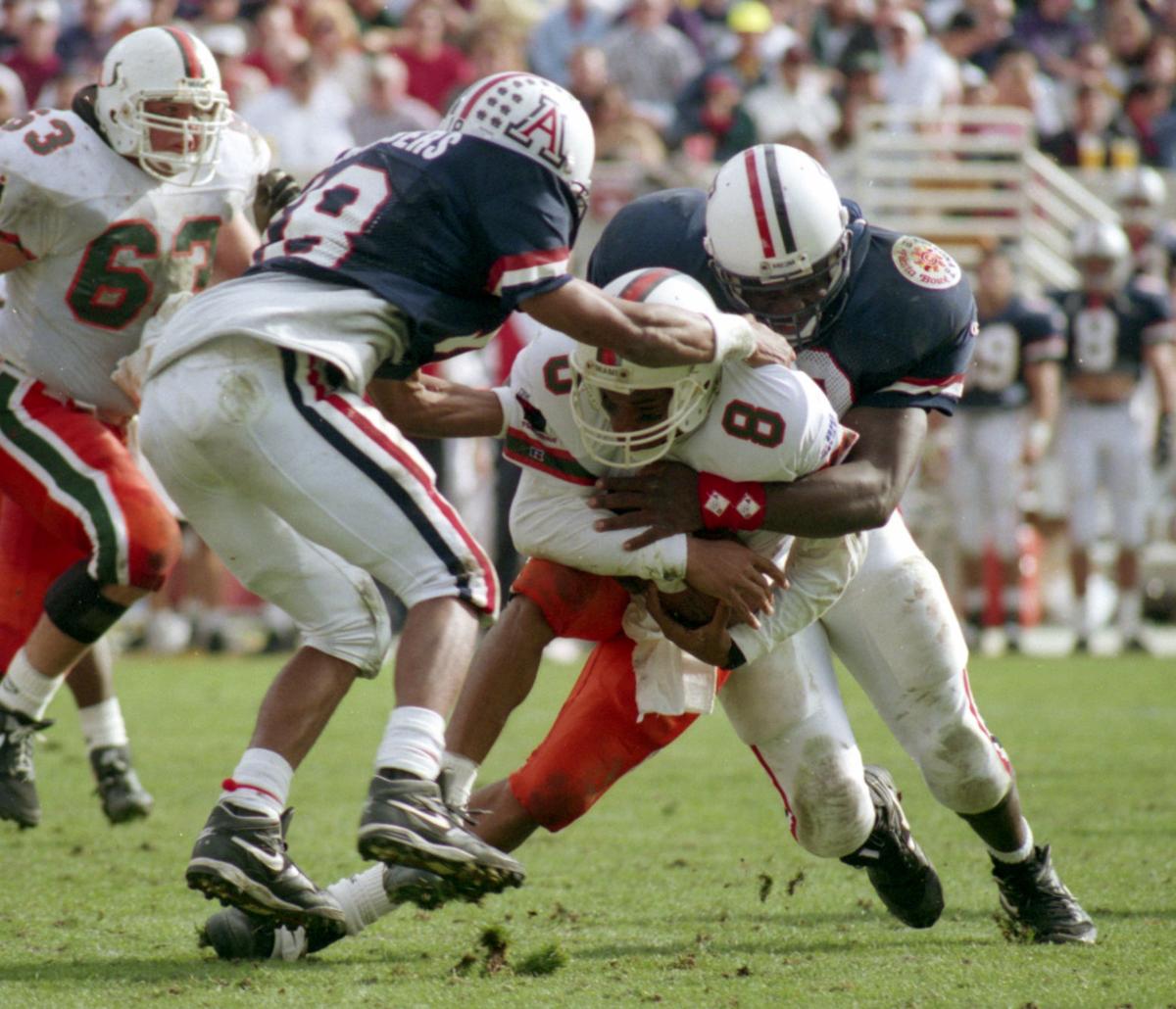
On college football letter-of-intent day, 1990, Arizona signed a class that included seven future NFL players: Chuck Levy, Josh Miller, Steve McLaughlin, Tony Bouie, Mike Scurlock, Rob Waldrop and Sean Harris.
Five of those from the Class of 1990 — Miller, McLaughlin, Bouie, Waldrop and Harris — became full-blown All-Americans.
It was the single greatest recruiting class in UA football history, one that became the core of the Desert Swarm success, and the appeal of it today is that you couldn’t see it coming. It wasn’t like Alabama or USC signing a brigade of future pros.
I mean, two of them, Miller and McLaughlin, were kickers. Levy was a converted quarterback. Waldrop was an undersized lineman, and Bouie, from Louisiana, was overlooked by LSU and the SEC schools and thought to be a better baseball prospect.
People are also reading…
But none had less of a résumé than Harris, a Tucson High School linebacker/wide receiver who struggled with academics and, at 6 feet 5 inches and 210 pounds, might’ve been a more productive basketball player for the Badgers.
“I liked Texas A&M,” Harris said Tuesday at a press conference introducing the Pima County Sports Hall of Fame Class of 2019. “But I looked at their linebackers and they were all 6-4, 245 and it was like, ‘I could never play there.’”
Now retired after spending an NFL career playing with icons like Peyton Manning and Brian Urlacher, Harris has had 25 years to process one of the most remarkable journeys of any Tucsonan to play professional sports.
“I wish I could go back to Tucson High and thank all of those teachers and counselors who had an impact on me, who cared more about me than about the sports I played,” Harris says. “I was the first person in my household to graduate from high school. I grew up in a really bad neighborhood. Sometimes I wonder how I made it, too.”
By the spring of 1995, Harris was a third-team Associated Press All-American, drafted 83rd overall by the Chicago Bears and with a UA degree in sociology.
He had become so grounded that the day the Bears drafted him, Harris didn’t go out and stage a party starring himself, as has become a ritual for college draftees.
“I had seen too many guys party and not get drafted until a day or two later,” Harris says. “That wasn’t going to be me.”
On Tuesday, Harris walked slowly into the DoubleTree Hotel, limping on two hips worn down by 15 years of old-style football.
“When I played with the Bears,” he remembers, “we’d have contact practices twice a day for six weeks. We’d have two-a-days at Arizona for a month. They don’t do that anymore. That’s why football players from my days have so many aches and pains. I’m going to have both hips replaced.”
As a Tucson High linebacker in 1988, an all-city player who rarely came off the field, Harris was a physical specimen. His THS coach, Todd Mayfield, called Harris a “freight train.”
“He was such a quiet young man, he wouldn’t say two words,” Mayfield said. “His is a success story like few others.”
Harris’ father died when he was 12. “Everything changed,” he says now. He sometimes lived with relatives, often without transportation to and from school. That’s when people like Mayfield and retired Tucson High teacher and coach Patsy Lee stepped up.
When Harris walked into Tuesday’s press conference, the first person he saw was Lee, who is also part of the Class of 2019. The two embraced.
“Hello, baby,” Lee said. “I haven’t seen you for way too long.”
In the summer of 1986, Lee made history when she became the first female coach in Tucson to coach a boys high school team. She became the Badgers’ sophomore boys basketball coach when Harris and his uncle, Lamar Harris, also a future UA football standout, were sophomores struggling in a disadvantaged economic and academic background.
“Sean lacked confidence in himself, very quiet, but I knew he’d be a great athlete if he stuck with it,” Lee says now. “He was all business. He grew up in the so-called projects of Tucson, but he was determined not to let it determine who he was going to be.”
Arizona football coach Dick Tomey recruited Harris, but entering the 1988-89 school year, Harris didn’t project as an academic qualifier. His GPA was under 2.0, which meant he had to take seven courses as a senior to be eligible for NCAA football.
Not only did he pass those seven courses, his SAT entrance exams improved so much that he was eligible to play in 1990, even though he chose to redshirt and get acclimated to life as a college football player.
When he completed his UA career, he had made 248 solo tackles, which still ranks No. 6 in school history.
Harris lives in Phoenix with is wife, Cha-Ron, a former Arizona basketball player he met in the weight room at McKale Center a quarter-century ago. The Harrises often make the Interstate 10 trip to Tucson; their oldest son, Jalen, a sophomore pass rusher who wears his father’s jersey number (49) has become one of the UA’s leading defensive players.
Their youngest son, Jason, is a 6-7, basketball and football prospect at Gilbert Higley High School who recently narrowed his six college football choices to Arizona, ASU, Oregon, Colorado, UCLA and Texas A&M.
Now that he’s retired, Sean Harris is a volunteer coach for his son’s team at Higley. That’s quite a journey for a humble Tucson High Badger, 30 years in the making.
“If people could see where Sean came from and compare it to where he is now, they’d just shake their head,” says Lee. “It’s a great story.”
Contact sports columnist Greg Hansen at 520-573-4362 or ghansen@tucson.com.
On Twitter: @ghansen711.

Greg Hansen
Columnist


