
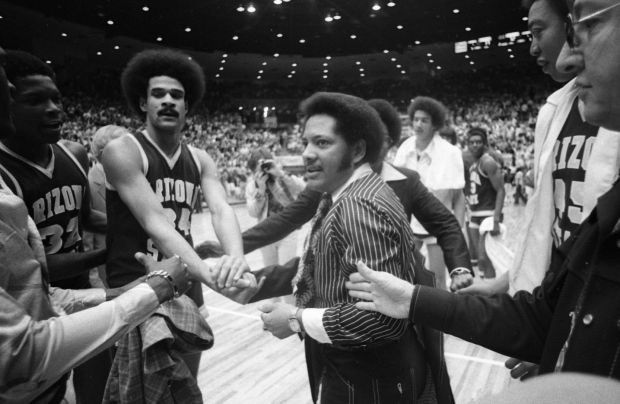
MARCH 21, 1972: ARIZONA HIRES FRED SNOWDEN TO COACH BASKETBALL
The lead paragraph to Daily Star sports columnist Abe Chanin ‘s piece of Dec. 18, 1968, said: “UA athletic director Dick Clausen wants to add a Negro coach to the staff.”
“We don’t have many Negroes in our school,” said Clausen. “We hope to change that in the future.”
A year later, in what is believed to be the first hiring of an African-American head coach at a Division I school, Clausen hired Compton (California) High School coach Willie Williams as Arizona’s head track and field coach.
When Clausen retired in 1972, new Arizona AD Dave Strack added to his legacy. Strack hired Fred Snowden to be Arizona’s basketball coach.
At the time, there were two African-American head coaches in college basketball — Cal-Riverside’s Fred Goss and Illinois State’s Will Robinson — but Snowden became the first at a Division I school.
People are also reading…
Snowden’s arrival in Tucson generated the hiring of African-American coaches John Thompson at Georgetown and George Raveling at Washington State.
Two years ago, I visited Strack in his Oro Valley assisted living facility a few days before his 90th birthday. I asked him about the genesis of hiring Fred Snowden.
“Actually,” he said, “I tried to hire Tom Jorgensen,” said Strack, something I had never heard. “He had played at Michigan and been my top assistant coach there. But he was coming off a fine season at Northern Illinois (21-4 in 1971-72) and wasn’t sure about moving all the way to Arizona and taking over a program that had gone through some bad times.”
The Wildcats had gone 6-20 in 1971-72 and 28-50 over the previous three seasons. Not only did Strack interview Jorgensen, he talked to Long Beach State coach Jerry Tarkanian about becoming Arizona’s head coach.
“Well, Tark was in the middle of that great run at Long Beach,” Strack told me. “He thought he could win the national championship there the next season. We didn’t get too far along.”
That left the 35-year-old Snowden, a Wayne State alumnus who had coached that school’s junior varsity to an 80-0 record and then went 101-5 at Detroit’s Northwestern High School.
As a third choice, Snowden was more than a home run hire. He was a grand slam.
On the day Snowden was hired, McKale Center was in the final stages of construction; it would open 11 months later. The responsibility of filling those 14,000 seats seemed overwhelming at times; the UA averaged fewer than 2,200 in the final season at Bear Down Gym.
Most new coaches are quick to speak about “changing the culture” at their new school; Snowden changed the identity of Arizona basketball. He said he declined a chance to be San Jose State’s head coach a year earlier, saying he preferred to wait for a better opportunity.
“My program got off the ground quicker than those at Georgetown and Washington State and I think for the future of blacks in college coaching, it was a good thing one of us succeeded right away,” Snowden said in 1989.
“Because I was the first, I felt a lot depended on whether I did well and whether I was perceived as a person of quality for the other black Americans who would come along.”
In his first month on the job, Snowden successfully recruited Detroit schoolboys Coniel Norman and Eric Money, that era’s equivalent of 5-star recruits. A few weeks later he landed another 5-star, forward Al Fleming of Indiana.
When the UA added Wisconsin point guard Jim Rappis it became the top recruiting class in school history, by far, and some might say the top ever assembled at Arizona even now. A year later, Snowden added two more “5-star” recruits: Michigan center Bob Elliott and Pennsylvania shooting guard Herman Harris.
All were African-Americans who probably would not have considered playing at Arizona under other circumstances. They didn’t just lay a foundation for Tucson as a basketball town, they did the framing and wiring, too.
Snowden’s first five UA teams went 102-39 (in the previous five years Arizona had gone 56-73). The UA reached the 1976 Elite Eight and routinely drew crowds in excess of 12,000 to McKale Center to watch Snowden’s up-tempo teams.
Where are they now: Snowden died of a heart attack in Washington ,D.C., in 1994. He was 57. After his five opening seasons at Arizona, he cut back on recruiting, he said, because of his fear of flying. Once the UA entered the Pac-10, Snowden’s Wildcats got progressively worse, going 34-47 his final three years. He was asked to resign in January of 1982, and later became an executive for Baskin-Robbins in Los Angeles, among other projects.
How he did it: “We are in the entertainment business,” Snowden said in 1972. “We will play exciting basketball.”
Exciting? In his team’s first public appearance, at Bear Down Gym, the final score was 135-128. Money scored 53 points.
After that, the culture of UA basketball changed forever.