

The mothers, fathers, sisters and daughters of college softball have not fully utilized the romance of the home run. There is no Bambino, no Hammerin’ Hank, no Reggie! Reggie! Reggie!
Instead, there is Oklahoma’s Lauren Chamberlain, whose 95 home runs from 2012-15 stand alone at the top. But Chamberlain was a leadoff hitter, and how long can a leadoff hitter expect to be anyone’s home run queen?
Sooner or later someone’s going to hit 96, or even better, 100, and when they do, college softball will have a Home Run Queen, in capital letters, its first true Big Bam or whatever the acceptable female equivalent is.
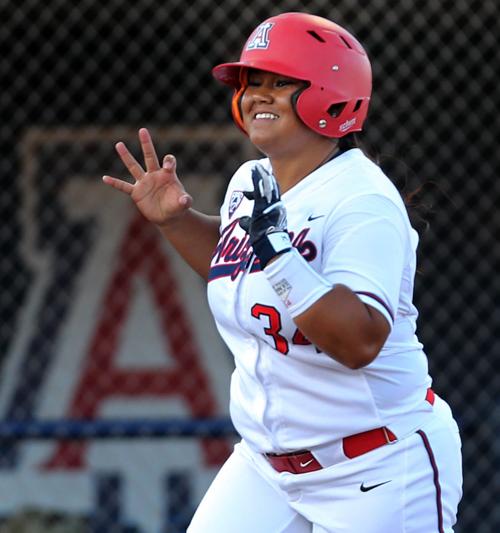
That someone could be Arizona senior third baseman Katiyana Mauga, who has 92 home runs and a finite period — two more weeks, maximum — to hit Nos. 95 and 96 or more, and become the Big Kat.
After Mauga hit home run Nos. 90 and 91 in the NCAA regionals last week, former Arizona Republic sportswriter Bob Crawford dispatched an email asking why no one thought to refer to Mauga as Big Kat.
People are also reading…
First, given the sensitivities of the day, it was necessary to determine if anyone would be offended. It’s not like baseball, where nicknames forever thrive — Big Poison, Big Unit, Big Hurt, Big Papi — but there has been no objection.
So on Friday night, Mauga, aka Big Kat, probably had the most meaningful game of her college career. She hit a home run, a double and a single as he Wildcats won 3-2 on Jessie Harper’s walk-off single in the seventh inning.
But it wasn’t Mauga’s 3 for 3 that won the game. It was probably her walk in the seventh, fighting off 10 pitches, refusing to give in during the most important inning of Arizona’s long season.
“I don’t think they wanted any part of her,” said UA coach Mike Candrea.
For Arizona to go beyond the warning track in the Women’s College World Series, it figures that Mauga will need to do what Chamberlain did in her Oklahoma career, which was rise to the occasion and carry a team on her bat.
At OU, Chamberlain hit 18 home runs in the postseason, with a .416 batting average. That means 16 percent of her NCAA-leading 95 long-balls were in the postseason. Chamberlain’s Sooners reached the World Series three times, winning in 2013 and finishing second in 2012.
Mauga entered Friday’s game at Hillenbrand with just three post-season home runs and a .245 career postseason batting average. In all other career games, Mauga has batted .352. She has hit six home runs against New Mexico State, and dozens of others against Fordham, Ball State, UTEP, Drake and other assorted victims.
But on Friday it meant so much more than a homer against Ball State.
Mauga’s third inning homer, giving Arizona a 2-0 lead, came after she patiently waited for a good pitch, after Baylor appeared to be avoiding throwing the ball over the plate.
“We know who she is,” said Baylor coach Glenn Moore. “We’d (scouted) about 40 of her at-bats on video. (We) just threw her a pitch we wanted back.”
This isn’t meant to be critical of Mauga. Baseball and softball players historically build their statistics against secondary starting pitchers and lesser teams. Willie Mays, for example, batted .475 in his career against Clem Labine and .196 against the great Bob Gibson .
The further Arizona advances, the better pitching it faces. When the Wildcats won their last national title, 2007, it played three World Series games against the inestimable Monica Abbott of Tennessee, who entered the series with a 50-2 record.
Yet somehow, shortstop Kristie Fox hit .481 in the last 10 postseason games, which included a 3-for-3 day with a home run as Arizona beat Baylor 2-1 in the World Series.
You’ve got to play like a Fox to go deep in college softball. On Friday, Mauga played like a Fox and then some.
One thing that goes unsaid is that Mauga sees fewer and fewer pitches in the strike zone as the season progresses. She has already been walked 151 times in her career and leads the Pac-12 in walks this season (43) and was second last year (43). Here’s where statistics lie: Mauga has been intentionally walked seven times in her career but, wink-wink, she’s probably been unintentionally-intentionally walked 100 times.
She saw 26 pitches Friday and never seemed to swing at anything but a strike. In a game so close that the margin of error was probably one pitch, Mauga helped to win the game as much by being smart (and cool) as by anything else.
“Coach said ‘be calm,’” she said. “If I swing out of my shoes, it’s not something I want or my teammates want.”
As Arizona bids to return to the World Series for the first time since 2010, Mauga is batting .545 in the postseason, with three home runs.
Talk about a senior moment.
Contact sports columnist Greg Hansen at 573-4145 or ghansen@tucson.com. On Twitter: @ghansen711

Greg Hansen
Columnist


