From I-17 north to the 40 to Highway 89 to 160, a caravan formed behind the Tuba City Warriors bus carrying the newly crowned girls basketball team on Feb. 28.
Fans honked their vehicles' horns as they followed them back to a place known for dinosaur tracks, where the Diné people raise sheep and basketball players dream of moments like this.
Earlier in the day, the girls raised the Copper Division state basketball championship trophy inside Phoenix's Arizona Veterans Memorial Coliseum after beating Snowflake, 59-54, to cap a 28-3 season. It was Tuba City's first girls basketball championship since 2002, the last of three consecutive titles.
This is a big thing for the reservation, where basketball is heaven, an escape, a refuge, where the lights are as bright as the stars at night.
The celebration grew the next day as police closed a long stretch of U.S. 160 into Tuba City for a parade, with streets lined with cheering fans.
People are also reading…
"It was really surreal, ending my whole high school journey like that," said Aubrey Begaye, who graduated in May. "It was like the cherry on top."
In the first weekend of April, there was another parade through town.
This could be just the beginning of annual parades, the dawn of a new dynasty.
Coach rebuilds a 'rez ball' power
TUBA CITY — It's a hot early June day, the first day of coach Peterson Butler's youth camp, where more than 75 kids signed up to be tutored by Butler and most of the players from the Tuba City championship team. Three full courts inside the 5,000-seat Tuba City Pavilion are in good use.
Before camp starts, Butler introduces his players.

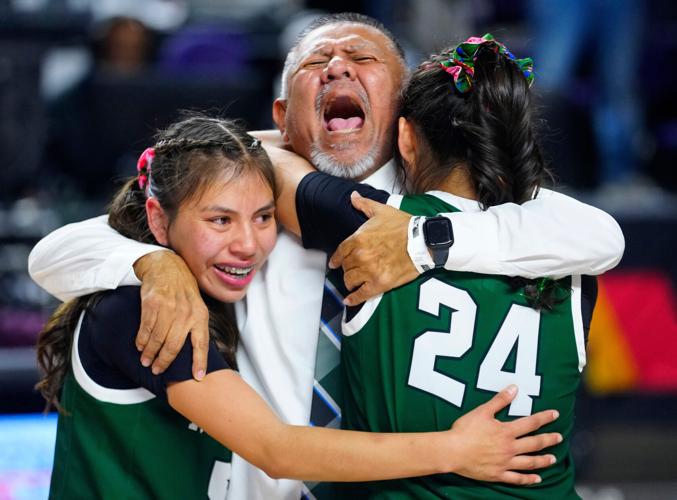
Tuba City head coach Peterson Butler hugs Nakota Tallman (5) and Layla Curtis (24) after winning the Copper Division Championship game over Snowflake at Arizona Veterans Memorial Coliseum in Phoenix on Feb. 28, 2026.
"They're the state champs," Butler tells the wide-eyed campers. "We meet every Wednesday at this time. If you got something you want signed, bring it with you. It's the only chance you can get their autographs.
"Come December, they'll be famous. The state championship banner will go up. The whole thing we want to do is to make you state champions in the future."
Some of the campers are asking about Layla Curtis, the Warriors' charismatic star.
Peterson Butler, who goes by Peter or Pete, was raised in the same remote part of land that Curtis lives. At Gap. Where there are no stoplights, one gas station and a trading post, where the bus drops off students who live off the grid on Highway 89 on the way to Page.
"I love it here," he said. "It's slow. It's peaceful. So many great memories climbing rocks and playing basketball."
Butler said some of his favorite times were spent as a child at the Gap, where his grandparents lived and helped raise him and his two brothers. They were all basketball players at Tuba City in the 1980s.
The Butler brothers were brought up in the traditions of the Navajo way. And basketball was a way of life.
"Basketball is every Navajo kid's dream to want to play," Butler said.
In the morning, before the sun breaks, Butler spreads corn pollen and bear root, an herb rooted in Native American folklore. Butler said he gained this tradition from his grandfather, father and uncle, who were all medicine men.
"As a small kid, I watched my grandfather heal people," Butler said. "That's where I became a true believer in the traditions."
Not everybody in Tuba City follows the Native traditions. And Butler is sensitive to that with his players, not pushing his traditions on anyone.
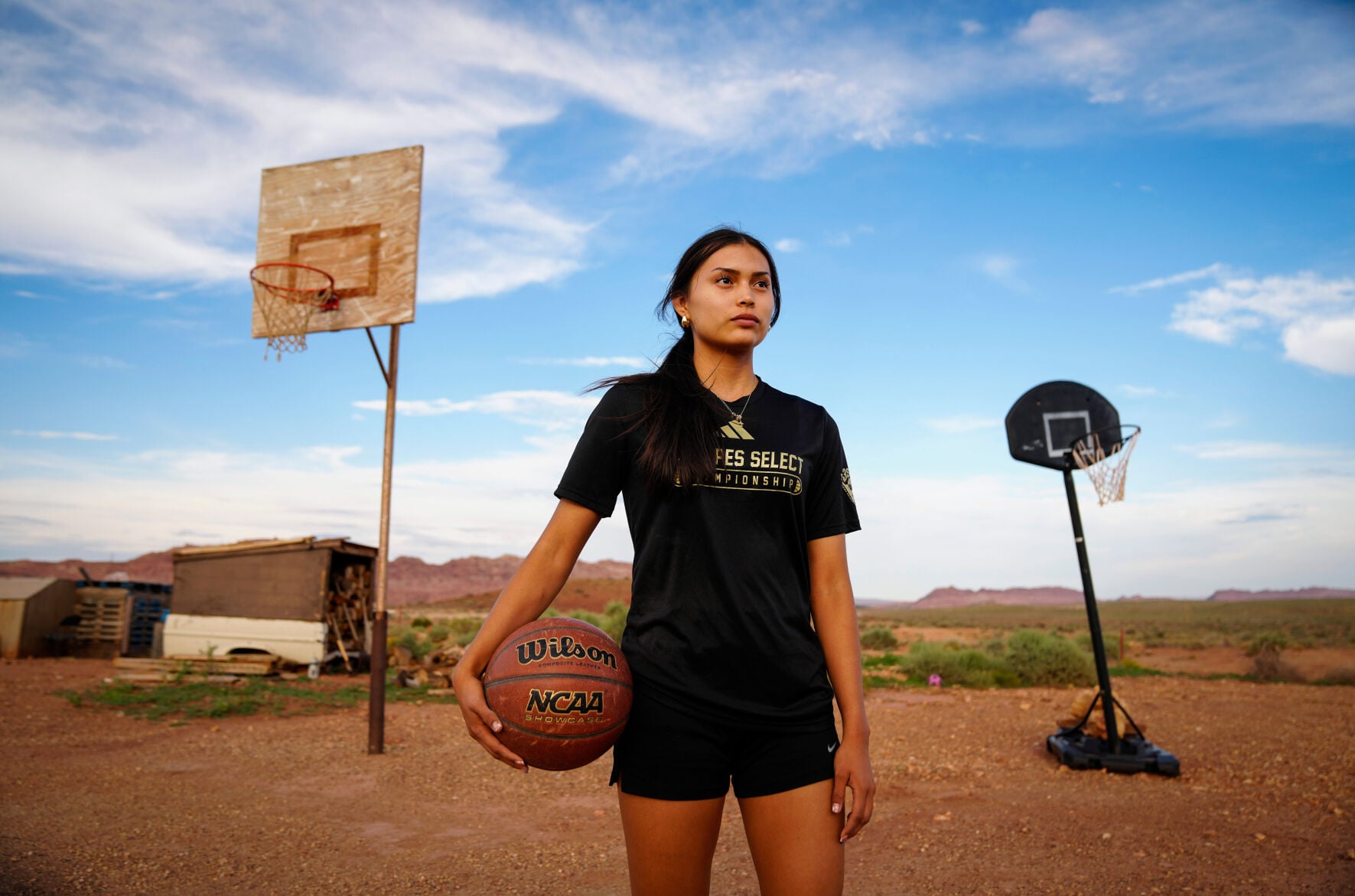
Layla Curtis poses for a picture at her home in The Gap on the Navajo reservation near Tuba City on Aug. 12, 2026. The hoop is the same one her father shot on as a Tuba City basketball star.
Some are Christian, like Layla, and like Peterson's brother Kenneth, who still holds the Tuba City High School boys basketball record with 11 made 3-pointers in a game in 1989, a team Kenneth said wasn't very good.
Kenneth helps out Peterson with his youth camp and works as a supervising processing manager at the hospital run by the Navajo Tribe in Tuba City. Peterson works with special-needs students at an alternative school near Tuba City High.
Kenneth received his college degree from Diné College in Tuba City. Cultural and religious differences didn't create distance between the brothers.
"Yes, I did grow up traditional," Kenneth said. "But it all depends on how you look at it. I didn't understand the meaning behind it. So ever since I met my wife, she was going to church, I went that way."
Kenneth sees why Peterson has such a deep passion for coaching, watching him lead an unselfish team that played in front of standing-room-only crowds last season. Peterson credits his daughter, Tori, for coming up with the game plan to stop Snowflake in the small-schools state championship game.
"I was a single father at one point and she was the one that I raised," Peter said.
Tori said she followed her dad to the gym as a little girl and loved to coach and would ensure the players knew the offense.
"My uncles played basketball, my dad played basketball, my grandpa played basketball," said Tori, a 2011 graduate from Ganado, where her dad was coaching at the time. "They constantly kept me in the gym. I wasn't a good player. But what I saw on the court from the other players, I could correct things. I'd rather coach."
Butler has brought a buzz back to Tuba City girls basketball with his disciplined style and the freedom he gives his players on the court.

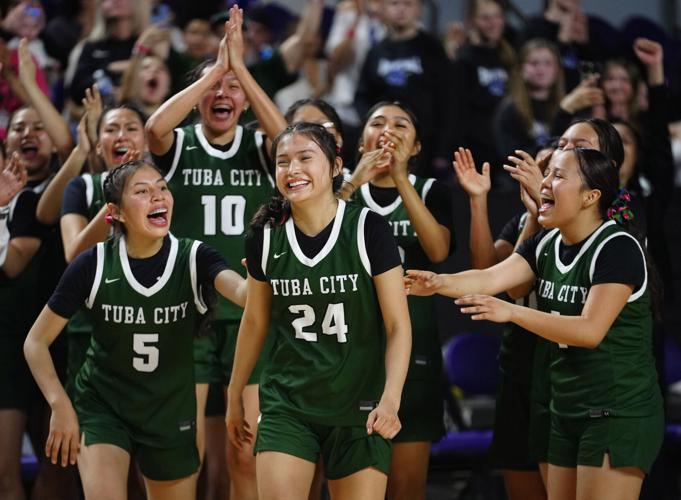
Tuba City guard Layla Curtis (24) reacts after being named Championship game MVP after Tuba City beat Snowflake during the Copper Division Championship game at Arizona Veterans Memorial Coliseum in Phoenix on Feb. 28, 2026.
Navajo Nation rallies behind its champions
When they showed up at the Coliseum for their last game, they saw a long line from the Navajo Nation take over the parking lot to see them one last time. The Coliseum seats were nearly all filled, mostly with fans from the reservation.
"The crowd was amazing, the whole house, like, shook," Tuba City athletic director April Clairmont said in her office that June day.
And as she finished the sentence, the letter "R" in "WARRIORS" fell from the back wall behind her, providing a fitting simile.
"It was like, 'Wham!' It was just like that," said Clairmont, who was born in Tuba City. "It was electric from start to finish."
Last season's championship brought all sorts of perks. The players for both the girls and boys teams were given Nike N7 collection shoes that honor Indigenous communities.
Before an Arizona Diamondbacks home game on June 7, Tuba City's girls team received on-field recognition for their championship.
"Just the game of basketball is bigger than anything, bigger than any other sport," Kenneth said. "Everybody will be there. Family members like to be there."
Basketball offers hope beyond high school in Tuba City
Some feel the only way to survive beyond high school is to leave the reservation, where drugs and alcohol consume many, whose hoop dreams die off after high school ends in the windswept canyons and mesas of loneliness.
Butler says he feels fortunate he didn't have to leave the reservation to survive. He cherishes the wide-open space and slower pace.

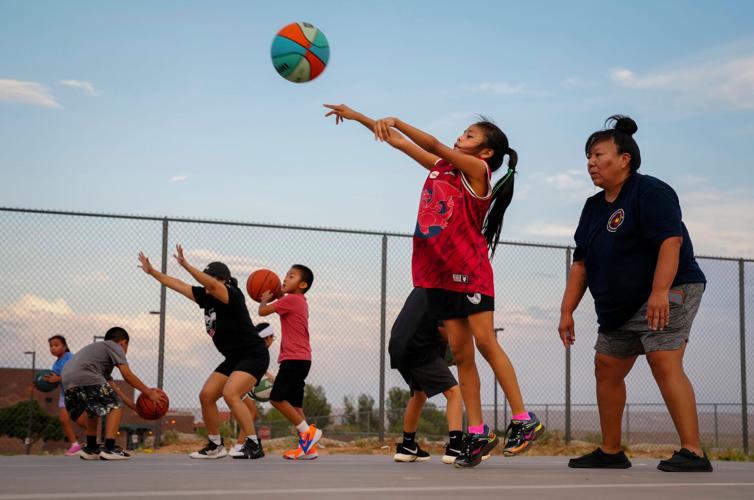
The Rez Hoops youth team practices on the courts outside Tuba City High School in Tuba City on Aug. 11, 2026.
It is a place where, if you cross the street on U.S. 160, you cross time zones and enter Hopi land. Tuba City is in northern Arizona, about 9 square miles, with about 9,000 people and is considered the largest community in the Arizona region of the Navajo reservation. A part of the 1969 movie "Easy Rider" was filmed around here.
Peterson Butler graduated from Tuba City in 1982, 10 years after Greyhills Academy opened, breaking off from Tuba City High. The total student population at the time, he said, was 1,200. He was part of a graduating class of 300. The basketball team was OK, but not dominant. He's seen Tuba City grow.
"Back in my day, there was only one Bashas," he said. "The only restaurant we had was a Dairy Queen.
"In the back side, there was no housing. It was just sand and weeds and rock. And then it just blew up."
Tuba City can boast that it was the first Native American team in Arizona to win a girls state title, in 1976, shortly after Title IX was enacted. The Warriors won another championship in 1978, when seasons were split between winter and spring. That 25-1 spring title team was led by coach Janet Lomakema.
Butler coached girls basketball at Ganado before Tuba City hired him, thanks in part to a letter of recommendation from former Tuba City boys basketball championship coach Charles Gover.
This is Butler's second stint at Tuba City. He coached Tuba City's 2004 and 2006 teams to the 3A state semifinals.
He then went to Ganado, where he was an assistant coach on the 2007 team that won its first state championship. The next year, he became Ganado's head coach and the Hornets lost in the final to a Winslow team led by legendary coach Don Petranovich. That Navajo border-town school has produced nine state championships, most of the players coming from the Navajo Nation.
"That was going to be it for me," Butler said. "If I didn't get that job (before last season), I was done coaching."
Now Butler feels a rebirth, ignited by a new generation of players who play as a team and allow the young superstar, Curtis, to lead them, even as a freshman.
"My main concern was, 'Are they going to accept her?'" Butler said. "But when we started winning, I was like, 'You know what? This girl is too good.'"
Layla Curtis carries Navajo hopes
GAP — Layla Curtis is already looking like a generational girls basketball talent on the Navajo reservation not seen since maybe Ryneldi Becenti starred at Fort Defiance Window Rock in the late 1980s before playing at Scottsdale Community College and Arizona State. She became the first Native American to play in the WNBA, for the Phoenix Mercury.
Curtis, who has a velvety jump shot and runs like the wind, already has NIL deals and an Instagram following of about 13,000.
She lives in another world, in a trading post way off the grid called Gap. It is 17 miles north of Tuba City on U.S. Highway 89.
Her mother, Denise, waits in her Silverado every day during the school year for the Tuba City bus to drop Layla off at the trading post and take her home over the rough terrain.
There, off a 3-mile rocky stretch of land up a ridge, she's been raised in a home with electricity but no running water, where she helps out with the family's sheep and horses and chickens and cattle, where she sometimes helps her mom make Native jewelry, where she shoots endlessly on a hoop handed down from her dad on the hard dirt surface.
She wouldn't want to be anywhere else. The basket is her sanctuary from the fast-paced, run-and-gun games in the massive reservation arenas. Nobody's honking at her while she's shooting. There are no distractions. No interruptions.
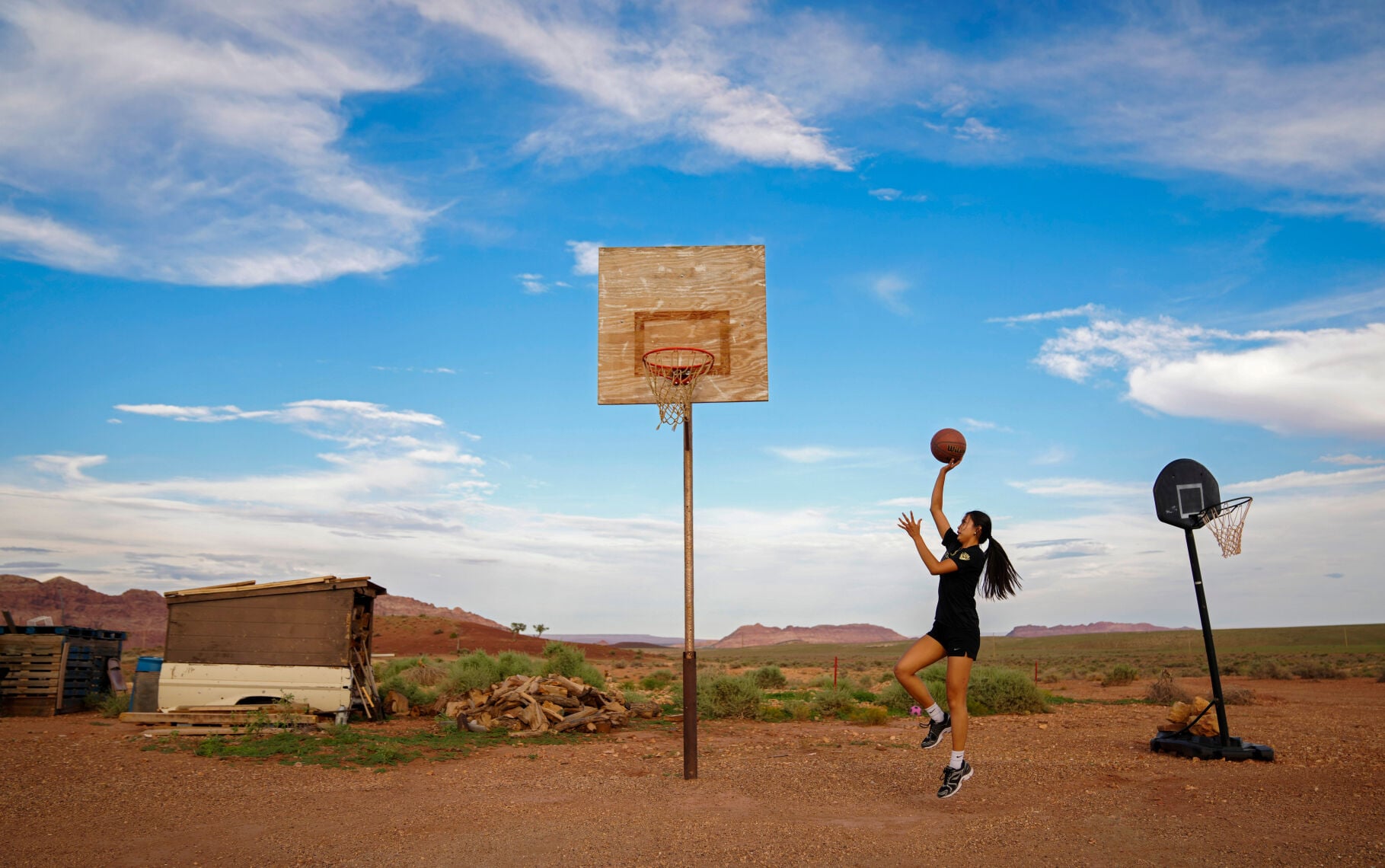
Layla Curtis shoots as she practices at her home in The Gap on the Navajo reservation near Tuba City on Aug. 12, 2026. The hoop is the same one her father shot on as a Tuba City basketball star.
It's just her and the basket and her dog, Melo, named after former NBA star Carmelo Anthony. The soon-to-be 4-year-old German Shepherd barks at the basketball's shadow while she shoots.
"In a way, it's peaceful, and it's calming to you, but, at the same time, I know I'm getting better, as well," Curtis said. "It's my safe place."
That rim has special significance. It was given to her dad, Donnie, by his aunt when he was a little kid. He handed it down to Layla with a new backboard he built from plywood and glue, attached to an iron pole cemented into the ground.
She has her weights with a bench spread out near the basket. She will lift weights when she's done with practice and shoot some more, Melo always following her, always barking at the shadows. The dog lies next to the weights while Layla lifts.
Melo also runs with Layla, who adds, "She's my workout companion."
There are scattered homes in the distance. They are Donnie's sister's house, his aunt's house, his grandma's place. Maybe six houses can be seen from the Curtis home. But look toward the basket, and there is nothing but desert and a surreal painted sky at sunset that is postcard perfect.
"It's pretty quiet," Donnie said. "It's not like the city, where it's so loud."
This summer, the 5-foot-6, 15-year-old has gone back and forth from the reservation to the Valley, where she has two private basketball trainers. She'll stay with her father, who works as a welder in south Phoenix to support his family. He returns to their reservation home on weekends.
"She adjusts to anything thrown towards her," Donnie said.
Layla Curtis follows a family legacy
Last season, as a freshman, Curtis averaged 21 points and set the pace for the run-and-gun Warriors on their way to the title, playing in packed arenas across Navajo Nation. If there was pressure, she didn't show it. She has picked up offers from Ottawa University in Surprise, Southern Utah and Oklahoma State. She went on an unofficial visit to Arizona State this summer.
"She is the spitting image of her father," said Earl Flaggs, who coached Donnie Curtis in Flaggs' two seasons as head coach at Tuba City in the early 2000s. "Her father is the toughest player that I have ever coached. Him and (now Villanover center) Duke Brennan. So tough and relentless.
"Her father had a shoulder injury that would pop out in games in high school. It was extremely painful. He would pop his shoulder back in and go back into the game. There was just a level of toughness."
Donnie was a 6-2 wing on Tuba City's 2002-03 team that lost to Kayenta Monument Valley on a 3-pointer in the 3A state semifinals.
When Layla moved on from cross-country, where she was a champion runner, to basketball in elementary school, the family called Flaggs to let him know there was another Donnie Curtis in the family. Flaggs, who is like family to them and is called "Papa" by Layla, took her under his wing.
Then, he saw how popular she had gotten, even before entering high school, and he helped get her NIL deals as chief executive officer of OG6 Sports Management. Ballislife is one of her NIL deals.
"I saw Layla play junior high basketball," Butler said. "She was an eighth-grade player and she just dominated. And then I saw her that summer playing against high school girls, and she held her own. When we started in the summer, she just took it upon herself to be the leader."
Butler challenged the seniors not to let Curtis take over the leadership role, but after a while, it was obvious they knew who was leading them. It was Layla Curtis.
But her dad made sure Layla never got special privilege, never acted bigger than anyone else.
"We already knew what was boiling," Donnie Curtis said. "But we just had to keep pushing her, and pushing her to get better. The main thing was to keep her humble. She seems to handle it pretty good.
"Even in junior high, she would bring so many people to come watch her play. People would say, 'I've never seen this many people at a junior high game.' She just got used to it. Even in junior high, people wanted to take pictures with her. She's used to it."
This summer, she played in Section 7 with Tuba City, in NABI and for a top club program in California.
When she feels life is going too fast, she comes back to Gap, her roots.
She is grounded with a strong Christian family. She recently went on a church retreat with her family, where they sang Christian songs throughout the evening, and then she went horseback riding.
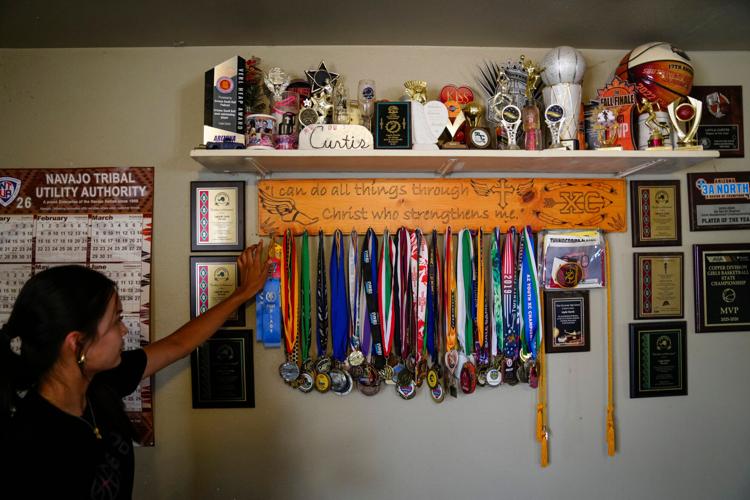
On the wall in their home's front room are Layla's awards, from cross-country running medals to the Most Valuable Player plaque the AIA gave her for her efforts in the Copper State basketball championship game. Her favorite Bible verse is also there: "I can do all things through Christ who strengthens me."
She will pray with her grandmother.
It's days like this, a cool August day for this time of year, when she's alone on her court with only the sounds of Melo's barking that she can quiet the noise that follows her.

Layla Curtis shows off her medals inside her home on The Gap on the Navajo reservation near Tuba City on Aug. 12, 2026.
"It's like a getaway from everything," Layla said. "When you're in the gym, on the court, with everyone watching you, it's pressure. But here, you have a break from everything.
"I would choose this over the city. If you're somewhere else, at a park, you'll hear cars drive by. But here you hear nothing but the ball bouncing and Melo barking."
Tuba City championship raises expectations
Curtis and her 21 points per game return for this school year with junior-to-be Nakota Tallman, who will play a bigger role after averaging nine points last season.
"We're talking back-to-back," Butler said. "We do have players who can do it. I'm expecting a lot out of (Tallman). She'll be a key factor of this next team, along with Layla and seniors-to-be. There's going to be enough left over for another two years."
The effort to repeat begins with the Warriors' season opener, Nov. 20 at 7 p.m. in Flagstaff.
Right now, Layla is in the midst of volleyball tryouts. She missed part of her freshman volleyball season due to a shoulder injury but returned in time for state.
She'll transition easily to basketball because her basketball is always there back in Gap, waiting for her.
The girls dream of playing basketball beyond high school, whether it's junior college, NAIA, anywhere. But it doesn't work out that way for everyone. One of the girls is preparing for a life as a welder.
They play in college-sized arenas, one Navajo school trying to outdo the next.
It started in the 1990s with Monument Valley and its 4,500-seat arena. Tuba City's massive pavilion was next, then Ganado's 5,500-capacity home. That led to Chinle's Wildcat Den, which can attract 7,500 people. And it grew bigger at Window Rock, Chinle's biggest rival.
On any given game night, the girls sell out as much as the boys games.
That's why people from the Navajo Nation camp out and get to the Coliseum six hours before tip-off to start a line to make sure they get prime seats for semifinals and championships. It's why the AIA rolls out the red carpet and gives them the prime-time slots to play.
It wasn't until 2000 that the Tuba City boys won their first state championship — the first of back-to-back titles — under Charles Gover. Yes, the parades awaited them back home. But no school that sits on the reservation has won a state boys basketball title since. The expansion of club basketball and Valley private schools and charters has made it harder to break through on top.
Holbrook won the 3A boys title in 2011, Winslow in 2018 and Page in 2021. But those are border towns not located directly on the Navajo reservation. Page is on the western fringe of the Navajo Reservation.
Cross-country has always been a dominant sport on the reservation, where kids would get their work in running hills and up canyons, guiding the sheep back to their homes.
"Back in the '70s and '80s, Tuba City's boys cross-country teams held the consecutive titles (10) national record," Gover said. "The feeling was, 'We can win, we can win, we can win.'
"There was always some backing in basketball at the community center. If you were winning, they packed the house. If you weren't winning, there was nobody there."
There hasn't been any huge gap for reservation girls teams to win state basketball titles. Whiteriver Alchesay, part of the White Mountain Apache tribe, won back-to-back 3A titles in 2022 and '23. Window Rock won five girls state titles in a row from 1992-96.
Taylor Riese, who has been a teacher and a basketball coach at Tuba City's boarding school for 11 years, comes from Wisconsin — a major departure from the reservation.
He is still in awe of this hoops phenomenon that arrives every February.
"On the reservation, it can be tough," Riese said. "There are some barriers for kids. But what's undeniable is how much they love basketball.
"Basketball is that tremendous outlet. You know how powerful basketball is here. They use the term 'Rez Ball.' That's looked at as a style of play. But for me, an outsider, it's like an overall philosophy. Like passion, competitive ferocity. These kids, they play so hard. For me, coming from the Midwest, I grew up in a basketball community back in Wisconsin. But it's nothing like here. In the Midwest, we packed gyms. Here, they pack pavilions. It's real cool."